Most Popular Floral Fragrances in India : A Real Buyer’s Guide
Spend enough time around fragrance buyers and you notice something. Almost everyone says they want “something floral.” Almost no one can…
Most Popular Floral Fragrances in India : A Real Buyer’s Guide
Spend enough time around fragrance buyers and you notice something. Almost everyone says they want “something floral.” Almost no one can explain what that actually means to them until you start asking the wrong questions and they correct you. Jasmine and mogra? Both jasmines, botanically. They smell almost nothing alike. A rose oil that’s lovely cold can go completely flat in a soy wax candle. Tuberose — the name sounds delicate — is one of the most overpowering scents I’ve personally worked with, and I’ve watched it ruin more first blends than any other floral. I’ve been using these fragrance oils in candle batches, CP soap, and perfume compositions for years now. What’s in this guide isn’t scraped from other articles — it’s what I actually know about how these fragrances behave, which applications they’re suited for, and what trips people up.
“Floral fragrance oils ko detail mein samajhne ke liye — humara complete guide padho.”
The Essential Oil Thing -Let’s Clear It Up First
Every few weeks someone messages asking whether a mogra or tuberose fragrance oil is “the real thing” or just synthetic. It’s a fair question and the answer is a bit more complicated than yes or no.
Most flowers physically cannot be steam distilled at any commercial scale worth talking about. Rose is the one real exception — and even then, you need somewhere between 3 and 4 tonnes of petals to get a single kilogram of extract. That’s why genuine rose absolute is priced the way it is.
Tuberose, mogra, lily of the valley, gardenia — none of them yield essential oil in practical quantities. Full stop. So when you see these sold as fragrance oils at ₹400–₹900, what you’re buying is a composed blend: synthetic aroma chemicals, natural isolates, or usually both. That’s not a problem. Fragrance oils are more batch-stable than botanical extracts and often smell closer to the actual flower because they’re built to smell that way, not extracted from whatever that season’s harvest produced.
The only thing I’d say: if a listing somewhere claims “100% pure tuberose essential oil” at ₹500, it’s just not true. Ask them for the COA.
The Most Popular Floral Fragrances -What I Actually Think About Each
1. Rose -Overused as a Category Name, Genuinely Useful as a Fragrance
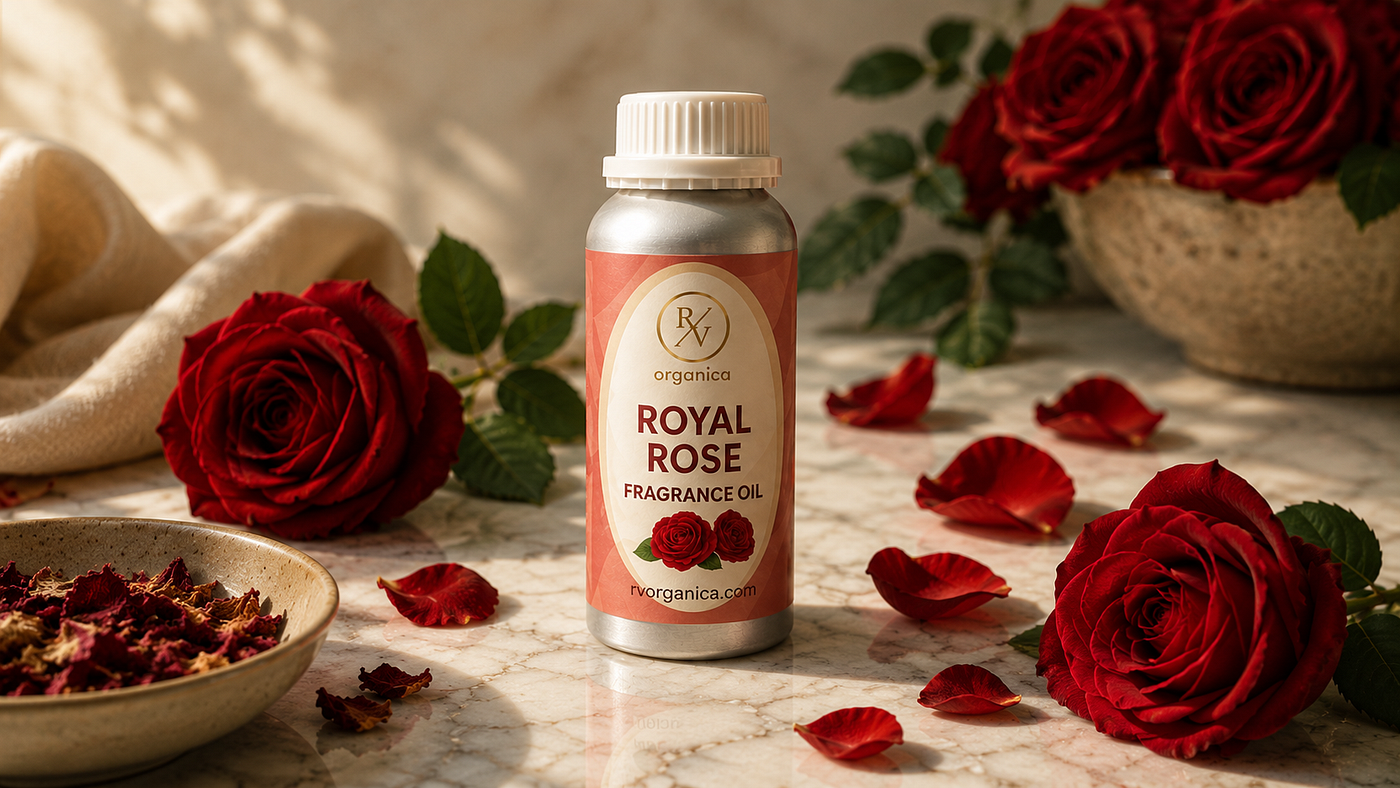
Rose gets recommended for everything, and most of the time that recommendation is actually correct. It’s one of the few florals that performs without too much fuss across perfume, candles, soap, and personal care. So the reputation is deserved — but the category label hides a lot of variation underneath it. At RV Organica, two rose options exist and they really do smell different from each other. Not subtly different. Different. Royal Rose has weight. It’s warm, full, a bit rich — the kind of rose profile that anchors a perfume rather than just decorating it. In candles it holds up at 8–10% in soy without needing a long cure. If the product needs to smell unmistakably like a rose, this one does it. British Tea Rose is a different story. Powdery, quieter, more English countryside than gulab garland. The reason I’d reach for this one over Royal Rose is soap: it behaves in cold process where a lot of rose variants don’t. Good call for body mists too, or anything where you want rose in the background rather than the foreground. One thing that’s caught me out a few times with rose in perfumery — don’t test the blend at day two and draw conclusions. A rose composition that smells stiff or chemical on day three can completely transform by week three. Let it mature before you decide it needs fixing.
**Rose Fragrance Oil — from ₹449 (35% off) | 4.6/5 stars [Royal Rose Fragrance Oil — from ₹399 (50% off)](https://rvorganica.com/products/royal-rose-fragrance-oil-1)**
2. Jasmine — More Complicated Than It Looks
Jasmine is probably the single most searched floral in India. It’s also the one I get the most questions about after something’s gone wrong.
The confusion usually comes from expectations. People smell jasmine in a budget body wash and assume all jasmine smells like that — light, clean, faintly sweet, a bit synthetic. A proper jasmine fragrance oil is nothing like that. It’s deep, a bit indolic, and it smells like jasmine grandiflorum rather than a lab recreation of one. People who’ve given up on jasmine because previous versions felt flat often react completely differently to a well-composed one. Now, the cold process soap situation. Jasmine is one of the more troublesome florals to work with in CP. Trace can accelerate fast. In high-oleic bases, ricing isn’t uncommon. Some batches are fine. Some aren’t. There’s no way to predict it for your specific recipe without testing, so run 100g first, add at light trace, keep your percentage at 4–6% of oil weight, and don’t assume a fragrance’s good reputation in candles means anything for soap. In perfume and roll-ons though? No issues. Projection is strong, the profile holds, and it doesn’t demand the kind of babysitting soap does.
3. Mogra -You Either Already Know This Scent or You Don’t Need Me to Describe It
Growing up in India, mogra is just part of the environment. Temple steps, wedding garlands, gajra in hair, mogra strings piled outside a mandir on a busy weekend morning. It’s not a fragrance you discover — it’s one you recognise. Botanically it’s Jasminum sambac, same genus as jasmine, completely different personality. Heavier, more ceremonial, more narcotic in the way certain flowers get when they’re at peak bloom. Where jasmine can play fresh and modern, mogra doesn’t try. It’s specific and it’s Indian and there’s no Western equivalent to it. That specificity is the whole point -and also the limit of where it works. Pooja décor, festive gifting, agarbatti, room diffusers targeting traditionally Indian audiences: mogra is the correct choice and nothing else replaces it. A “fresh clean floral” soy candle for a contemporary wellness brand? Wrong fragrance entirely. One thing for candle makers: mogra’s hot throw at 24 hours is often underwhelming. By day five or six it settles. I’ve seen batches that smelled barely there at the first test burn develop into very good candles by the end of the week. Resist adjusting your load before you’ve given it proper time.
**Mogra Fragrance Oil — from ₹399 (50% off)**
4. Lavender — Technically Herbal, But This Is Where Floral Beginners Should Actually Start
I know lavender is herbal-floral rather than purely floral. I’m including it here because it outsells most of the pure florals and for good practical reasons. It’s the most stable fragrance oil in this category, by a significant margin. CP soap -cooperates. Soy candles -consistent throw at 6–10%, doesn’t need much fuss. Melt and pour -fine. Saponification doesn’t turn it sour. Trace doesn’t accelerate on you. I’ve used lavender in soap recipes where I was out of testing time, which is something I’d never do with jasmine. If someone has had a run of jasmine disasters in soap and asks what to try instead, lavender is what I tell them. Not because it’s boring -the herbal quality reads well in finished products -but because it actually cooperates with a wide range of base formulas. It also crosses into unisex territory more naturally than most florals. Rose reads feminine to most people. Lavender doesn’t force that, which matters if you’re building a wellness range that doesn’t want to segment. What lavender can’t do: feel culturally rooted in an Indian context the way mogra or rose does. For that specific brief, it’s wrong. For most other things, it’s the most reliable option in the collection.
5. Tuberose — Start at Half the Amount You Think You Need
My standing advice for anyone working with tuberose for the first time: start at half the amount you think you need. The scent is rich, waxy, intensely white-floral -and it projects significantly harder than its concentration suggests. A blend that smells balanced at 5% can become genuinely difficult to be around at 10%. That’s not a flaw in the fragrance oil, it’s just tuberose. It has contradictions built into it: creamy and sharp at the same time, floral but with something almost rubbery at the edge, beautiful when it’s right and too much when it’s slightly off.
People who love tuberose tend to love it specifically. People who hate it usually smelled it in a product where someone hadn’t tested load rates carefully -or assumed it would behave like rose. It earns its place in premium wax melts, high-concentration perfume compositions, luxury soap where a dramatic brief makes sense. Not an everyday floral. But when a product genuinely needs it, there’s no close substitute.
6. Cherry Blossom -No Cultural Baggage, That’s the Point
Cherry blossom isn’t trying to be rose or mogra. It has no deep cultural roots in Indian context, no ceremonial associations, nothing that limits where it can go. That’s actually useful. The profile -soft, lightly fruity, fresh but floral -reads as modern without being cold. Body mist buyers like it. Shower gel formulators use it a lot. In lighter soy candle collections, it works without demanding much from the formulator or the customer. Over the past couple of years it’s become one of the most consistently requested profiles from buyers building ranges for younger demographics or product lines that want a contemporary floral without the weight of rose or the specificity of mogra. It’s not complex. It doesn’t need to be.
**Cherry Blossom Fragrance Oil — from ₹449 (50% off)** | 4.78/5 stars, 9 reviews
7. Ylang Ylang — Blend It In, Don’t Lead With It
Ylang ylang is rarely the right choice as a solo fragrance. It’s lush and tropical-floral at moderate concentrations, genuinely beautiful in a blend — and then at higher loads on its own it tips into medicinal in a way most people find unpleasant. Where it belongs: as a modifier. In a floral-oriental composition it adds depth. In a floral-woody blend it softens edges. In hair care and shampoo formulations, there’s historical precedent for it across dozens of professional lines. It has its place — just not usually as the headline note.
The Rest of the Collection
Dark Rose Labdanum — Rose base with labdanum underneath it — resinous, a bit smoky, heavier than either standard rose option. Winter candle collections, darker oriental perfume compositions. Not a daytime rose.
Lily of the Valley — Green and spring-floral, gentle without being weak. Better in body mists and airy candle collections than anything that needs real projection.
Orchid Flower — Powdery, soft, feminine. 4.8/5 rating — consistently one of the higher-reviewed options in the whole collection.
Frangipani — Tropical-floral, warm, sweet. Diffusers love it. Suits spa product lines that want something exotic but not heavy.
Japanese Cherry — Similar orbit to cherry blossom but slightly more structured. 4.5/5, 8 reviews.
Divine Lotus — Aquatic-floral, quiet, clean. Good diffuser fragrance. 4.83/5.
Raspberry & Sweet Pea — Fruity-floral rather than pure floral. Highest-rated product in the collection at 4.83/5. Light and cheerful — moves well in gifting ranges.
Phulwari and Baby Breath — Both are multi-floral blends with an Indian bouquet character. Phulwari especially suits festive ranges where a single-flower note would feel too simple.
By Application — The Short Version
Candles
Biggest mistake: burning a test candle at 12–24 hours and deciding the throw is weak. Most florals need 48–72 hours cure time before throw stabilises. Mogra and tuberose need closer to five to seven days. I’ve nearly reformulated batches that just needed more time. Flash point matters too. Floral oils typically sit between 65–90°C. Add fragrance at least 10°C below that number, not at it. The MSDS tells you the actual figure -check it before the first pour. Most consistent in soy at 6–10%: Lavender, Royal Rose, British Tea Rose, Cherry Blossom.
Cold Process Soap
More fragrance oils fail in CP soap than any other application. Most of those failures were avoidable. Run a 100g test before you scale anything up. Add fragrance at light trace. Keep it at 4–6% of oil weight. If trace accelerates anyway — and with jasmine it sometimes will -stop trying to fix it by mixing more and just get the batter into the mould. Lavender: most stable. British Tea Rose and Lily of the Valley: reliable. Mogra: moderate. Jasmine: test first, every time, in your specific recipe.
Perfume and Roll-ons
Work at 15–25% depending on target concentration. Let the blend sit for at least two weeks before you evaluate it. Blends that smell sharp or unintegrated at day three often round out considerably by day twenty-one. The urge to tweak early is usually wrong. One thing worth knowing: certain jasmine-family aroma chemicals can cause sensitisation at consistently high concentrations over time. Stay within standard usage rates -it’s not overcaution, it’s just how professional formulators work.
Body Mists and Personal Care
Leave-on formats: 2–5% in carrier. Rinse-off products like body wash: 0.5–2%. Water-based body mist with fragrance oil but no solubiliser will separate. The oil floats, the product looks wrong, customers think it’s spoiled. The fragrance isn’t the problem — the base formulation is missing something.
Buying Without Getting It Wrong
The number one mistake I see: someone smells a fragrance in the bottle, loves it, buys a litre, and discovers it does something completely different in their actual application. Cold scent and in-use performance are two separate things. A fragrance gorgeous cold can morph in hot wax. Seize in soap. Lose its top notes inside two weeks in a perfume blend. The only real answer is to test in your actual process before committing volume. Good supplier tells: they know the flash point off the top. They quote usage rates for specific applications, not “add as much as you like.” They hand over a COA and MSDS without making it feel like you’ve asked for something unreasonable. Suppliers who hedge or give generic answers like “safe for all uses” -that’s telling you something about their QC.
Storage Across Indian Summers
Fragrance oils degrade above 30°C. Most of India is well above 30°C for roughly six or seven months of the year. Oxidation changes the scent — sometimes slightly, sometimes enough that a fragrance you bought in January smells noticeably different by May. Cool dark cupboard, ideally air-conditioned: fine. Car, window-facing shelf, unventilated storeroom: not fine. Buying three to four months of stock at a time is usually more practical than stocking up when the bulk deal looks good in March.
FAQ
What are the most popular floral fragrances in India?
Rose and jasmine lead consistently across fragrance oils, personal care, and perfumery. Mogra is probably third, particularly for anything with a traditionally Indian brief: pooja products, festive ranges, agarbatti. Lavender and cherry blossom have been growing steadily in candle and contemporary personal care categories. Sweet floral perfumes combining rose and jasmine notes are also among the top performers right now.
Fragrance oil vs. essential oil what’s actually different?
Essential oil comes from plant material. Fragrance oil is a formulated blend -synthetics, natural isolates, or a mix. The key point is that most flowers don’t yield extractable essential oil in any commercially viable quantity. Rose does. Mogra, tuberose, gardenia, lily of the valley don’t. So anything sold under those names cheaply is a fragrance composition. Nothing wrong with that -but know what you’re buying. The COA is the document that tells you what’s actually in the bottle.
Which floral fragrance oils are safe to use in cold process soap?
Lavender is the most reliable. British Tea Rose and Lily of the Valley are solid. Mogra needs testing. Jasmine is the one I’d never use in production without running a small test batch first -accelerated trace and ricing are real risks, and they don’t always show up the same way twice. The base recipe you’re using matters as much as the fragrance, so “this fragrance is fine in soap” from a supplier means less than running it in your actual formula.
Why does my floral candle smell weak on the first burn?
Cure time -almost always. Most florals need 48 hours minimum before hot throw is worth evaluating. Mogra and tuberose can need five to seven days. The candle you burn at 12 hours and the one you burn at day six are often completely different products. Evaluate after a full cure. Adjust fragrance load only after that.
Can floral fragrance oils go into perfume?
Yes, and many of the best-known Indian and international perfumes are built on floral bases -rose, jasmine, tuberose, mogra, ylang ylang as heart notes. Work at 15–25% in alcohol or carrier. Then wait. Two to four weeks of maturation changes a blend considerably. What smells unbalanced on day one is often exactly right by week three.
Where to Find These
RV Organica’s floral collection covers 36 products — rose, jasmine, mogra, tuberose, lavender, cherry blossom, ylang ylang, orchid, frangipani, and more. Pack sizes from 100g to 25kg, bulk available on request. Every batch ships with a COA and MSDS. Orders are dispatched from Panipat, Haryana, with delivery across India.
Full collection: **rvorganica.com/collections/floral-fragrances**
First order above ₹1,499 — use FIRSTORDER for 10% off. Free shipping over ₹999.
메타데이터
- post_id
- 5632c7e67cf7
- slug
- most-popular-floral-fragrances-in-india-a-real-buyers-guide-5632c7e67cf7
- url
- https://medium.com/@vinay_48861/most-popular-floral-fragrances-in-india-a-real-buyers-guide-5632c7e67cf7
- canonical_url
- https://medium.com/@vinay_48861/most-popular-floral-fragrances-in-india-a-real-buyers-guide-5632c7e67cf7
- author_url
- https://medium.com/@vinay_48861
- status
- ok
- fetched_at
- 2026-06-27 07:40:21