Retinol Strength vs Frequency: What Matters More in Real Life
Most skin does not need “more strength” first. It needs a routine it can actually tolerate and maintain.
Retinol Strength vs Frequency: What Matters More in Real Life
Most skin does not need “more strength” first. It needs a routine it can actually tolerate and maintain.
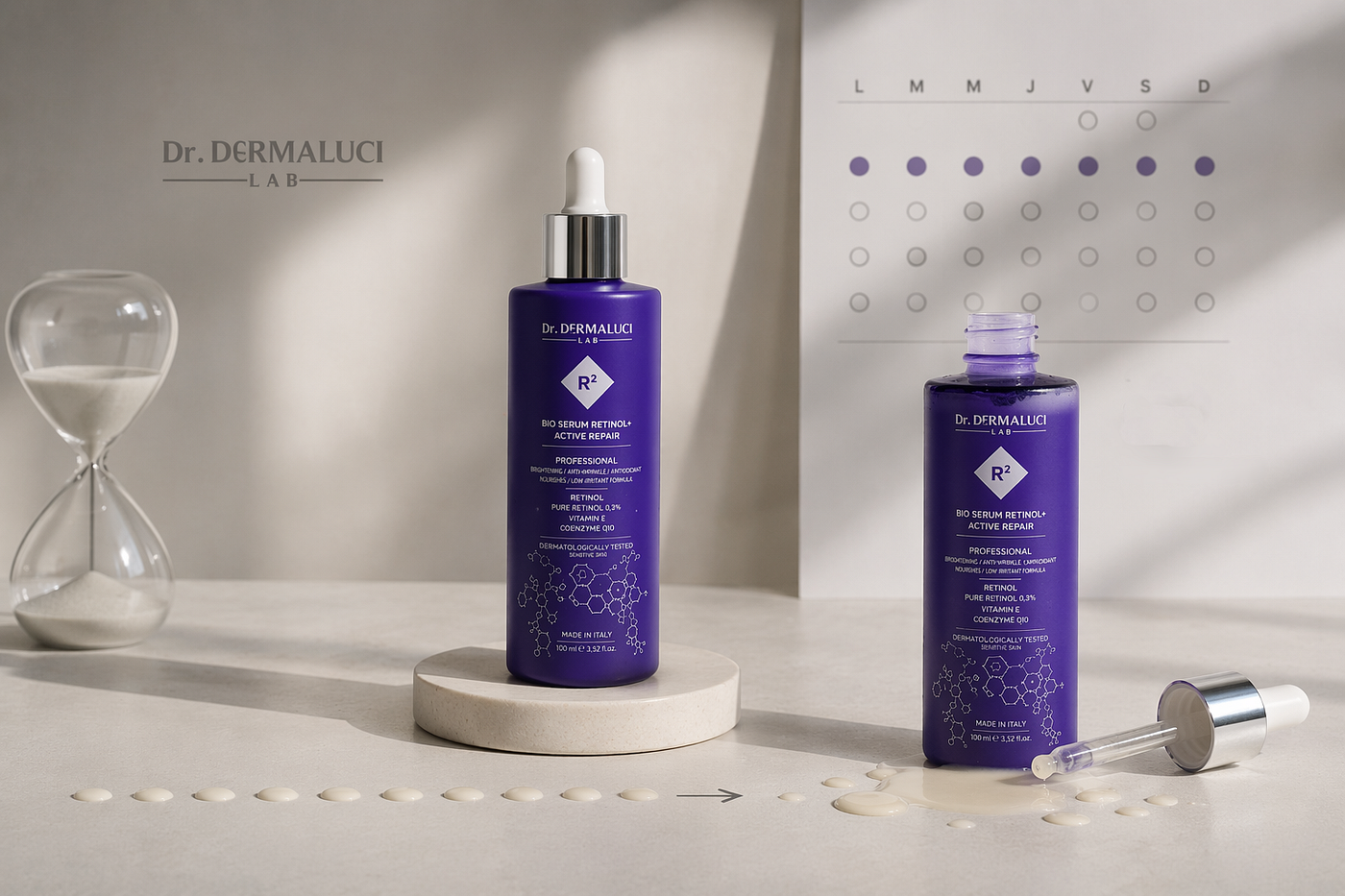
Most skin types don’t need to start with a higher concentration. You need a routine that you can tolerate, stick to, and maintain over time.
When it comes to retinol, the better question is usually not “Which percentage is best?” but “Which retinol can I use consistently without damaging my skin barrier?” Practical dermatology tends to lean that way: start with the least irritating option, use it every other night or less at first, and build slowly. Comparative studies support that thinking: when strength increases, irritation often increases too, while results do not always improve in the same proportion.
There is something very human about this mistake. We tend to assume stronger automatically means better. In skincare, that is not always true. Sometimes skin responds far better to a “less impressive” formula that it can actually tolerate for months. And from Dermalucilab’s perspective, that is the difference between an ambitious routine and an intelligent one.
What is really at stake
Retinol is not only about wrinkles. It can also help with texture, dullness, uneven tone, and early signs of photoaging.
But the difference between “owning a retinol” and “getting results from retinol” often comes down to tolerance.
If your product irritates your skin so much that you stop using it, the problem is not necessarily that you needed more strength. Most likely, you needed a more sustainable strategy.
What the data shows
One trial comparing 0.3% vs 0.5% over 12 weeks found improvements with both, but the 0.5% side showed more frequent and more intense irritation.
Another study evaluating 0.1%, 0.3%, and 1% found that 0.3% and 1% were comparable in several skin remodeling markers, while 0.3% was better tolerated than 1%.
And to challenge the obsession with “moving up,” an integrated clinical analysis with 0.1% stabilized retinol still found measurable photoaging improvement with good overall tolerance.
The practical interpretation is not that strength does not matter. It does. But only after frequency and tolerance are already in place.
The question that changes the routine
Instead of asking, “Should I move up to 0.5%?” it is often better to ask:
Am I using my retinol regularly enough to give it a real chance?
If the answer is no, increasing the percentage probably will not solve the problem. It is more likely to make adherence harder.
When frequency matters more
Frequency tends to matter most when you have sensitive skin, reactive skin, or you are a beginner. It also matters when your barrier is already stressed by weather, exfoliation, over-cleansing, or multiple active ingredients.
Dermalucilab, for example, recommends introducing retinol slowly, supporting the barrier, and avoiding strong exfoliating acids in the same evening routine at the beginning. That approach reduces irritation, but just as importantly, it increases the chance that someone will stay consistent long enough to see results.
And when strength matters more
Strength becomes more relevant when you have already achieved consistency. When you have been using your current retinol for weeks without redness, stinging, or disruptive peeling, and your skin still needs more help for tone, texture, or lines, then increasing strength may make sense.
But it is rarely the first move. It is usually the second or third.
The trap of “my skin got used to it”
A common belief is that if you no longer feel tingling or dryness, the product stopped working. That is not a reliable idea. Irritation is not proof of effectiveness. In fact, good dermatology aims for the opposite: effectiveness with tolerance.
What almost nobody looks at
The full formula. A percentage alone does not tell the whole story. Stability, delivery system, and supporting ingredients all shape the user experience. That is why a well-formulated 0.1% retinol can feel more effective in real life than a harsher, higher-strength product.
A simple rule for readers
If you still cannot use your retinol consistently, do not increase the strength. If you already use it regularly without irritation, then it may make sense to consider whether you need a stronger formula.
Topics that may interest you
The best related Dermalucilab article to connect here is: Gentle Retinol Routine for Sensitive Skin — Dermatologist Advice
Natural product link
A logical internal product link in this article would be: Pure Retinol Serum 0.10%
Finally
If you want the most honest answer, here it is: for most skin, frequency you can maintain matters more than buying the highest retinol strength available. Strength becomes more important once consistency is already solved. Before that, the smarter focus is usually tolerance, barrier support, and routine stability.
FAQs
Should I increase frequency or strength first?
Usually frequency.
Does more strength mean better results?
Not automatically. Higher concentrations can increase irritation without delivering proportionally better outcomes for everyone.
How long does retinol take to show results?
Visible changes usually take weeks, not days.
Do I need sunscreen with retinol?
Yes. Daily SPF is an essential part of responsible retinol use.
Can I use retinol during pregnancy?
Retinoids are generally not recommended during pregnancy.
Checklist
✔ Think about adherence before potency ✔ Assess irritation before raising the percentage ✔ Build frequency gradually ✔ Support the skin barrier ✔ Use SPF every morning ✔ Increase strength only after stable tolerance
Author bio
Valeria — Founder, Dr. Dermaluci Lab Founder of Dr. Dermaluci Lab. The brand positions itself around science-backed skincare for sensitive and reactive skin, combining formulation expertise with active botanical ingredients.
메타데이터
- post_id
- 5634365933f0
- slug
- retinol-strength-vs-frequency-what-matters-more-in-real-life-5634365933f0
- url
- https://medium.com/@contact_48155/retinol-strength-vs-frequency-what-matters-more-in-real-life-5634365933f0
- canonical_url
- https://medium.com/@contact_48155/retinol-strength-vs-frequency-what-matters-more-in-real-life-5634365933f0
- author_url
- https://medium.com/@contact_48155
- status
- ok
- fetched_at
- 2026-06-27 18:20:27