What Is a Schema Diagram? A Guide with 4 Examples
A comprehensive guide to database schema diagrams, with 4 illuminating examples.
What Is a Schema Diagram? A Guide with 4 Examples
A comprehensive guide to database schema diagrams, with 4 illuminating examples.
A schema diagram is a compelling visual representation of a database system’s structure and organization. It functions as a blueprint for how entities, attributes, and relationships within a database are interconnected. This article is intended to demystify schema diagrams and provide you with a comprehensive understanding of their purpose and utility. Whether you are a database administrator, a software developer, or simply inquisitive about the inner workings of databases, this guide is for you. It defines database tables, columns, and their relationships.
Example 1: Online Shopping System
Let’s take a look at how an online shopping system works behind the scenes. Online shopping has changed the way we shop, making it easier for people around the world to buy what they need. But have you ever wondered what happens after you click “purchase”? Behind every smooth transaction, there’s a complex system of databases, servers, and applications working together. A schema diagram gives us a clear picture of how these parts fit together, helping us understand how online shopping platforms actually work.
Entities:
Customer: Represents the customers who place orders.
Order: Represents the orders placed by customers.
Product: Represents the products that can be ordered.
Category: Represents the categories to which products belong.
OrderDetail: Represents the connection between orders and products.
Relationships:
Customer ‘places’ Order: Each order is placed by a customer. Order ‘contains’ Product: Each order can contain one or more products. Product ‘belongs to’ Category: Products are categorized into different categories. Order Detail ‘connects’ Order and Product: Represents the many-to-many relationship between orders and products.
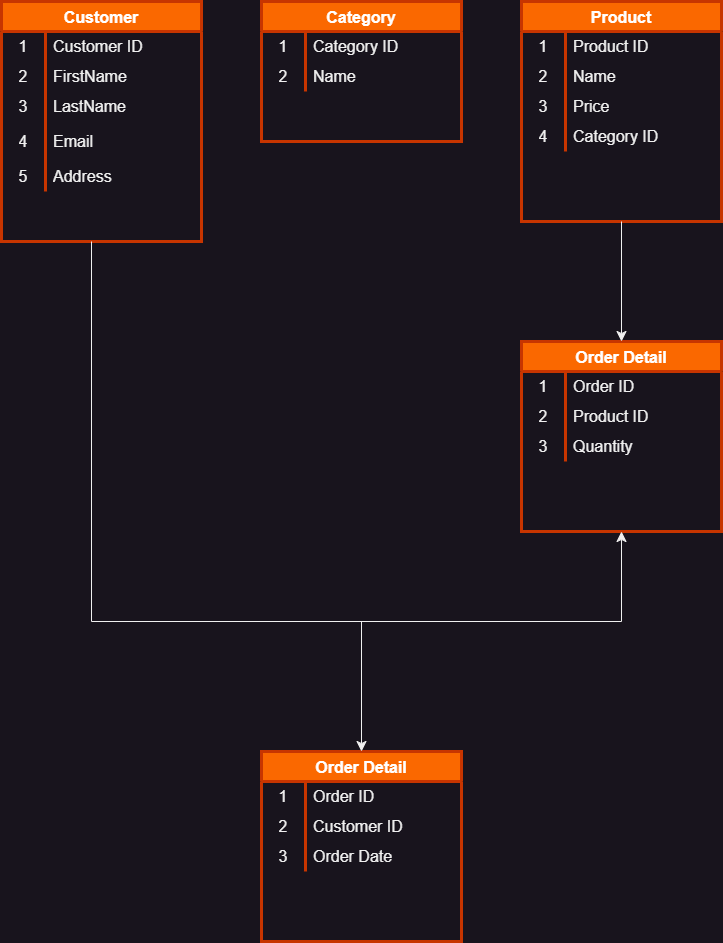
Online Shopping System Diagram
This schema models an online shopping system where customers place orders. Each order can contain one or more products. Products belong to categories for easy classification and search. The Customer table represents the customers who place orders. The Category table represents the categories to which products belong. The Product table represents the products that can be ordered. Each product belongs to a category, represented by the foreign key Category ID. The Order table represents the orders placed by customers. Each order is placed by a customer, who is represented by the foreign key Customer ID. The Order Detail table represents the many-to-many relationship between orders and products. Each row in this table represents a product contained in an order and the quantity of that product in the order.
Example 2: University Database
Now, let’s delve into another example by exploring the schema diagram of a university database. Universities are complex ecosystems with students enrolling in courses, professors teaching those courses, and departments overseeing academic activities. Understanding how these pieces fit together can provide valuable insights into the inner workings of educational institutions. So, let’s take a closer look at the structure of a university database and how it manages student enrollment, courses, professors, and departments.
Entities:
Student: Represents the individuals enrolled in courses at the university.
Course: Represents the academic courses offered by the university.
Professor: Represents the faculty members who teach courses.
Department: Represents the different academic departments within the university.
Enrollment: Represents the enrollment of students in courses.
Relationships:
Student ‘enrolls in’ Course: Students enroll in courses offered by the university. Professor ‘teaches’ Course: Professors teach courses offered by the university. Course ‘belongs to’ Department: Each course is associated with a specific department. Enrollment ‘connects’ Student and Course: Represents the enrollment of students in specific courses.

University DataBase Diagram
This schema models a university database where students enroll in courses taught by professors. Each course belongs to a department, and students are enrolled in specific courses. The Student table represents the individuals enrolled in courses at the university. The Course table represents the academic courses offered by the university. The Professor table represents the faculty members who teach courses. The Department table represents the different academic departments within the university. The Enrollment table represents the enrollment of students in courses.
Example 3: Library Management System
Our this example takes us into the realm of libraries with a focus on the schema diagram of a Library Management System (LMS). Libraries play a crucial role in providing access to knowledge and resources, and behind their operations lies a system that efficiently manages books, patrons, and transactions. By examining the schema diagram of an LMS, we gain insight into how libraries organize their collections, track borrowing activities, and facilitate user interactions. Let’s dive deeper into the entities, relationships, and workings of a Library Management System.
Entities:
Book: Represents the individual books available in the library.
Patron: Represents the library users who borrow books.
Transaction: Represents the borrowing transactions made by patrons.
Author: Represents the authors of the books in the library.
Genre: Represents the genres or categories to which books belong.
Relationships:
Patron ‘borrows’ Book: Patrons borrow books from the library. Book ‘authored by’ Author: Each book is authored by one or more authors. Book ‘belongs to’ Genre: Books belong to specific genres or categories. Transaction ‘records’ Book and Patron: Transactions record the borrowing activities of patrons for specific books.

Library Management System Diagram
In this schema, the Library Management System tracks the interactions between patrons, books, authors, genres, and borrowing transactions. The Book entity represents individual books available in the library, while the Patron entity represents the users who borrow these books. Each borrowing activity is recorded as a Transaction, connecting the Patron and Book entities. Additionally, books are categorized into different Genres, and each book is authored by one or more Authors. This schema enables efficient management of library resources, facilitating book borrowing and organization.
Example 4: Hospital Management System
Our exploration continues with the schema diagram of a Hospital Management System (HMS). Hospitals are intricate systems where patient care, medical records, and administrative tasks intersect. Understanding the schema diagram of an HMS unveils the structure that supports these vital functions, shedding light on how hospitals manage patient information, medical staff, and facilities. Let’s delve into the entities, relationships, and inner workings of a Hospital Management System.
Entities:
Patient: Represents individuals receiving medical care at the hospital.
Doctor: Represents the medical professionals providing treatment to patients.
Appointment: Represents scheduled appointments between patients and doctors.
Medical Record: Represents the health records of patients, documenting their medical history and treatments.
Relationships:
Patient ‘has’ Medical Record: Each patient has a medical record documenting their health history and treatments. Doctor ‘conducts’ Appointment: Doctors conduct appointments with patients for medical consultations and treatments. Patient ‘appoints’ Doctor: Patients schedule appointments with doctors for medical care. Doctor ‘belongs to’ Department: Doctors are associated with specific medical departments within the hospital.

Hospital Management System Diagram
In this schema, the Hospital Management System orchestrates the interactions between patients, doctors, appointments, medical records, and departments. Patients are linked to their medical records, ensuring comprehensive documentation of their health journey. Doctors conduct appointments with patients, providing medical care within specific departments of the hospital. Appointments serve as scheduled interactions between patients and doctors, facilitating healthcare delivery. Additionally, the system organizes medical staff into departments, streamlining patient care and administrative processes. This schema diagram illuminates the framework supporting efficient hospital management and patient care delivery.
If you found helpful follow me for more web development tips and guides
메타데이터
- post_id
- 5645f4454fd4
- slug
- what-is-a-schema-diagram-a-guide-with-4-examples-5645f4454fd4
- url
- https://medium.com/@mudassirali_79816/what-is-a-schema-diagram-a-guide-with-4-examples-5645f4454fd4
- canonical_url
- https://medium.com/@mudassirali_79816/what-is-a-schema-diagram-a-guide-with-4-examples-5645f4454fd4
- author_url
- https://medium.com/@mudassirali_79816
- status
- ok
- fetched_at
- 2026-06-15 20:49:13