Financial Astrology Research Foundations: 20 Concepts From Planetary Cycles to Statistical Controls
Every article in this series stands on a small set of ideas from astronomy, wave mathematics, and statistics. None of them requires an…
Financial Astrology Research Foundations: 20 Concepts From Planetary Cycles to Statistical Controls
Every article in this series stands on a small set of ideas from astronomy, wave mathematics, and statistics. None of them requires an equation to understand. Read this page once and the whole series opens up; keep it bookmarked and every article’s footer will bring you back here.
I. The sky: astronomical primitives
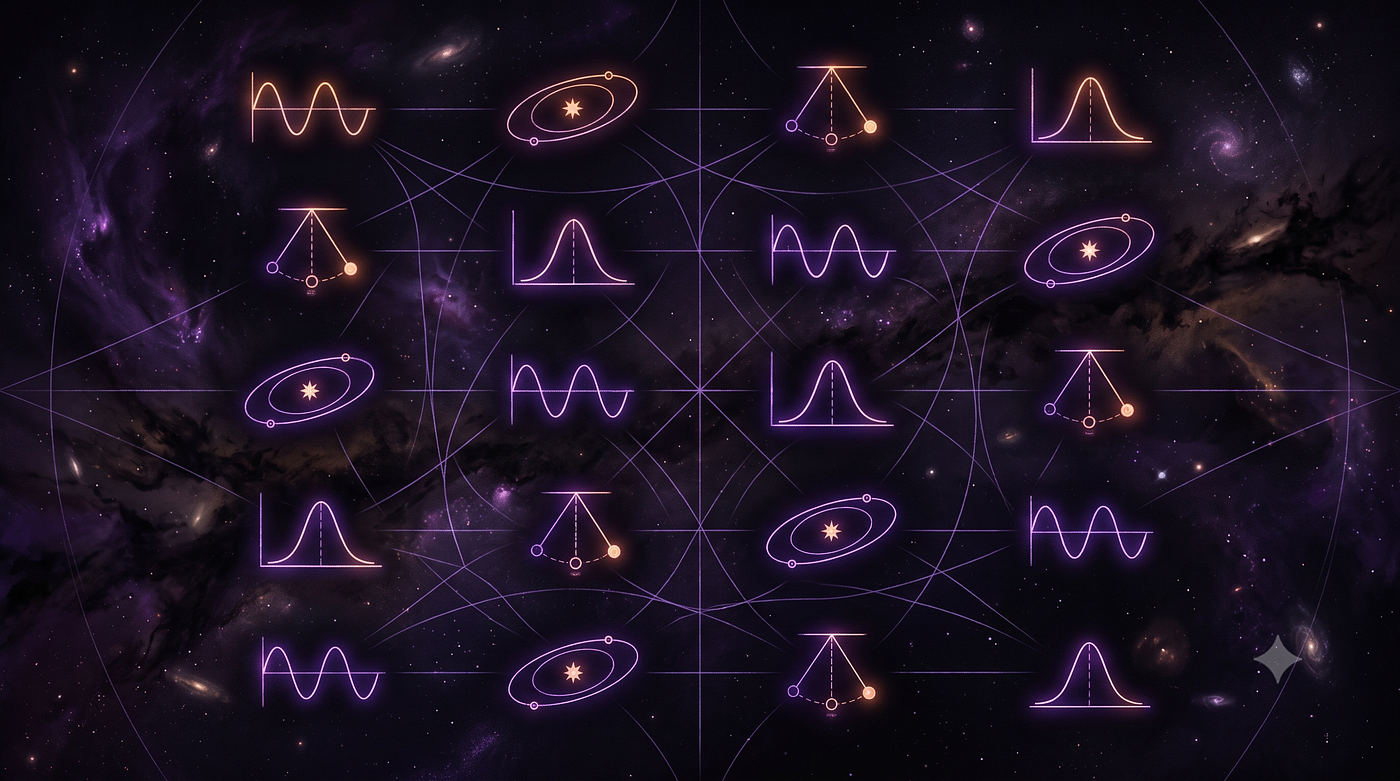
1. Planets as oscillators. A planet on its orbit is a clock: it returns to the same place at a fixed rhythm. Mercury does it every 88 days, Saturn every 29 years. Statisticians happily accept that markets have yearly, monthly, and weekly seasonality. Every one of those calendar units is itself an astronomical cycle. The founding question of this research is simply: do any of the other cycles carry a seasonal effect too?

Concept 1: cycle repetitions in a century of data. Slow cycles mostly ask for faith.
2. Two skies: heliocentric and geocentric. The same solar system looks different depending on where you stand. From the Sun (heliocentric), every planet moves smoothly forward. From Earth (geocentric), planets appear to slow, stop, and reverse. Neither view is wrong. They carry different information, and one of our experimental findings is that for the fast inner planets, the Earth-centered view is the one that matters. Markets, after all, are traded on Earth.

Concept 2: real Mars from two vantage points. Retrograde exists only in the view from Earth.
3. Angular separation and aspects. At any moment, two planets sit some angle apart on the sky’s circle: 0 degrees, 90, 137, anything. Traditional astrology names a handful of these angles “aspects”: conjunction (0 degrees), square (90), trine (120), opposition (180). Ptolemy defined them, eighteen centuries ago, as musical intervals; the opposition is the octave, the square the fourth. When we test aspects, we are testing whether these special angles deserve their special status.
4. Velocity, stations, and retrogrades. Kepler’s second law says a planet moves faster when closer to the Sun. Its speed “breathes” along the orbit. Seen from Earth, a planet’s apparent speed can even fall to zero (a station) before it appears to move backward (retrograde). Speed, not just position, is a signal channel. Kepler himself located the cosmic harmony in velocities after decades of failing to find it in distances.
5. Synodic cycles. Two planets have a joint rhythm: the time from one conjunction to the next, called their synodic period. Two slow planets create a much slower joint cycle. Jupiter and Saturn meet only every twenty years. Most of the structure we study lives in these pair rhythms, not in any single planet’s motion.
II. The language: waves and harmonics
6. Harmonics. Any position on a circle can be described by a family of waves: the fundamental (one cycle per revolution), the second harmonic (two), the third (three), and so on. This is Fourier’s mathematics, and it is the natural language for cycles. The astrologer John Addey spent a lifetime arguing that it is astrology’s natural language too. When we write “H7” we mean the seventh harmonic, a wave completing seven cycles per revolution.
7. Interference and beats. When two waves meet, they add. In phase, they reinforce (constructive interference); out of phase, they cancel (destructive). Two waves of nearly equal frequency produce a slow pulsation, a beat, at the difference of their frequencies, plus a fast component at the sum. This is the single most load-bearing idea in our work. Nearly every feature we test on planetary pairs is, mathematically, one of these interference terms. If you understand why two guitar strings slightly out of tune produce a slow throb, you understand our feature set.

Concept 7: a real beat (Mars H1 + Jupiter H5). At every envelope zero the pattern inverts.
8. Phase and phase-locking. Phase is where in its cycle a wave currently is. Two cycles are phase-locked when they hold a stable relationship over time, like dancers keeping step. We measure this with coherence statistics; a high value means the pair keeps time together for decades. Whether phase-locked pairs matter more to markets than drifting ones is an empirical question we tested.
9. Carriers and modulators. AM radio works by letting a slow signal shape the loudness of a fast one: the fast wave carries, the slow wave modulates. Much of our modeling uses this structure, a fast planetary harmonic gated by a slow one, and it is central to the strangest phenomenon in this research: models whose predictions invert sign for years at a time.
10. Octaves. Doubling a frequency gives the same note, higher. That is an octave. The idea generalizes: a fast planet’s cycle, halved enough times, lands in the same range as a slow planet’s, letting them be compared as members of one family. Whether markets respect this self-similarity is another claim we put to the test.
III. The system: what the experiments taught us
11. Signal lives in interactions. Tested one at a time, individual planetary features show little. Tested as pairs, more; as triplets, more still. In our dependence screens the share of significant results climbed from 65% to 85% to 96% up that ladder. A resonance system is like music: the information is between the notes. This is why single-factor studies of astrology keep finding nothing, and why we stopped running them.

Concept 11: dependence significance climbs as bodies interact.
12. Speed determines role. In our results, what a body does in the system tracks how fast it moves: slow outer planets set long structure, fast bodies express it, asteroids sit in between. And the Moon, astrology’s favorite, behaved in our tests not as a signal source but as a signal destroyer, washing out structure wherever it entered.
13. Discretization destroys. Converting continuous sky geometry into categories (signs, elements, aspect boundaries) consistently lost information in our tests, sometimes dramatically. The raw waves know everything the categories know, plus everything between the category walls. This finding puts us in genuine tension with tradition, and we do not soften it: the map of twelve boxes is coarser than the sky it describes.

Concept 13: five encodings of the same geometry. Boxes lose what waves keep.
14. Channel separation. Markets have several measurable properties: which way they move (direction), how violently (volatility), how persistently (trend regime). Our results repeatedly found planetary structure correlating with the how channels, volatility and regime, far more readily than the which way channel. Direction is the hardest question in this entire field, and most claims you will ever read quietly assume it is the easiest.
15. The distributed signal. Whatever survives our tests does not live in any single planetary voice. It lives spread across hundreds of tiny components, each individually indistinguishable from noise, occasionally aligning. That has a hard consequence: there is no magic aspect, no golden cycle, no one weird trick. Anyone selling you one has not done this work.
IV. The market: what we measure against
16. Markets ask different questions. “Will it go up?”, “will it get wild?”, “will the trend hold?”, “will assets move together or apart?” These are different questions with different degrees of difficulty, and a method can have real power on one and none on another. Much confusion in financial astrology comes from mixing them. We test each channel separately and say plainly which one a claim concerns.
V. The discipline: how not to fool yourself
17. In-sample versus out-of-sample. A model explaining the past proves almost nothing. With enough knobs you can fit anything that already happened. The only evidence that counts is performance on data the model never saw, tested in the order time actually flows (walk-forward). Several of our own most exciting results died on this rule, and those funerals are some of the best articles in this series.

Concept 17: a flexible model explains 200 days of pure randomness, then meets day 201.
18. Permutation tests and the multiple-comparisons trap. Test five hundred ideas at the usual significance level and chance alone hands you twenty-five “discoveries.” The cure is brutal arithmetic: shuffle the data thousands of times to learn what luck looks like, then demand results beat it even after correcting for every test you ran. Our permutation gate is the reason this research says “null” so often, and the reason its rare positives mean something.

Concept 18: 500 skill-less strategies. Chance alone anoints the amber ones.
19. The fair imposter. The deepest trick in our toolkit: a claim must beat not just randomness, but a convincing fake. That means data with the same smoothness, the same rhythms, the same statistical texture, only with the claimed cause removed. A time-shifted sky. A synthetic wave with a planet’s frequency but no planet. If your “planetary” result is matched by the fake, you have discovered mathematics, not astronomy. Our hardest verdicts, and the climax of this series, rest on exactly this test.
20. Leakage, selection, and Goodhart. The three classic ways researchers deceive themselves: letting information from the future contaminate the past (leakage); reporting the winners and forgetting the graveyard of losers (selection bias); and optimizing a proxy until it stops meaning anything (Goodhart’s law). We fell into each of these at least once across our 470 registered experiments. We caught ourselves, published the correction, and built a checklist so it stays caught. Those stories are told here in full, because in this field, the errors are as instructive as the findings.
These twenty ideas are the complete toolkit. No article in the series assumes anything more.
Financial Astrology Research Group — traders, coders, data scientists and astrologers investigating planetary cycles in markets since 2021. Join the conversation: t.me/financial_astrology_stats | Research disclosure
메타데이터
- post_id
- 564d9162ea3c
- slug
- financial-astrology-research-foundations-20-concepts-from-planetary-cycles-to-statistical-controls-564d9162ea3c
- url
- https://medium.com/@citlacom/financial-astrology-research-foundations-20-concepts-from-planetary-cycles-to-statistical-controls-564d9162ea3c
- canonical_url
- https://medium.com/@citlacom/financial-astrology-research-foundations-20-concepts-from-planetary-cycles-to-statistical-controls-564d9162ea3c
- author_url
- https://medium.com/@citlacom
- status
- ok
- fetched_at
- 2026-07-10 19:34:48