Grandma Cave’s Old Folks Home
What I learned about life and death in my grandmother’s house on Tyler Street
Grandma Cave’s Old Folks Home
What I learned about life and death in my grandmother’s house on Tyler Street
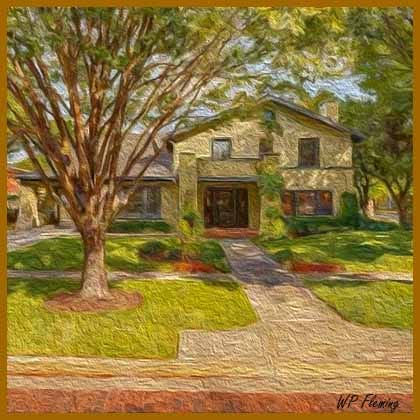
Grandpa and Grandma Cave’s home in Amarillo — painting by the author.
In 1887, when the Fort Worth and Denver City Railroad reached the Texas Panhandle, rancher Jim Berry laid out a small townsite near Amarillo Creek, a few miles west of what is now downtown. He called it Old Town — sometimes Oneida — but the post office soon adopted the name Amarillo, Spanish for “yellow,” after the color of the creek’s banks and wildflowers. Frequent flooding soon drove settlers to higher ground, and in 1888 railroad agent Henry B. Sanborn established a new site two miles east. Within a year nearly everyone had moved, and that “New Town” became the Amarillo that endured.
Just forty years later, in 1928, a fine house was erected along one of Amarillo’s elegantly bricked roads, Tyler Street. The young town still smelled of livestock and promise. Radios were beginning to hum in the evenings, and Amarillo even had its own voices on the air — WDAG and KGRS — sending weather reports, farm news, and a bit of that snazzy new jazz drifting across the flatlands of the Texas Panhandle. Whoever built the house must have been proud of their prosperity, for they installed one of the few home elevators in town — an iron-gated affair that opened right from the parlor and rose, with dignity, to an upstairs hallway.
I don’t know who those first owners were, or how many hands the place passed through before Grandpa bought it — sometime around 1960 — but I like to imagine them all showing off that elevator to guests, the gate clanking shut as the motor hummed: a small symbol of status in a cow town that had learned to swing. We children loved using it, though we were cautioned it was costly to operate — twenty-five cents’ worth of electricity for a single ride, they said — so we seldom hopped aboard. Still, that was the part we admired most about the place: a quiet reminder of an age when machinery inspired wonder more than routine.
In that big home, Grandma Cave took in elderly boarders — three or four at any given time. They were folks worn down by age or illness and too frail to live alone. She offered a kind of care that fell somewhere between home and nursing home — what folks back then often called “board and care.” Though she had no formal medical or nursing training, Grandma had learned to give therapeutic massages and took great pride in easing aching joints and tired backs — even mine, if I asked. She cooked for them, kept their rooms tidy, and listened to their stories, sometimes late into the night. Looking back, I can’t help but admire her ambition and the way she managed that household like a small ship of her own.
Grandpa continued to run his busy paint contracting business, which he’d built up over many years. Out back, a big detached garage held his fishing gear along with paints, ladders, and the supplies he loaded into his panel truck for jobs around town. Most of the work he delegated to his crew, which for several years included my father. Grandpa kept his bird dogs in a pen behind the garage — good dogs, but he never let them in the house.
Grandma kept a bookshelf filled with old medical texts. I would often browse through them and occasionally borrow one to take home, but aside from the pictures, I didn’t glean much. Back then — apart from a few towering figures like Einstein or Wernher von Braun — I believed doctors were the smartest people alive, possessing brainpower far beyond my reach. Nonetheless, those many visits to that home gave me a taste of medicine. I witnessed over the years a number of the people die and be replaced. I heard talk of their maladies and causes of death. The diagnosis that impressed me the most was Buerger’s disease (thromboangiitis obliterans). I saw it twice there — men who had lost their legs from smoking, and neither had quit. It left a deep and lasting impression.
Not until many years later, when I found my way into graduate school studying organic chemistry and fretting about what kind of job might follow, did I begin thinking back to Grandma’s house— the quiet rhythm of her care, the old medical books, and the boarders who depended on her steady hands. I began to realize how much those early impressions had shaped me, planting seeds of curiosity. In time, those memories grew even larger in meaning than I could have guessed. They were my first true lessons in medicine — not taught by professors, but whispered from the quiet boarding rooms of the Tyler Street house, where life and death seemed to linger on opposite sides of the same narrow hallway. Long before I ever put on a white coat or opened a case file, I had already come to sense the frailty of the human body, and the quiet, steadfast courage of those who bore its failings with grace.
I felt honored when Grandma Cave made the long trip to Houston — despite her failing health that would soon claim her — to visit me while I was still a medical student. She had taken quiet pride in my decision to become a physician, though I doubt she ever imagined how deeply her own example had guided me there. It wasn’t the clinics, hospital wards, or the lecture halls that first taught me compassion, but those evenings in her Tyler Street house — the faint scent of liniment in the air, the soft murmur of her boarders, and her calm presence beside them. In her own way, she practiced medicine long before I did. I’ve often thought that whatever empathy I brought to my patients began there, in the hush of her care.

Author in hospital on-call room, circa 1996
메타데이터
- post_id
- 5652a7bfb296
- slug
- grandma-caves-old-folks-home-5652a7bfb296
- url
- https://medium.com/@jchjcck/grandma-caves-old-folks-home-5652a7bfb296
- canonical_url
- https://medium.com/@jchjcck/grandma-caves-old-folks-home-5652a7bfb296
- author_url
- https://medium.com/@jchjcck
- status
- ok
- fetched_at
- 2026-07-09 03:40:04