HBM4 Meets the Grid: Memory, Power, and Cost per Query
How next-gen memory collides with energy economics to shape the future of AI inference.
HBM4 Meets the Grid: Memory, Power, and Cost per Query
How next-gen memory collides with energy economics to shape the future of AI inference.
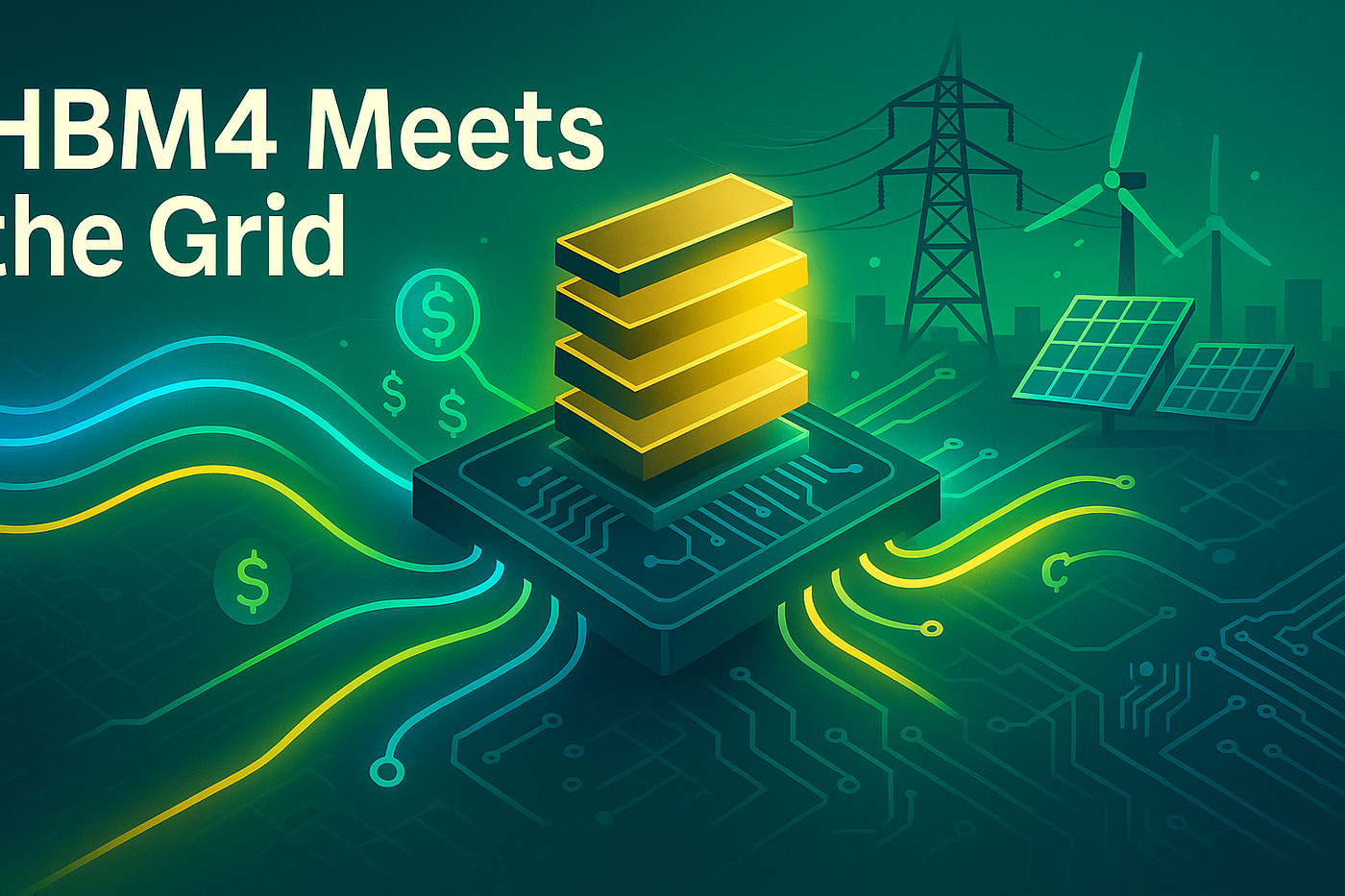
Explore how HBM4 transforms AI cost per query, linking semiconductor memory, grid power constraints, and sustainable product design.
The Memory Breakthrough That Isn’t Free
Every few years, a hardware leap redefines what’s possible in AI. GPUs. TPUs. Specialized ASICs. Now comes HBM4 (High Bandwidth Memory, 4th generation) — a memory technology promising unprecedented throughput for AI models.
But here’s the catch: HBM4 doesn’t just improve performance — it changes the economics of power. Every terabyte per second delivered to a GPU requires electricity, and every watt burned cascades into cost per query.
As AI workloads shift from research labs into consumer apps, the marriage of semiconductor physics, grid electricity, and inference economics becomes the defining frontier.
This is the story of how HBM4 meets the grid — and why product teams must start designing with watts as carefully as they do with weights.
What Is HBM4, Really?
HBM4 is the latest generation of high-bandwidth memory stacked vertically alongside processors. Unlike traditional GDDR or DDR memory, HBM brings memory closer to the compute units via 3D stacking and through-silicon vias (TSVs).
- HBM2 gave GPUs the bandwidth needed for deep learning’s early boom.
- HBM3 fueled the scaling of large language models (LLMs).
- HBM4 is expected to push bandwidth well past 1.5 TB/s per stack, potentially doubling capacity per package compared to HBM3E.
For AI training and inference, this means fewer bottlenecks moving weights and activations in and out of GPUs. Bigger models become usable, faster responses become possible.
But there’s a price: HBM is energy-hungry, expensive, and grid-sensitive.
The Power Cost of Bandwidth
Memory bandwidth is not free. Each read/write operation consumes energy, and as speeds climb into terabytes per second, the power draw scales.
- HBM2e modules consumed around 3–5 watts each.
- HBM3 modules pushed into the 7–10 watt range.
- HBM4 is expected to go higher, depending on clock speeds, with each GPU potentially hosting dozens of stacks.
In a hyperscale data center, this multiplies into megawatts of memory-driven load.
Now zoom out: if you’re running an AI service with 10 million queries per day, even a small increase in joules per token translates into thousands of dollars in electricity bills — plus cooling costs.
Cost per Query: Where Memory Meets the Grid
Traditionally, “cost per query” has been framed in terms of cloud compute cost: how much an inference run costs per token on AWS, Azure, or Google Cloud. But behind those line items sit power bills and memory constraints.
Here’s the equation simplified:
Cost per Query ≈ (Energy per Token × Grid Price per kWh) + Overheads
With HBM4, the energy per token shifts downward (thanks to fewer compute stalls) but the static power of the memory system increases. The balance depends on workload:
- Large, memory-bound LLMs → Big gains from HBM4, since bandwidth eliminates bottlenecks.
- Smaller, compute-bound inference → Costs may rise if the memory overhead isn’t justified.
This is why product managers and infra leads need to look beyond FLOPs. The new KPI isn’t just “latency per token,” but watts per query.
The Grid Angle: AI as an Electricity Customer
AI companies increasingly resemble industrial power users. Just as aluminum smelters or steel mills negotiate energy contracts, data center operators now negotiate with utilities.
Adding HBM4 accelerates this trend:
- More watts per rack → Higher local demand.
- Thermal density issues → More cooling energy.
- Peaky workloads → Greater stress on local substations.
In places like Dublin and Northern Virginia, utilities are already delaying or rejecting new data center connections due to power scarcity. Imagine deploying HBM4-heavy clusters in such regions — it’s not just a technical decision, but a grid integration strategy.
Real-World Analogies
- Fiber-Optic Boom ≈ HBM4 Bandwidth When fiber optics first rolled out, internet speeds exploded — but so did backbone electricity demand for routers and switches. Bandwidth without power planning created bottlenecks elsewhere.
- Sports Car Analogy A Ferrari can hit 200 mph, but only if you can afford the fuel. HBM4-equipped GPUs are Ferraris of AI compute. The question is: Can your data center afford the gasoline (electricity)?
- Cloud Gaming Example Cloud gaming companies once thought latency was their only battle. Power costs ended up crushing margins. AI inference may follow the same curve if energy economics aren’t baked into design.
HBM4 Economics: Price, Scarcity, and Risk
HBM4 will not only be power-hungry — it will be expensive. Estimates suggest over $1,000 per stack, with advanced packaging yields still maturing.
For AI providers, this means:
- Higher upfront GPU costs → Passed down to users unless amortized.
- Supply bottlenecks → Only a few vendors (Samsung, SK Hynix, Micron) dominate HBM production.
- Strategic risk → If you design your product assuming cheap HBM4, a supply shock can derail your roadmap.
When you combine cost of silicon + cost of power, the final “cost per query” becomes a moving target — sensitive not just to algorithmic efficiency, but to global supply chains and regional electricity rates.
Designing Around HBM4 and the Grid
So, how do teams prepare?
1. Measure Energy per Token
Just as developers measure latency, add joules per token as a first-class metric.
2. Use Memory-Aware Architectures
Techniques like quantization, pruning, and MoE (mixture-of-experts) reduce reliance on raw memory bandwidth.
3. Geographic Load Placement
Run HBM4-heavy inference in regions with cheap renewable surplus (e.g., hydro in Quebec, geothermal in Iceland).
4. Align with Utilities
Negotiate contracts like industrial users. Consider co-locating with renewable projects.
5. Plan for Scarcity
Don’t assume unlimited HBM4. Have fallbacks: HBM3E deployments, memory-optimized algorithms, or tiered service levels.
Case Studies & Early Signals
- NVIDIA Hopper + HBM3 already showed how memory pricing affects total GPU cost. With HBM4, these dynamics intensify.
- Microsoft’s AI infrastructure increasingly ties GPU rollouts to renewable energy sourcing. Expect HBM4 deployments to follow.
- TSMC & Samsung fab roadmaps suggest limited packaging capacity — meaning early adopters will face scarcity premiums.
The Future: Joules as a Feature
In the 2010s, the killer feature was latency. In the 2020s, it was scaling. In the 2030s, it may be energy per query.
HBM4 sits at the center of this transition. It promises blazing speed, but only if we acknowledge the grid underneath. Product managers, engineers, and strategists must design with watts, not just weights.
Conclusion: Designing for Power, Not Just Performance
HBM4 will accelerate AI like never before. But it won’t be free. It brings higher costs, greater power demands, and deeper ties to grid economics.
The winners will be teams who treat electricity as a design input — balancing performance gains against energy realities. Those who ignore it risk brittle products, soaring costs, and grid backlash.
The lesson is simple: memory meets megawatts. And from now on, cost per query is as much about kilowatt-hours as it is about GPUs.
💡 What do you think? Is your organization measuring watts per token yet? Drop a comment below — I’d love to hear how teams are planning for HBM4’s arrival.
메타데이터
- post_id
- 56530b8a2db2
- slug
- hbm4-meets-the-grid-memory-power-and-cost-per-query-56530b8a2db2
- url
- https://medium.com/@ThinkingLoop/hbm4-meets-the-grid-memory-power-and-cost-per-query-56530b8a2db2
- canonical_url
- https://medium.com/@ThinkingLoop/hbm4-meets-the-grid-memory-power-and-cost-per-query-56530b8a2db2
- author_url
- https://medium.com/@ThinkingLoop
- status
- ok
- fetched_at
- 2026-06-17 08:20:12