Liege Chapter Two
Goat Blood And Hay Smoke
Liege Chapter Two
Goat Blood And Hay Smoke
Beyond the mountain peaks and shadowed forests, the company of Lord Crowley Duskmorne finally came to a halt.
The horses snorted heavily as cold wind swept down from the cliffs above, sharp enough to cut through cloak and steel alike.
“We make camp here for the night,” Crowley said at last.
His voice carried easily through the clearing — calm, steady, and as unyielding as winter itself.
At once, the men dismounted.
The rhythm of motion soon filled the silence: the clatter of armor, the dull thud of boots against frozen earth, the creaking of saddles, the rustle of canvas as tents slowly rose beneath the fading light.
Even now, exhaustion failed to disrupt discipline. Every man moved with purpose, each already knowing his role without need for further command.
When the campfire was finally lit, Crowley took his seat beside it.
The flames cast their glow across his scarred face, shaping his features into something half-shadowed beneath the night. He stared silently into the fire, unmoving, as though searching for something buried deep within the shifting embers.
Four guards remained stationed around the clearing, silent sentinels against the whispering dark beyond the trees.
Among them stood William.
The young guardsman found his eyes repeatedly drifting back toward Lord Crowley despite himself.
There was admiration in the stare.
But unease as well.
He studied the lord’s stillness — the unnatural way the man seemed carved from stone itself, unmoving even as sparks drifted against the dark fabric of his tunic.
William found himself wondering what thoughts hid behind that silence.
Whether Lord Crowley felt hatred for the brother he hunted…
— or nothing at all.
“You stare too much, guardsman.”
William stiffened immediately.
Crowley’s eyes remained upon the fire.
“You have something to say.”
“I apologize, my lord,” William answered quickly. “I did not mean disrespect.”
Silence lingered briefly between them.
William hesitated.
Then finally:
“If I may be bold, my lord…”
Crowley said nothing.
William swallowed once before continuing.
“My mind keeps returning to it.”
The fire crackled softly between them.
“Why would Lord Johana do such a thing?”
For a few moments, Crowley did not answer.
The flames reflected quietly within his eyes.
“My brother,” he said at last, “was always trying to become something he was not.”
His tone remained calm. Measured. Almost clinical.
“When opportunity finally came to prove himself, he failed.”
The wind swept through the clearing.
“He was careless,” Crowley continued. “And carelessness breeds ruin.”
His gaze remained fixed upon the fire.
“Veserya burned because my brother mistook destruction for strength.”
At the mention of the name, something subtle shifted among the men nearby.
One guardsman lowered his eyes immediately.
Another tightened his grip around the spear resting beside him.
Even the crackling flames seemed to grow louder for a moment.
Many who survived the horror no longer spoke the name easily.
Not after the fire. Not after the screams. Not after the smoke swallowed entire streets whole.
William unconsciously touched the cloth wrapped around his neck.
Beneath it, the old burn scars throbbed faintly against his skin.
The catastrophe had carved itself too deeply into those who survived it. Some flew into trembling fits at the mere sound of the city’s name, while others buried the memory so deeply they refused to speak of it at all.
Then William finally broke the silence.
“I was from Veserya, my lord.”
His voice came quieter than before.
“I was there when it happened.”
Crowley’s gaze remained fixed upon the fire.
“The sins of my brother have left many men like you.”
“Too many,” William murmured beneath his breath.
His fingers drifted once more beneath the cloth wrapped around his neck, brushing unconsciously against the twisted burn scars hidden beneath it.
Crowley noticed the movement.
But said nothing further.
And so the night dragged onward.
Some time later, William finally rose from the fire and made his way toward the smaller campfires scattered throughout the clearing.
Yet one word lingered within his mind like smoke.
“Incompetence,” he murmured quietly beneath his breath.
The word tasted bitter.
A bitter thing to lose everything over.
Just because some lord had been incompetent.
That was how Crowley had described it.
William lowered himself beside the dying embers of a smaller fire, its fading warmth brushing faintly against his scarred neck.
Slowly, his fingers found the edge of the cloth wrapped there.
They traced the uneven ridges beneath it.
Rough. Twisted. Permanent.
The smell of ash lingered softly within the night air.
Somewhere nearby, a log cracked loudly within the fire.
A spark spiraled upward into the darkness.
William’s eyes followed it instinctively until the tiny ember vanished from sight.
But the afterglow remained burned against his vision.
A flicker.
Then another.
Suddenly brighter.
Larger.
Alive.
Without realizing it, his thoughts drifted backward.
Back to Veserya.
Back to the roar of flames swallowing stone and timber alike.
Back to the night the world itself seemed to burn.
It had begun as a day like any other.
William stood guard at the castle gates while warm sunlight rested across his face and the wind carried the scents of fresh bread and distant spices upward from the crowded markets below.
The city of Veserya breathed around him — vibrant, untroubled, unaware of the doom that waited beyond its walls.
From the courtyard, the steady murmur of voices rose and fell: merchants haggling over coin, messengers shouting news from the southern provinces, and the soft laughter of noblewomen crossing the marble steps. Somewhere, a bell tolled — clear and bright — calling the people to the day’s consul, when lords and peasants alike would bring their grievances before the king, hoping for justice or mercy.
William adjusted his grip on his spear and watched the gates open and close, each visitor another thread in the endless rhythm of duty. For that brief morning, the world had seemed still, almost kind.
From a distance, William noticed an old man making his way toward the gate, a young girl walking close beside him. The man’s garments were plain and worn thin at the edges, his beard coarse and uneven, the faint scent of goats clinging to him — a shepherd, perhaps, or a tanner from the outskirts.
The girl, though simply dressed, moved with quiet grace. She could not have been more than fifteen, her golden hair catching the sunlight like strands of thread spun from summer itself. There was something in her posture — careful, composed — that set her apart from the common folk who passed before the gate each day.
William straightened slightly, studying them as they drew nearer. On this day of consul, no station was beyond scrutiny. Peasant or lord, merchant or beggar — all who entered would be examined, recorded, and sent forth to kneel before the king. It was order, the kind Veserya prided itself upon.
The old man paused at the base of the gate, clutching his daughter’s hand as if drawing courage from her presence. Then, with a tremor in his breath, he stepped forward.
“My lord — begging your pardon — but I… I’ve a matter that needs addressing. Don’t rightly know who to take it to.”
William regarded him from beneath his helm, the sunlight glinting off the rim. The man’s words stumbled over themselves, weighed down by nerves.
“If you seek counsel with the king,” William said flatly, “you must go inside.”
“Aye, but…” The man’s eyes darted toward the great doors, then back again. “The matter’s delicate. If I speak of it before the court, I fear I might be punished.” His voice lowered to almost a whisper, thick with unease.
That made William pause. He studied the man again — ragged, yes, and desperate, but there was no deceit in him. Only fear.
“Very well,” he said at last. “Follow me.”
He gave a brief signal to a nearby guardsman before turning on his heel. The old man nodded hurriedly and guided his daughter after him. She moved in silence, her gaze restless as they passed beneath the archways and along the stone corridor — eyes catching on every suit of armor, every carved emblem on the wall, as though each might hold judgment over her.
Inside, they sat at a simple wooden table, its surface worn smooth by years of use. Dust motes drifted lazily in the slanting light. William leaned forward, forearms resting on the table, his tone clipped and professional.
“Speak, then. What is it?”
The old man swallowed hard before answering. “My name is Robert, ser. This here is my daughter, Julia. We live beyond the walls — just us two. Her mum, she passed from sickness some years past. Julia’s all I’ve got.”
William gave a curt nod. “Go on.”
Robert wrung his hands together, eyes fixed on the grain of the wood. “There is a young nobleman, you see. The young Lord Mayer.”
“Lord Mayer,” William repeated, his brows knitting together.
“Yes, ser. The young lord has taken a liking to my girl. He has been… persistent.” Robert’s voice wavered, the word hanging uneasily in the air.
“Persistent?” William’s tone sharpened. “What do you mean?”
“It began with visits, my lord — unannounced yet frequent,” Robert said, his voice trembling with fear. “Lord Mayer would appear, his words sweet as honey, his gifts as plentiful as the summer harvest. He sought to persuade my daughter, Julia, to accompany him to the city — promising her a life beyond our humble means.”
He drew a shaky breath. “I, with all due respect, intervened, my lord. I implored him to cease his advances, to leave us in peace. But I saw the anger in his eyes — a hatred that burned cold. He pushed me aside, and Julia, in her fright, struck him across the face.”
The memory seemed to weigh on him; his shoulders sank. “Lord Mayer left without a word, but his silence was more terrifying than any threat. The next morn, I awoke to Julia’s screams. I found our goats — every last one — slain. Their throats cut, their blood pooling before our door like a grim omen.”
Robert’s voice broke. “Since that day, my lord, Julia has known no peace. Night terrors plague her sleep, and I fear…” He hesitated, his voice catching. “I fear what may come next. She is all I have left, my lord. I beg of you — grant us your protection.”
William’s expression darkened. To defy a noble was folly, but to ignore this plea felt like cowardice. Lord Mayer — cousin on his mother’s side to the Prince of Veserya. The weight of that name could crush men lesser than William.
He exhaled slowly. “Listen, old man. I have served this house long enough to know that our king values fairness. Bring this matter before him. He will grant you justice.”
For the first time, Robert looked up. Hope flickered through his despair — faint, but alive. The fear of losing his daughter had nearly broken him, yet William’s words gave him something to hold onto.
After their conversation ended, William personally escorted the father and daughter through the great doors of the castle. The corridors swallowed them in echo and marble light. Every few steps, Robert would glance upward — at the towering arches, the banners of Veserya fluttering faintly overhead — as though he were walking through another world entirely.
William guided them past the guards and courtiers, ensuring their names were recorded and their petition accepted. Only then did he step back, content that his duty was done.
The wait was long. Hours bled into dusk; torchlight replaced the sun, and by the time their turn came, the sky beyond the high windows had gone dark.
At last, Robert was called before the throne. He moved stiffly, shoulders hunched, the girl close behind him.
King Julius Veserya sat beneath the vaulted dome, draped in an orange robe embroidered with gold and jewels that caught the flickering light. His crown rested lightly upon his gray hair, and his beard was trimmed with precision. Every movement, every breath of the man spoke of authority so complete it needed no words.
Robert dropped to one knee, eyes fixed on the marble floor. His hands shook as he tried to find his voice.
“Your Majesty — ”
He never finished.
“Well, if it isn’t old Robert.”
The words sliced clean through the air. Smooth, mocking, unmistakable.
Robert’s head jerked upward in shock. The voice came from near the dais — young, confident, dripping with malice.
Lord Mayer.
The very man he had come to accuse now stood smiling before the court, amusement glinting in his eyes.
A hush fell over the hall. Even the courtiers seemed to lean in, sensing blood in the air.
“Your Majesty, this man is a dear friend of mine,” Lord Mayer declared as he strode to the front of the court, his tone bright with false warmth. He smiled as though greeting a companion at a feast, not the man come to accuse him.
Robert’s breath caught in his throat. He dared not move. One wrong word could cost him his head.
King Julius’s gaze shifted between them, unreadable. “Well then,” he said slowly, “if you don’t mind, Mayer, I would hear from your friend.”
The words hung in the vast chamber, still as the air before a storm. Even the courtiers leaned forward, sensing that something dangerous lingered beneath the pleasantries.
Robert stood trembling, the marble floor cold beneath his knees. He had rehearsed his plea a hundred times in the dark, whispered it to himself until the words became prayer. Yet now, under the weight of so many eyes — the king’s, the nobles’, the very man who had cursed his home — the words faltered.
“Your Majesty,” he began, his voice a thin quiver, “with your blessing… I seek to wed my daughter to Lord Mayer.”
The silence that followed was absolute.
Then it shattered.
The words rippled through the court like stones cast into still water. Gasps and whispers rose from every side.
Julia’s breath hitched, her eyes wide as though she’d been struck. The color drained from her face. “Father…” she mouthed soundlessly, disbelief twisting her features.
Across the hall, William stiffened, his jaw tightening in shock. “What?” The word escaped him before he could stop it. His gaze snapped to Julia, but she stood frozen — her body trembling, her eyes glistening with the threat of tears she refused to shed.
Around them, the court erupted in murmurs, the sound swelling like an incoming tide. Nobles exchanged glances of outrage and fascination. The notion alone — a peasant girl wed to a lord — was heresy against the natural order.
The king’s expression darkened like a gathering storm. He leaned forward upon his throne, each motion deliberate, heavy with restrained fury.
“What madness is this?” His voice filled the chamber, deep and cold. “Do you grasp what you ask? You would see a commoner raised to the station of nobility? This is preposterous!”
Before the murmurs could settle, Lord Mayer stepped forward, seizing the silence like a blade drawn from its sheath.
“Your Majesty,” he said, his voice clear, unwavering — the voice of a man already condemned in his heart. “I do not deny it. My heart is bound to hers. There must be a way.”
The king’s jaw clenched, the muscles along his face taut as stone. His gaze locked onto Mayer’s, the weight of an iron chain.
“A way?” he repeated, each word deliberate. “Think, boy. You speak of love, but what of duty? Of lineage? Do you grasp the gravity of what you suggest?”
Mayer met his king’s stare without flinching. “I am smitten by her,” he said quietly, then louder, as though daring the hall to challenge him. “What of it?”
A hush fell across the court — deep, suffocating. The sound of the torches seemed to vanish.
The king exhaled through his nose, his voice tightening with the effort to remain calm. “Mayer, you are young. You speak as though love is eternal, yet know this — it is fleeting. A fire that burns bright, then fades to ash. In time, you will wed as duty demands. I shall see to it personally.”
But Mayer did not yield. He stepped forward once more, his words cutting sharper now. “And what of my mother?”
The air shifted. The court shifted with it — uneasy glances, the rustle of silk, the faint intake of breath. The question itself was a blade unsheathed in the presence of royalty.
The king’s eyes darkened. “Mayer,” he warned, voice low, thunder gathering beneath the name.
Yet Mayer pressed on. “Was she, too, a passing fancy? A temporary pleasure?”
The hall erupted. Gasps, shouts, outrage — voices crashing like a wave against marble walls.
“Silence!” The king rose, his presence alone cutting through the noise. His fury filled the space, drowning all sound but his own. “You will hold your tongue!”
But Mayer’s restraint was gone. His voice rang with years of quiet rage, a wound laid bare.
“No!” he shouted. “Let them hear it! Let them all know the truth!”
He turned toward the gathered lords and ladies, his face burning with defiance. “The king has another son — me! Hidden away, veiled as a cousin to my own brother! A bastard born of a — ”
The rest was lost in a crack that split the air like thunder.
The king’s hand had struck him. Flesh on flesh. The sound echoed through the great hall, silencing every breath.
Mayer staggered back, eyes wide, cheek aflame. For a heartbeat, the court stood frozen — all the grandeur, all the ceremony, brought low by a single act of fury.
The king stood motionless, his face carved in fury barely restrained. When he finally spoke, his voice was ice.
“We will speak in private.”
He turned to his royal officers, his tone sharp enough to cut the silence. “Take Lord Mayer to my chambers. This council is concluded.”
At once, the guards obeyed. They moved swiftly, their armor clattering in the heavy quiet as they seized Mayer by the arms. He did not struggle. His gaze, burning with defiance and shame, lingered on his father one last time before he was led away.
The vast doors closed behind them with a resonant thud — the sound of finality.
The court remained still. No one dared to speak, no one dared to move. It was as if the very air had turned to glass. Only when the echo of the doors faded did the whispers begin — thin, fearful murmurs rippling through the gathered lords and ladies like the remnants of a storm.
One by one, they dispersed, their silks rustling softly as they retreated from the weight of what they had witnessed. Yet even as the chamber emptied, the revelation lingered — a poison in the air that would not dissipate.
Outside, Julia walked beside her father. Neither spoke. Their steps were slow, heavy with shame and disbelief. The space between them felt vast — not of distance, but of trust shattered and silence unhealed.
Robert kept his eyes fixed ahead, unable to face the daughter he had betrayed. Julia’s gaze stayed low, her tears unshed, her heart hollow. Between them hung a silence far louder than words.
Then a voice shattered the stillness — sharp, cutting, alive with fury.
“What in the hell is wrong with you?”
William’s hand shot out, seizing Robert by the collar and dragging him close. The motion was sudden, violent; the old man staggered but did not resist. His eyes stayed downcast, the weight of shame already bending his spine.
“Why?” William hissed, his voice trembling with restrained rage. “You told me she was all you had — that you’d die before letting harm come to her. And now this? You cower? You yield? You sell your own flesh and blood?”
His grip tightened, knuckles white, the veins in his neck drawn taut.
Robert said nothing. His lips parted as if to speak, but no words came — only a shallow, broken breath. He turned his face aside, unable to bear the young soldier’s eyes.
William’s fury burned hotter in the silence. He drew breath to speak again —
— but a hand caught his arm.
“Let him go.”
Julia’s voice was soft, but there was steel beneath it. She stood beside them, her eyes steady, her hand trembling only slightly against his sleeve.
William turned to her, disbelief plain in his voice. “What? Julia, after everything — ”
“Please,” she said again, firmer this time. “Let him go. We do not need your help anymore.”
The words hit harder than any strike. For a moment, William just stared at her, his anger faltering, leaving only wounded disbelief.
Slowly, his fingers uncurled. Robert slipped from his grasp, collapsing back against the wall with a sound that was more sigh than breath.
William stepped away, the fight leaving him all at once. He exhaled sharply, his voice low, bitter.
“Pathetic. A fool of a man.”
And without another word, he turned and walked off, his footsteps echoing down the stone corridor until only silence remained — silence, and the two he left behind.
Father and daughter stood alone, bound by blood yet divided by something far crueller — the choice that had broken them both.
With that, William turned away.
But then his breath caught.
Down the path where Robert and Julia had gone, an eerie glow flickered against the night. At first, faint — like lanterns in the distance — then brighter, growing, spreading. The distant crackle of flames reached him before the scent did.
Burning wood.
Smoke curled upward in twisting ribbons, swallowing the stars. The orange light danced across the dark horizon, swelling with every heartbeat until it painted the sky in fire.
William did not move. He could only stand and watch as the blaze devoured the night — as the fire took hold of Veserya.
Then came the sound.
The bells.
They rang out, mournful and unending, their iron voices carrying through the valley.
Back in the king’s chambers, Lord Mayer sat slouched in his father’s chair, one arm draped lazily over the gilded armrest, a half-empty goblet of wine dangling from his fingers. His eyes were distant, glazed, unfocused — the eyes of a man unmoored from consequence.
The doors burst open.
King Julius stormed in, his robes sweeping behind him, his fury burning hotter than the torches that lined the walls.
“I should have you executed,” he hissed, striding forward. “Do you understand the damage you’ve done? Do you grasp the weight of your insolence?”
Mayer did not rise. He merely took another slow sip, letting the wine roll over his tongue before swallowing.
“I have given you everything!” Julius thundered. “Though you are a bastard, I have provided for you — clothed you, fed you, placed you in halls grander than you ever deserved. What more could I have done?”
Mayer finally looked up. His smirk was small, cruel, deliberate.
“How about being a father?” he said softly. “A real family? One that didn’t treat me like a stain to be hidden? A mother who didn’t hate me just for existing — for being the living proof of her husband’s shame.”
Julius faltered, breath heavy, anger warring with guilt. His hands clenched into fists.
“I hear your grievances, Mayer,” he said at last, his voice trembling beneath the weight of emotion. “I know… I know, son. But you should not have done this. Why could you not come to me? When did I ever abandon you?”
Mayer laughed — a hollow, bitter sound. He raised his cup once more, toasting the air.
“When?” His eyes gleamed, cold and distant. “The moment I was born. Mayer — that isn’t even my name. The woman you chose to pretend as my mother doesn’t even know I exist.”
Julius’s face hardened, the last trace of tenderness vanishing.
And then, from outside the castle walls, the bells tolled again — deep and distant.
Their echo rolled through the corridors like a death knell, each toll slower than the last, heavy with doom.
The door to the king’s chamber burst open. Two guardsmen stumbled in, blades drawn, faces pale and slick with sweat.
King Julius turned sharply. “What is happening?” he demanded. “Why have the bells been tolled?”
The first guard approached, his sword trembling slightly in his grip. “I’m afraid, Your Majesty…” he said, voice low. “This is the end of Veserya.”
And before another word could be spoken — steel flashed.
The blade drove clean through the king’s chest, the sound of metal meeting flesh sharp and final. Julius gasped once, eyes wide with disbelief, then fell to his knees as blood darkened his robe.
Mayer froze where he stood. For a heartbeat, the world seemed to stop — the crackle of fire outside, the toll of bells, all fading into silence.
Then he moved, stumbling backward toward the window, horror etched across his face. “What have you — ”
The second guardsman lunged before he could finish, driving his sword into the young lord’s stomach. Mayer’s breath left him in a wet gasp as the man shoved forward, hurling him through the window.
Glass shattered.
The boy’s body crashed through the night air before breaking violently against the trees below with a sickening crack.
Inside the chamber, the first guardsman knelt beside the fallen king, calmly wiping blood from his blade.
He glanced toward his companion leaning out from the shattered window.
“A bit much, don’t you think?” he muttered.
“No witnesses, my lord,” the other answered plainly.
Outside, Mayer lay broken among tangled roots and shattered branches.
Blood soaked steadily into the earth beneath him while every breath scraped painfully against his lungs.
Yet through the agony, he still managed to lift his head.
Just enough to see the city below.
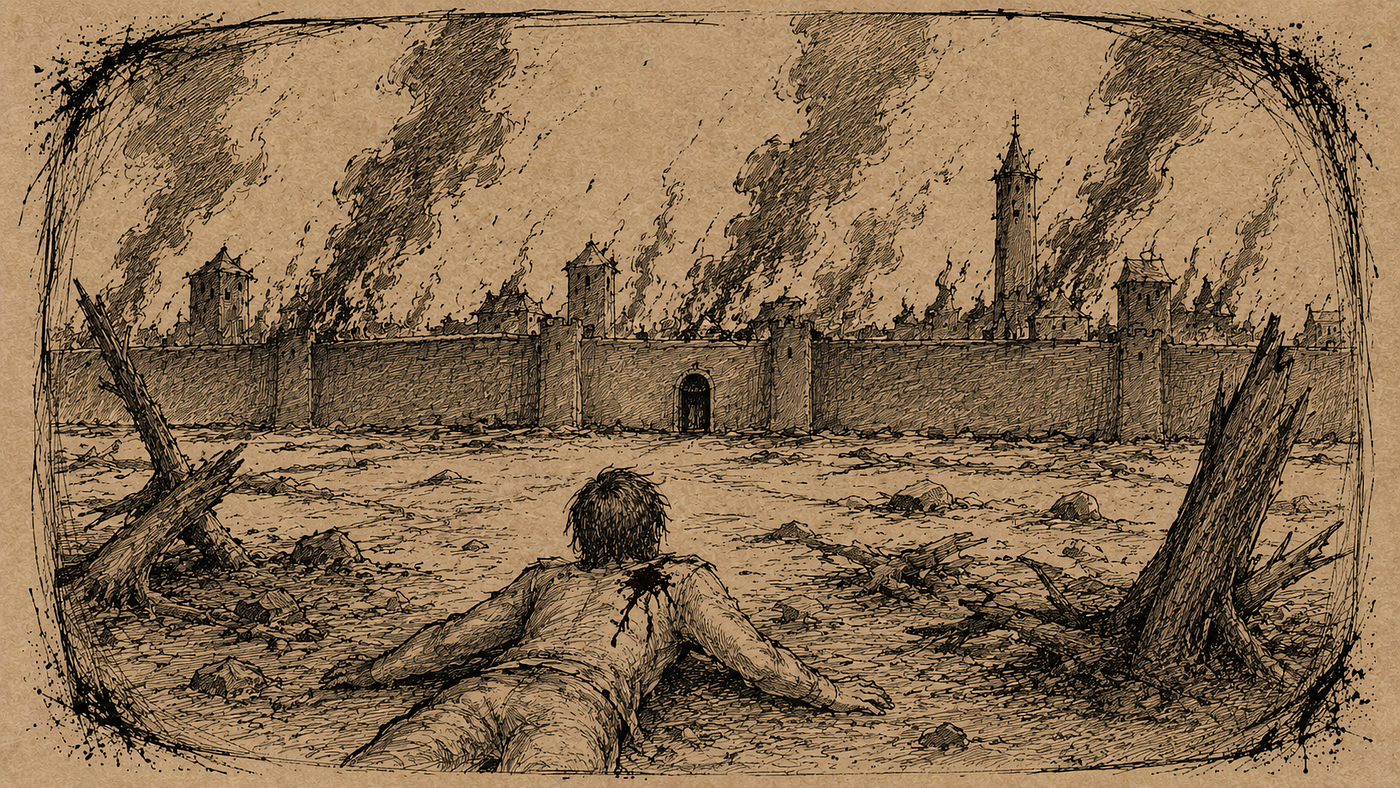
Veserya burned.
The flames rose higher than the walls themselves, bright enough to sear the eyes, beautiful and terrible all at once. Smoke rolled endlessly into the heavens while ash drifted across the night like black snowfall.
The bells still rang somewhere in the distance.
Not warning bells anymore.
Mourning bells.
And as the bells slowly faded into the night, the walled city of Veserya died.
Next Chapter>
메타데이터
- post_id
- 566ea7f91ae1
- slug
- liege-chapter-two-566ea7f91ae1
- url
- https://medium.com/@Virerra/liege-chapter-two-566ea7f91ae1
- canonical_url
- https://medium.com/@Virerra/liege-chapter-two-566ea7f91ae1
- author_url
- https://medium.com/@Virerra
- status
- ok
- fetched_at
- 2026-06-09 15:37:30




