When Silence Learned to Breathe
In the quiet village of Nagoro, time doesn’t move the way it used to. Once filled with laughter, footsteps, and everyday life, the village…
When Silence Learned to Breathe
In the quiet village of Nagoro, time doesn’t move the way it used to. Once filled with laughter, footsteps, and everyday life, the village now stands still. But if you listen closely, the structures still speak.
Chapter 1: Echoes of Laughter
Nagoro once felt like a place where time moved with people, not against them. Every corner of Nagoro carried sound, warmth, and everyday life. It wasn’t just a village; it was a living memory.
In Nagoro, the silence isn’t empty; it feels like something is still listening.
“I remember when this place was full,” the school says softly, its broken windows letting in light and wind together. “Every morning, children used to run inside me. They were loud, careless, always laughing. I could barely keep up with their energy.”
The old hut lets out a slow creak, almost like a tired smile. “I remember them too. They would pass by me every day. One of them always tripped near my door, and still laughed like it didn’t matter.”
“I used to feel alive because of them,” the school continues. “My classrooms were never quiet. Even when they were supposed to study, they found ways to talk, joke, and distract each other.”
“I wasn’t loud like you,” the hut says, “but I was full. A family lived inside me. Evenings were warm. I could hear soft conversations, the sound of cooking, the comfort of people just being together.”
“Those days felt endless,” the school says.
“But they weren’t,” the hut replies.
Chapter 2: The Quiet Goodbye
In Nagoro, change didn’t arrive suddenly, it slipped in quietly. At first, Nagoro still looked the same, but something important was slowly fading away.
“I noticed the change first,” the school says. “One child stopped coming. Then another. Slowly, my classrooms began to empty.”
“I felt it too,” the hut says quietly. “The family started talking about leaving. They said the city had more opportunities, more work, a better life.”
“They promised to come back,” the school adds.
“But they didn’t,” the hut says.
“I kept waiting every morning,” the school continues. “I thought maybe today I would hear footsteps again. But all I heard was the wind.”
“I waited every evening,” the hut says. “But the warmth inside me slowly disappeared.”
Chapter 3: When Time Stood Still
Nagoro slowly became a place where time felt heavier. Days passed, but nothing really changed anymore. The village began to feel like it was holding its breath.
“The old people stayed for a while,” the school says. “They would sit outside, watching the road like they were expecting someone.”
“They leaned against me sometimes,” the hut adds. “I could feel how weak they were becoming.”
“And then, they were gone too,” the school says.
The wind passes through them, heavier this time.
“For a long time, it was just us,” the hut says. “Empty. Quiet. Forgotten.”
“Yes,” the school replies. “I stood open, but no one entered.”
Chapter 4: The Imitation of Life
Just when Nagoro felt completely abandoned, something unusual began to happen. It wasn’t life returning — but it looked like it from a distance.
“But one day,” the school says, “I saw someone walking toward us.”
“I saw her too,” the hut says. “She didn’t look afraid.”
“Her name was Tsukimi Ayano,” the school says. “She came back.” “She started bringing people with her,” the hut adds.
“But they weren’t real,” the school says.
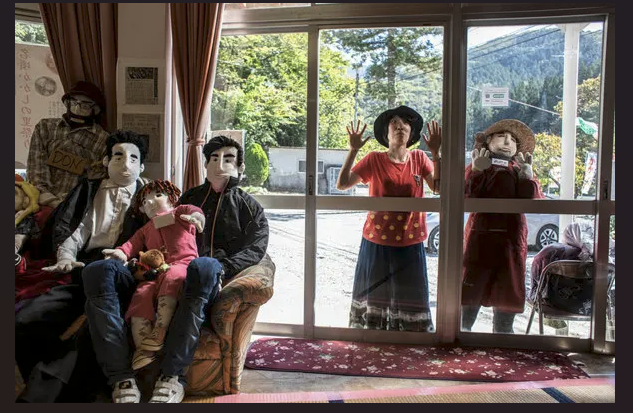
“They were dolls,” the hut continues. “Life-sized; sitting inside me like they belonged there.”
“They filled my classrooms,” the school says. “For a moment, I thought everything was normal again.”
“I felt that too,” the hut admits. “But something was missing.”
“They didn’t move,” the school says.
“They didn’t speak,” the hut adds.
“They didn’t laugh,” the school continues.
“It wasn’t the same,” they both say quietly.
Chapter 5: When Nature Took a Breath
Over time, Nagoro stopped trying to go back to what it was. Instead, something new quietly began to grow. Nature slowly stepped in where people had left.
“But then something else happened,” the hut says one day.
“Yes,” the school replies, softer now. “Something different.”
“I felt a small plant grow through my floor,” the hut says.
“I felt moss spreading across my walls,” the school adds.
“I didn’t stop it,” the hut says.
“Neither did I,” the school replies.
“Trees started growing around us,” the hut continues.
“Branches reached through my windows,” the school says.
“I slowly stopped feeling empty,” the hut admits.
Chapter 6: A Different Kind of Life
Nagoro today is not what it used to be, but it is not lifeless either. In its own quiet way, Nagoro has found a new rhythm.A sparrow flies in and settles inside the classroom.
“I have someone living with me now,” the school says.
A small stray dog curls up near the hut’s entrance.
“He comes here every day,” the hut says gently. “He sleeps by my door like this is his home.”
“They don’t replace what we lost,” the school says.
“But they stay,” the hut replies.
“And that feels enough,” the school adds.
“People come sometimes,” the hut says. “They walk around, looking at everything.”
“They look at the dolls,” the school says. “They try to understand what happened here.”
“But they leave,” the hut says.
“That’s okay,” the school replies.
“I’m not waiting anymore,” the hut says.
“Neither am I,” the school agrees.
The wind moves through the village again, but this time it carries the sound of leaves and birds.
“I think we’re still alive,” the hut says after a while.
“Yes,” the school replies quietly.
“Just not in the way we used to be.”
And this time, the silence around them doesn’t feel lonely; it feels complete
The story of Nagoro is not just about abandonment; it is about transformation. The school and the hut no longer serve their original purpose, yet they continue to exist, adapt, and feel in their own way.
Where human life faded, nature stepped in. Where voices disappeared, silence found meaning. And in that quiet shift, these structures didn’t die, they evolved.
Sometimes, emptiness is not the end. It is simply a different kind of life waiting to be understood.
Source: nytimes.com
FAQS
1. Do people live in Nagoro?
Yes, but very few. Only a small number of elderly residents still live in Nagoro. Most of the younger population moved to cities for jobs, leaving the village nearly empty.
2. Is Nagoro village haunted?
No, Nagoro is not actually haunted. It may feel eerie because of the lifelike dolls placed around the village, but there are no real ghost stories or paranormal evidence — just an unusual and emotional atmosphere.
3. What happened in Nagoro?
Nagoro experienced rural depopulation, which is common in many parts of Japan. Younger people left for better opportunities in cities, and over time, the older residents passed away. This caused the village population to shrink drastically.
4. How many dolls are in Nagoro?
There are around 300+ life-sized dolls placed across the village. In fact, the dolls now outnumber the actual residents.
5. Who made the dolls in Nagoro?
The dolls were created by Tsukimi Ayano. She started making them to represent former villagers and bring a sense of life back to the empty spaces.
메타데이터
- post_id
- 5673d78c2fdc
- slug
- when-silence-learned-to-breathe-5673d78c2fdc
- url
- https://medium.com/@harshbharekar/when-silence-learned-to-breathe-5673d78c2fdc
- canonical_url
- https://medium.com/@harshbharekar/when-silence-learned-to-breathe-5673d78c2fdc
- author_url
- https://medium.com/@harshbharekar
- status
- ok
- fetched_at
- 2026-07-13 06:23:13




