An Appreciation of Colourants: Past, Present, and Future
I was out walking in London one afternoon when I got a call from my brother, Chris. During the course of our conversation, he suggested…
An Appreciation of Colourants: Past, Present, and Future
I was out walking in London one afternoon when I got a call from my brother, Chris. During the course of our conversation, he suggested that I should consider doing an MA in Art History. My immediate reaction was negative. I was suddenly thrust back to the long drawn out commitment to my PhD in computer science years earlier. Then, there were the seemingly endless literature searches, updates to ongoing experiments and perpetual revisions.
Furthermore, humanities courses actually unnerved me. The persuasive nature of humanities courses seemed far more difficult to address than did the persuasive nature of science courses. I felt that in science, it was easier to retreat to the apparent objectivity and detachment behind a scientific question. Yet, having spent most of my career in scientific computing areas, I knew instinctively that this was not true. The data that scientists use reflects many subjective choices, but can be regarded as neutral by many readers. In some ways, I felt it was easier to provide support for an opinion in science than in art.
I’ve spent most of my career in areas of science and engineering, yet in my personal life my interest in art has grown immeasurably. I’ve often tried to understand art’s increasing appeal to me. Perhaps the lack of a clear answer has, in fact, contributed to its enduring appeal. I have not yet identified a ‘because’, and for someone whose work is highly analytical, that can come as something of a relief.
Any of us can appreciate art, anyone at all. I can be with a group of people where all of us have different opinions about a work of art. Yet, each of our opinions has merit. People can appreciate art for any number of reasons: the emotional response it elicits; the visual qualities it displays; the admiration of the artist who created it; or even society’s response to it. There are more opinions and perspectives than there are facts and certainties.
I decided to enrol in the Art History programme at Univerisity London Birkbeck when I realised how obvious my dissertation topic area was to me. I looked at my bookshelf and counted almost a dozen books about the history of colour. It is utterly fascinating how colour can bypass all logic and reasoning and speak to an instinct that has evolved in living things for millions of years. Learning about the history of the colour blue led me to wonder about the appeal of colours. Were there deep biological triggers for colour preferences? Did colours have universal meanings across cultures?
However, the more I read about colours, the more interested I became in the materials that provided them to viewers. Pigments and dyes did not just represent colours; they represented trade, economics, war, intrigue, philosophy, religion, magic, chemistry and biology.
Initially I wanted to do a dissertation about the history of colourants. Within that I would emphasise colourants from ancient times to the advent of modern synthetic pigments and dyes. Although I had long done informal reading about pigments and dyes used during that timeframe, I was unfamiliar with current trends in colourant production.
I knew my dissertation would need a more specific focus, but it was only after I took a workshop on Cyanobacteria dyeing at London’s Lifelabs Institute that that focus became clear. I wanted to concentrate on the values of microbial colourants in bioart.
The workshop presented laboratory techniques on how to culture bacteria that produced a blue dye and how to apply it to fabric. When I finally held my own little square of blue silk cloth, I realised that I was in the middle of an ongoing art movement about colourants (See Fig.1).
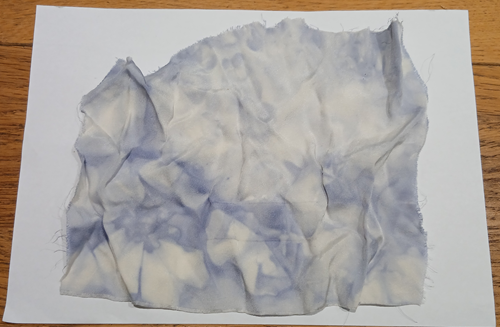
FIG. 1. A piece of silk I dyed after being taught how to apply biotechnology lab techniques to cultivate and apply the bacteria Janthinobacterium lividum.
Discovering the use of microbial colourants in bioart was strangely ironic for me. I have worked in biomedical fields for years, and I never set out to relate my interest in art to the field of science at all. Yet I realised that biotechnologies were being used to create art in new ways. I also realised that some of the microbially produced colourants had medicinal properties. Although technologies have changed greatly over the past few millenia, there have been persistent overlaps between colour and medicine. Terminologies have also changed. For example, the Latin term ‘pigmentum’ once meant a category of shipping good that included both materials that produced colour for art and materials that were used for medicine.[1]
I’ve adapted and serialised my dissertation into a series of articles I hope you’ll enjoy. The focus will be on the values of microbial colourants in bioart, but I first want to preface that discussion with a review of values that indicate why people have sought to use coloured materials to produce art. I will then describe the essence of bioart. Finally I will describe different values that are associated with microbial colourants.
Enjoy the **next article**!
Articles in the Series
- An Appreciation of Colourants: Past, Present, and Future
- Social Values of Colourants: From Antiquity to the Advent of Modern Synthetic Pigments
- Social Values of Colourants: The Early Era of Mass Produced Synthetic Pigments
References
[1] R.D. Harley, Artists’ Pigments c. 1600–1835: A Study in English Documentary Sources, (Archetype Publications, 2001), pp. 31, 152.
메타데이터
- post_id
- 567fb4d959ea
- slug
- an-appreciation-of-colourants-past-present-and-future-567fb4d959ea
- url
- https://medium.com/@kevin-garwood/an-appreciation-of-colourants-past-present-and-future-567fb4d959ea
- canonical_url
- https://medium.com/@kevin-garwood/an-appreciation-of-colourants-past-present-and-future-567fb4d959ea
- author_url
- https://medium.com/@kevin-garwood
- status
- ok
- fetched_at
- 2026-07-09 13:13:48