Looking at Opium Smoking Spaces of the 20th Century Through The Blue Lotus, The Adventures of…
Interior Space Nerd Trivia Nobody Asked For
Looking at Opium Smoking Spaces of the 20th Century Through The Blue Lotus, The Adventures of Tintin
Interior Space Nerd Trivia Nobody Asked For
While reading The Adventures of Tintin: The Blue Lotus, which a friend had gifted me some time ago, I found myself particularly drawn to the “opium den” spaces depicted in China. The urban and interior spaces throughout the book are generally striking, but the ritualistic nature of the opium dens especially caught my attention and led me to start researching them further.
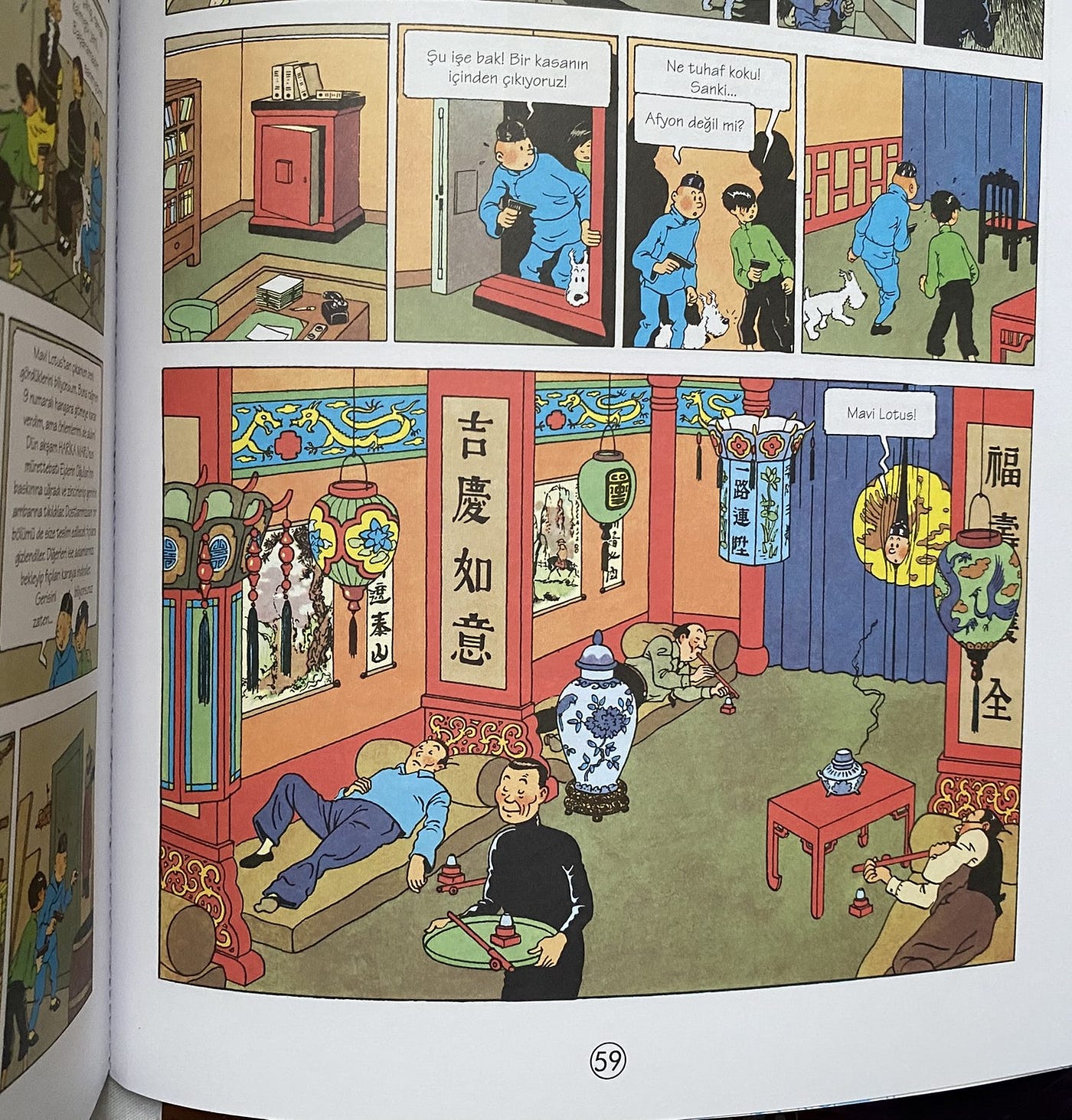
Hergé, The Adventures of Tintin: The Blue Lotus. Alfa Yayıncılık.
Opium dens were spaces where opium was sold and consumed, and they were widespread both in China and in places with a Chinese diaspora (such as the United States, London, and other parts of Europe). In China, these rooms functioned not only as social gathering spaces but also as sites where more intimate and ritualized practices took place. In that sense, they were not merely physical interiors, but part of the social rituals of the period. Unsurprisingly, these spaces were used by different social classes. They were generally hidden within existing buildings: located on upper floors, in back rooms, or in structures opening onto narrow streets.

If we take a closer look at the interiors of opium dens, they can be understood as a constructed whole organized around a triangle of object (the pipe), action (smoking), and space (the den).
(This reading draws on Y. Chou’s analysis of opium dens as constructed cultural interiors.)
Although Tintin’s adventures depict these spaces in vivid colors, opium dens were in reality much darker, dimly lit, and enclosed interiors, clearly separating themselves from everyday spaces.
For this reason, it is possible to read them as heterotopic spaces — interiors that exist within the city yet remain outside its norms, socially suppressed and architecturally concealed, drawing on Michel Foucault’s concept of heterotopia and its application to opium dens in Y. Chou’s research on Limehouse.
Within these spaces, dominated by an atmosphere of fantasy and fear, the bodily positions of the users, such as lying down, crouching, or bending, effectively horizontalize the space, bringing furniture and surfaces closer to the body.
If we consider Tintin’s presence in these interiors as that of a kind of tourist, opium dens can also be described as “tourist attraction” spaces, a concept discussed by A. Wilkinson in relation to the literary and cultural framing of opium dens.

Chinese people smoking the “evil poppy” in an opium den. Date and location unknown.
You might wonder why beds appear in this anti-domestic interior. One might assume it is because opium renders people physically incapacitated, but that is not quite the case. The primary reason is that lying down is simply the most comfortable position for holding the opium pipe over the lamp. Additionally, these beds were often designed with partitions on three sides, both to provide a degree of privacy and to reduce drafts that could cause the opium lamp to flicker.

Opium comes from the sap of a specific “opium” poppy. China, Circa 1900.
Although opium dens were part of broader social rituals, this does not necessarily mean that people went there primarily to meet or socialize with other users. In fact, one of the main reasons these spaces were created and frequented was the difficulty of preparing opium pipes. The preparation process was complex, and most users could not do it alone. In opium dens, attendants prepared the pipes for incoming users.
It is striking to realize how far a short Tintin book led me. Through this research, I gained at least a basic understanding of the Opium Wars in China, as well as the roles of the British, the Japanese, and other colonial forces.

© Hergé / Tintinimaginatio — 2026
While writing this piece, another work came to mind that I would like to recommend, especially if you enjoy art-historical or cultural narratives that are not overly academic. The series Blue Eye Samurai explores how the West (particularly the British) infiltrated Asia through opium, illicit trade, and violence, weakening societies from within, and narrates the irreversible consequences of colonial contact through a hybrid and marginalized character.
Thanks for reading!
Sources & Further Reading
- Chou, Y. The London Chinese Opium Den as a Modern Cultural Production. University of Warwick, 2019.
- Wilkinson, A. Addiction, Narrative and the Spaces of Opium. Cardiff University, 2022.
- Foucault, Michel. Of Other Spaces (1967).
- A Short (But Important) History on Opium Dens, Trading Partners Silk Road. https://www.tradingpartners-silkroad.com/a-short-but-important-history-on-opium-dens/
- Journey into the Opium Underworld, Collectors Weekly. https://www.collectorsweekly.com/articles/journey-into-the-opium-underworld/
메타데이터
- post_id
- 56823a48cd4f
- slug
- looking-at-opium-smoking-spaces-of-the-20th-century-through-the-blue-lotus-the-adventures-of-56823a48cd4f
- url
- https://medium.com/@dogabal/looking-at-opium-smoking-spaces-of-the-20th-century-through-the-blue-lotus-the-adventures-of-56823a48cd4f
- canonical_url
- https://medium.com/@dogabal/looking-at-opium-smoking-spaces-of-the-20th-century-through-the-blue-lotus-the-adventures-of-56823a48cd4f
- author_url
- https://medium.com/@dogabal
- status
- ok
- fetched_at
- 2026-07-14 22:48:41