USMonte Carlo Outlook 2025–2026: Commodities, Gold, Crypto and U.S.
By early 2026, the defining risk for global portfolios is no longer inflation, recession, or even growth — it is U.S. geopolitical…
USMonte Carlo Outlook 2025–2026: Commodities, Gold, Crypto and U.S. Rate Risk in a Politically Driven Market
By early 2026, the defining risk for global portfolios is no longer inflation, recession, or even growth — it is U.S. geopolitical exposure itself. What international investors are quietly reassessing is not whether the U.S. economy will slow, but whether U.S. assets can still function as neutral anchors in a world where Washington is increasingly willing to weaponize trade, energy, finance, and geography.
Tariff escalation is technically back on the agenda. Energy policy is openly geopolitical again, from Venezuela and Iran to Mexico’s refining corridor (disguised under a broad narco-trafficking narrative). Even Greenland — long treated as a strategic abstraction — is now part of a wider ROI downgrade calculus. Combined with a rapidly expanding military budget and structurally widening deficits, this environment changes how global capital prices sovereign safety. The result is a gradual but persistent reallocation away from long-dated U.S. Treasuries toward assets that sit outside political jurisdiction — most notably gold and other precious metals.
This dramatic transition is already visible at the institutional level. Central banks are accelerating gold accumulation not as a tactical inflation hedge, but as a balance-sheet neutralizer in a fragmented geopolitical order. Gold’s appeal lies precisely in what it does not depend on: no issuer, no sanction risk, no rollover exposure. From a portfolio construction standpoint, Monte Carlo stress testing consistently shows that allocations to gold and precious metals materially improve Value-at-Risk outcomes under scenarios involving fiscal slippage, yield repricing, or capital controls — precisely the risks that dominate the 2026 outlook.
Bitcoin occupies a more complex position. Technically, it continues to behave as a high-beta asset within liquidity cycles, yet structurally it increasingly trades as a sovereign-agnostic reserve option during episodes of trust erosion. From an Elliott Wave perspective, Bitcoin appears to be transitioning from a post-distribution correction into a new impulsive phase, historically associated with periods of monetary stress rather than speculative excess. This supports a measured, asymmetric allocation — not as a replacement for gold, but as a volatility-absorbing satellite position.
Crucially, this rebalancing is not driven by expectations of a yield curve inversion. The opposite is true. The 2026 U.S. yield curve is likely to remain non-inverted but elevated, with long-dated maturities decoupling sharply from both 2020 and 2025 levels. Short-term rates remain policy-anchored; long-term yields, by contrast, are increasingly governed by poorer expectations in terms of the uncontrolled rise of the U.S. budget deficit, generally anemic manufacturing and job creation pace, and defense spending that is no longer constrained by political consensus.
This is the backdrop against which portfolio risk must now be evaluated. Not a crisis scenario — but a structural one, where neutrality itself has become scarce.
This analysis uses a historical-style Monte Carlo framework with macro-driven assumptions. Inputs are intentionally conservative and regime-aware, designed to explore risk distribution rather than forecast point prices.
Framework and Assumptions
The simulation covers a one-year buy-and-hold horizon, reflecting the 2025 environment with a forward-looking lens into 2026.
Key structural assumptions:
- Macro-focused regime: fiscal expansion, rising deficits, and renewed rate pressure
- Anti-correlations between gold, Bitcoin, and U.S. Treasuries
- No rebalancing during the year
- Historical-style volatility, no explicit fat-tail modeling
This model portfolio is intentionally tilted toward real assets and rate hedges, reflecting growing concerns around U.S. fiscal credibility, global investor perception of dollar risk, and policy uncertainty linked to a second Trump presidency.
Monte Carlo Results (20,000 Simulations)
Portfolio-level outcomes (1-year horizon):
- Expected return: ~7.2%
- 95% Value-at-Risk (VaR): -5.5%
- 95% Conditional VaR (CVaR): -8.7%
- Probability of drawdown worse than -15%: ~0.2%
These results highlight a positively skewed distribution: moderate upside with contained downside, largely driven by diversification across gold, energy, and crypto, which offset equity and rate volatility in stress paths.
Crucially, TBT (ProShares UltraShort 20+ Year Treasury) behaves as a convex hedge in scenarios where long-dated yields reprice higher under deficit expansion and heavier Treasury issuance.
Why Rates Matter More Than Equities in 2026
Equities remain important, but rates are the transmission channel, while geopolitical risk is the inflection point in this formula.
Trump-era fiscal dynamics previously coincided with:
- rising issuance,
- steepening yield curve,
- and growing sensitivity of risk assets to long-end yields.
Looking forward, the projected expansion of the U.S. military budget from ~$1T toward ~$1.5T, combined with persistent deficits, implies renewed pressure on the Treasury curve.
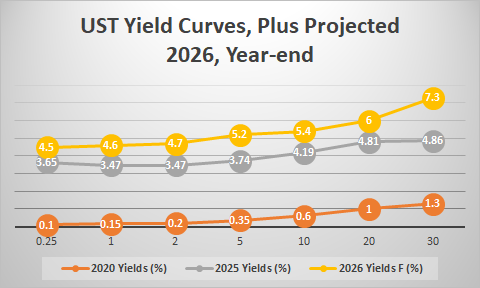
Illustration: U.S. Treasury Yield Curve Shifts
The chart above contrasts the 2025 U.S. Treasury yield curve, which reflects ongoing normalization after the late-cycle volatility of prior years, with a 2026 outlook that is elevated across maturities. Unlike traditional recession signals such as yield curve inversions from earlier periods, current data suggests the curve remains upward-sloping — short-term yields are anchored by policy but long-term yields are driven higher by fiscal pressures, military budget expansion, and increased Treasury issuance. This dynamic results in longer maturities breaking through the ceiling relative to 2025 expectations rather than inverting, reflecting rising term premiums and risk compensation.
The simulation uses recent yield levels — for example, one-year notes near ~3.5% and ten-year notes around ~4.18% as of early January 2026 — as the base for 2025 positioning, and then projects a structurally higher 2026 curve driven by deficit-funded spending and supply pressure.
Interpretation: What the Simulation Is Really Saying
This no longer looks like a call for aggressive risk-taking contrary what made the highest portfolio returns in 2024–2025. It’s a reminder that macro structure dominates micro narratives in 2025–2026.
- Gold and Bitcoin are not “risk-on trades” here; they are confidence hedges.
- Energy provides cash-flow-linked inflation protection.
- TBT is a policy expression, not a timing trade.
The Monte Carlo distribution reflects a market where volatility is absorbed by diversification, not avoided.
Final Thought: The Cost of Credibility in a Repricing World
The defining risk of 2026 is the ongoing broad repricing. Rates, deficits, and credibility now shape asset behavior more than earnings or growth forecasts.
Let me remind that Monte Carlo analysis doesn’t predict outcomes. It reveals where portfolios break, and where they don’t. In this regime, that distinction matters more than ever.
메타데이터
- post_id
- 568bde4f151d
- slug
- usmonte-carlo-outlook-2025-2026-commodities-gold-crypto-and-u-s-568bde4f151d
- url
- https://medium.com/@volony/usmonte-carlo-outlook-2025-2026-commodities-gold-crypto-and-u-s-568bde4f151d
- canonical_url
- https://medium.com/@volony/usmonte-carlo-outlook-2025-2026-commodities-gold-crypto-and-u-s-568bde4f151d
- author_url
- https://medium.com/@volony
- status
- ok
- fetched_at
- 2026-06-15 20:49:13