The Day the Border Appeared Overnight: A Story of the Partition of India (1947)
On the evening of August 14, 1947, twelve-year-old Amina stood outside her family’s home in Lahore. The streets were unusually quiet…
The Day the Border Appeared Overnight: A Story of the Partition of India (1947)
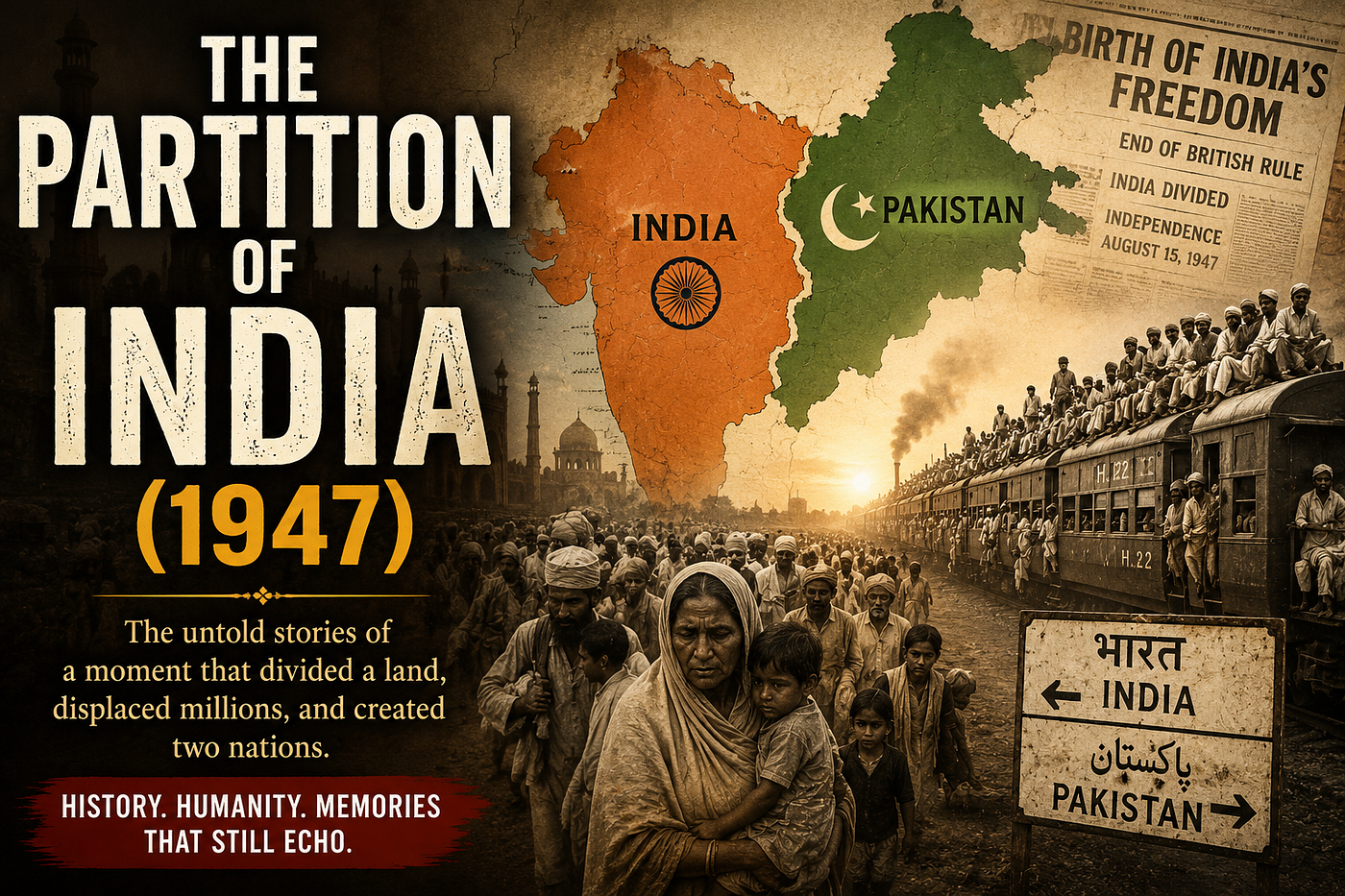
On the evening of August 14, 1947, twelve-year-old Amina stood outside her family’s home in Lahore. The streets were unusually quiet. Earlier that day, people had celebrated the birth of a new nation. Flags fluttered in the warm summer breeze, and hopeful voices echoed through the neighborhood.
But inside her home, no one was celebrating.
Her father carefully folded family photographs into a small wooden box. Her mother packed clothes, a few cooking utensils, and a worn copy of the Holy Quran. There was no room for furniture, jewelry, or the house that had belonged to the family for generations.
“We’ll come back in a few weeks,” her father whispered, more to comfort himself than anyone else.
He was wrong.
The next morning, their neighborhood had changed forever.
Rumors spread that violence had reached nearby villages. Families who had once shared meals and celebrated festivals together suddenly feared one another. Crowds gathered in the streets. Shops closed without warning. People began leaving with whatever they could carry.
No one knew exactly where the new border would fall.
No one knew whether their home would become part of India or Pakistan.
No one knew if they would ever return.
For millions of people in 1947, history wasn’t something they read in books.
It arrived at their doorstep.
The Partition of British India remains one of the largest and most heartbreaking human migrations in history. More than fifteen million people crossed newly created borders, while an estimated one to two million lost their lives in the violence that followed.
Yet behind every statistic was a person.
A father who never reached home.
A mother searching for her children.
A train that arrived full of silence instead of passengers.
For nearly two centuries, Britain ruled much of the Indian subcontinent. The region was incredibly diverse, home to hundreds of languages, cultures, and religious communities, including Hindus, Muslims, Sikhs, Christians, Buddhists, Jains, and many others. Despite their differences, millions lived side by side for generations, sharing markets, neighborhoods, and traditions.
As the twentieth century progressed, demands for independence grew stronger. Many leaders dreamed of ending British rule, but they disagreed about what the future should look like.
Some believed one united country could represent everyone.
Others feared that religious minorities would not receive equal political protection in an independent nation.
Years of political negotiations, mistrust, and increasing communal tensions made compromise increasingly difficult.
By 1947, British leaders had decided to leave India.
The question was no longer whether independence would come.
It was how.
The answer changed the lives of millions almost overnight.
A new boundary, later known as the Radcliffe Line, divided the provinces of Punjab and Bengal. Villages, farms, railway lines, and even families suddenly found themselves separated by an international border.
In many places, people went to sleep in one country and woke up in another.
Imagine living in a town where your closest friend belongs to a different religious community. You’ve grown up together, attended each other’s weddings, and helped each other’s families during difficult times.
Then, almost overnight, fear replaces trust.
Rumors spread faster than facts.
Neighbors begin leaving.
Crowds become angry.
The familiar streets of your childhood suddenly feel dangerous.
That was the heartbreaking reality for countless ordinary people.
Some families walked hundreds of kilometers under the scorching summer sun. Others traveled by overcrowded trains packed far beyond capacity. Many carried only a small bag containing clothes, family photographs, and religious books. Everything else — their homes, businesses, farmland, and memories — was left behind.
For those who survived the journey, reaching safety did not mean the suffering was over.
Refugee camps quickly filled with exhausted families. Food was limited. Clean water was scarce. Diseases spread easily. Parents searched desperately for missing children, while volunteers worked day and night to provide shelter and medical care.
Despite unimaginable hardship, stories of extraordinary kindness also emerged.
In many towns, people risked their own lives to protect neighbors from different religious communities. Some hid families inside their homes until it was safe for them to escape. Others escorted frightened children across dangerous roads or shared their last pieces of bread with complete strangers.
These acts of humanity remind us that history is never only about conflict.
It is also about courage.
Today, the Partition of 1947 continues to shape the identities of India, Pakistan, and Bangladesh. Millions of families still remember the villages their grandparents left behind. Old letters, faded photographs, and family stories keep those memories alive across generations.
For younger people, Partition may seem like a chapter in a history textbook.
For many families, it is still a personal memory.
Grandparents recall the train journeys.
Parents remember the stories they heard as children.
The pain, hope, loss, and resilience have been passed from one generation to the next.
The Partition teaches a timeless lesson.
Political decisions are often discussed through maps, speeches, and official documents.
But their true impact is measured in human lives.
Borders can divide land in a single day.
Healing hearts can take generations.
As we look back on 1947, we should remember not only the leaders who negotiated independence but also the ordinary men, women, and children who carried the greatest burden of history.
Their stories remind us that peace, understanding, and compassion are among the most valuable things any society can protect.
History is not simply about the past.
It is a mirror that reflects the choices we make today — and the future we create for tomorrow.
메타데이터
- post_id
- 569d2f7ead2d
- slug
- the-day-the-border-appeared-overnight-a-story-of-the-partition-of-india-1947-569d2f7ead2d
- url
- https://medium.com/@hmashort/the-day-the-border-appeared-overnight-a-story-of-the-partition-of-india-1947-569d2f7ead2d
- canonical_url
- https://medium.com/@hmashort/the-day-the-border-appeared-overnight-a-story-of-the-partition-of-india-1947-569d2f7ead2d
- author_url
- https://medium.com/@hmashort
- status
- ok
- fetched_at
- 2026-07-09 13:13:48