Progressive Overload Is a Tool, Not a Religion
At some point, “add more weight” stops being wisdom and starts being a dare. Here’s what nobody in the fitness industry wants to admit.
Progressive Overload Is a Tool, Not a Religion
At some point, “add more weight” stops being wisdom and starts being a dare. Here’s what nobody in the fitness industry wants to admit.

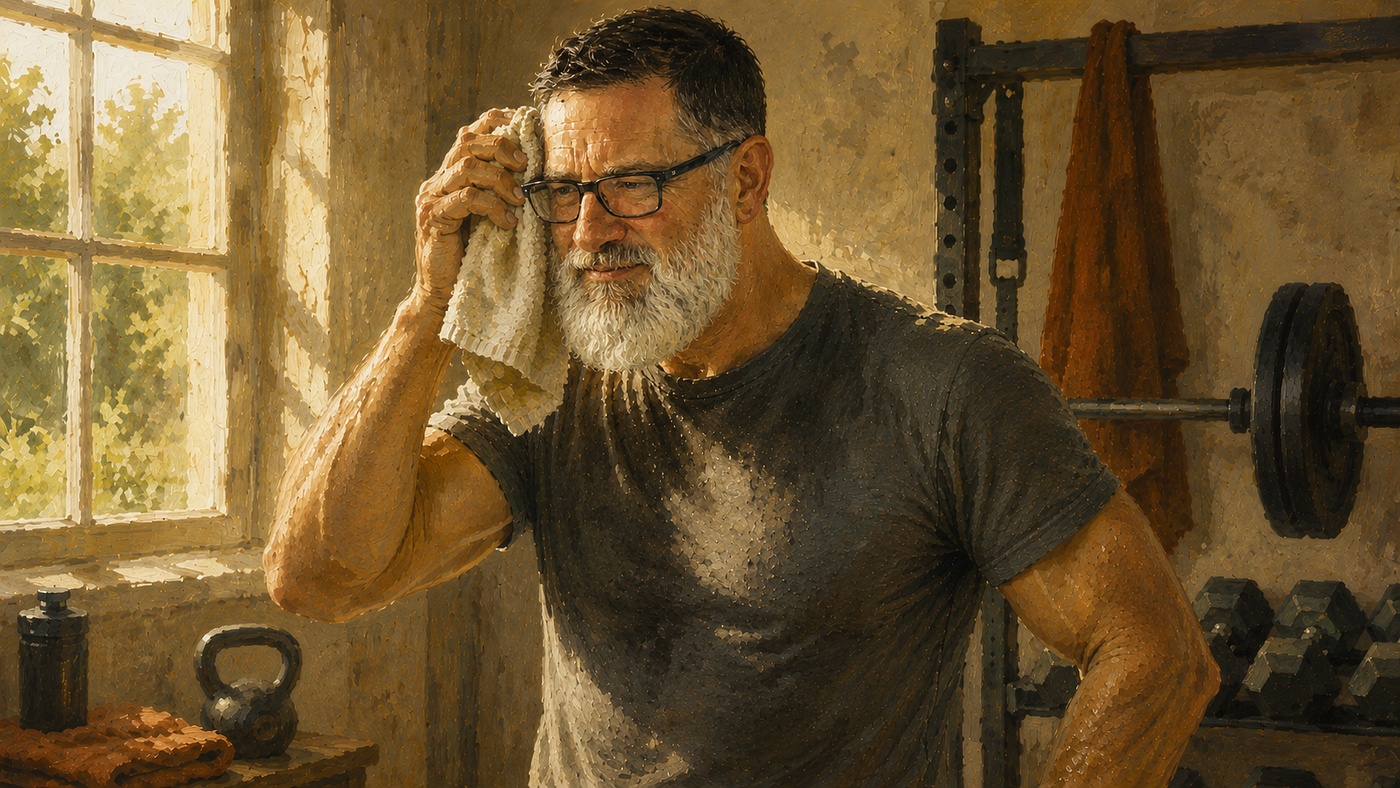
AI image generated of the author by the author. The author is real. The gym is not. :-)
There’s a question I don’t see asked nearly enough, and a loyal reader of mine posed it to me as a follow-up.
I have a question about progressive overload. I know what it is — I read about it constantly. But. It is not possible for a person to continue to endlessly increase weights and/or reps. How come nobody talks about maintenance? At what point do you say okay that’s enough now? I’d like to see an article about that.
Your Wish is my command, Jo …
Everyone talks about progressive overload. Everyone. It’s the foundation of strength training, and honestly, it deserves that reputation. The basic idea is simple: you apply stress to your body, your body adapts, and then you apply a little more stress. Rinse and repeat. That’s how you get stronger.
But here’s the part that gets glossed over: you cannot do this forever.
I’ve been lifting seriously for years now, after spending most of my earlier life running. Half-Ironman triathlons, marathons, more miles than I care to count. When I finally transitioned to the weight room, progressive overload was the framework everyone pointed me toward, and was the basis of my lifting in my football and military days. More weight.
More reps. More volume. Progress is the goal, and progress is always upward.
Except that’s not how the human body actually works. And if you’ve been at this long enough, you already know that.
The Math Eventually Stops Working
Let’s say you add five pounds to your squat every two weeks. That sounds modest. But follow that math out for two years and you’re suddenly squatting an amount that would embarrass a competitive powerlifter half your age. The numbers don’t lie. At some point, the progression has to end.
Your tendons and ligaments don’t adapt at the same rate as your muscles. Your joints have opinions. Your nervous system gets tired in ways that a good night’s sleep doesn’t fully fix. And if you’re over 50, recovery is a different animal entirely than it was at 30. Your body isn’t being difficult. It’s being honest.
The fitness industry doesn’t love talking about this because maintenance doesn’t sell anything. You can’t package it. You can’t launch a “12-Week Maintenance Program” and charge three easy payments for it. There’s no dramatic before-and-after photo when the headline is “stayed exactly the same and felt great about it.”
But maintenance, done right, is one of the most sophisticated things a lifter can do.
What Progressive Overload Was Always Supposed to Be
Here’s something worth remembering: progressive overload was never meant to be a permanent state of escalation. It’s a phase. It describes what happens during the building period, when your body has room to grow. But strength training isn’t one long endless build. It’s a series of cycles, and eventually those cycles level off.
Think of it like the Navy. You advance in rank through performance, testing, time in service. But at some point, most people reach a rank that suits their career, their life, their goals, and they serve effectively at that level for years. Nobody calls that failure. They call it a career.
Lifting works the same way. You build toward a capable, functional, sustainable level of strength. And when you get there, the goal shifts from building to protecting what you’ve earned.
How to Know When You’re There
This isn’t a precise science, and anyone who tells you otherwise is selling something. But there are some honest signals worth paying attention to.
The first one is recovery. If you’re consistently running behind, if your joints are nagging, if you dread training days instead of looking forward to them, you may have pushed past what your body can sustain at progressive load. That’s information, not weakness.
The second is performance plateau. Most lifters hit a natural ceiling where their numbers stall despite doing everything right. Proper sleep, solid nutrition, good programming. The numbers just stop moving. This isn’t always a problem to fix. Sometimes it’s the destination.
The third is life context. If you’re 62 years old and you can squat your bodyweight, press respectable weight overhead, pull from the floor without drama, and carry groceries without thinking about it, congratulations. You’ve arrived somewhere genuinely useful. The question now isn’t “how do I get stronger” but “how do I stay here.”
What Maintenance Actually Looks Like
Maintenance training looks a lot like regular training, which is part of why it confuses people. The difference is in the intent, not necessarily the structure.
You’re still lifting. You’re still training with some intensity. But you’re no longer chasing personal records as the primary metric of success. You’re training to preserve muscle mass, which matters enormously after 50 because sarcopenia, the gradual loss of muscle that comes with aging, is relentless if you don’t push back against it. You’re training to maintain bone density, joint function, balance, and coordination.
You might drop a little volume. You might train three days a week instead of four. You might stop testing your one-rep max on anything, because that particular number stopped being useful information when you weren’t competing anymore.
What you don’t do is quit. Because the research on this is clear: detraining happens fast, especially as we age. The muscle you’ve built doesn’t negotiate. Stop training and it starts leaving.
Permission to Stop Chasing
If you’ve been in the weight room for a few years and you’re wondering when you’re allowed to stop worrying about whether you’re progressing, here’s your answer: whenever the progression stops serving you.
Progressive overload is a tool. A hammer is a great tool. But you don’t keep swinging the hammer after the nail is in. You put it down, look at what you’ve built, and start maintaining it.
The goal was never to keep adding weight forever. The goal was to build a body that serves you well for the rest of your life. If you’ve done that, or you’re close to it, the most intelligent thing you can do is protect it.
That’s not giving up. That’s knowing what you actually came here for.
If this landed somewhere useful for you, Proud Boomer Wellness exists because I got tired of fitness content that treats people over 50 like a problem to solve instead of a demographic that actually knows a few things. A paid subscription is $20 a month or $80 a year, and it keeps this kind of content coming. And if you want the longer version of this philosophy, my book Not Done Yet lays it all out, including how to build strength you can actually sustain. You can find it on Amazon at https://amzn.to/4ed2Td6.
메타데이터
- post_id
- 56bfa9026071
- slug
- progressive-overload-is-a-tool-not-a-religion-56bfa9026071
- url
- https://medium.com/@theProudBoomer/progressive-overload-is-a-tool-not-a-religion-56bfa9026071
- canonical_url
- https://medium.com/@theProudBoomer/progressive-overload-is-a-tool-not-a-religion-56bfa9026071
- author_url
- https://medium.com/@theProudBoomer
- status
- ok
- fetched_at
- 2026-06-12 07:40:50