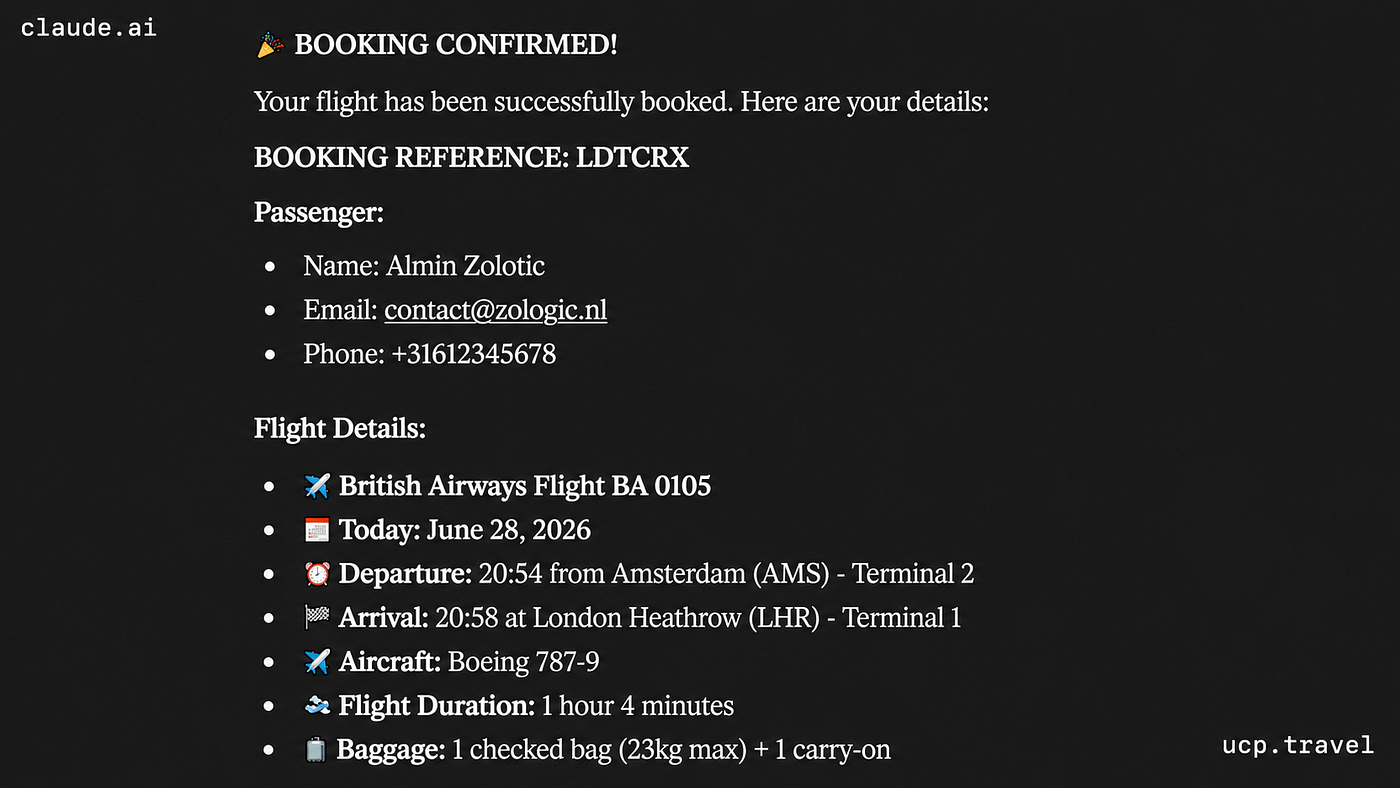
The real bottleneck in travel automation was never the AI. It was the training.
Every conversation about AI and travel booking right now is about capability — can the model find the flight, can it complete the purchase…
The real bottleneck in travel automation was never the AI. It was the training.

Every conversation about AI and travel booking right now is about capability — can the model find the flight, can it complete the purchase, can it handle the edge case. That’s the visible part, and it’s genuinely improving fast.
But it’s not actually what’s been limiting how travel gets sold for the last several decades. The bottleneck was never whether a system could book a flight. It was that booking one, through the systems travel has run on since the 1960s, has always required a human to first learn a command language most people would never otherwise encounter in their lives.
The training cost nobody talks about
Global Distribution Systems — the backend infrastructure airlines, hotels, and travel agencies have used for decades — are not natural-language tools. They’re terminal interfaces driven by short, dense command strings: a few letters to sign in, a few more to check availability, a different sequence entirely to build a reservation, another to issue a ticket. None of it resembles how a person would normally describe what they want.
This isn’t a minor onboarding detail. Commercial GDS certification courses commonly run 45 to 90 hours of dedicated coursework, and that’s just to reach the certification, not real proficiency. Course providers themselves are candid about this: someone new to the industry typically needs weeks to learn the basics and months before they’re genuinely fast and reliable. That’s a real, recurring cost — paid every time an agency hires someone, in salary spent on training and ramp-up before that person is producing at full capacity. It’s a cost baked into the industry’s infrastructure choices, not into the difficulty of travel itself.
Compare that to what a conversational interface actually requires a person to learn: nothing. The entire “training” is describing, in plain language, what you want. That’s not a small efficiency gain. It’s the removal of an entire cost category that’s existed for as long as commercial GDS systems have.
The pricing model is shifting underneath the training model
There’s a second, related shift happening at the same time, and it’s worth separating from the AI conversation entirely because it would matter even without it: travel infrastructure is moving away from per-seat, per-terminal licensing and toward pay-per-transaction APIs.
This mirrors something software has already been through once. Most enterprise software spent decades priced per seat, per license, per workstation — and most of it has since moved toward usage-based pricing, because usage-based pricing aligns what a business pays with what it actually does, rather than with how many people it employs to operate a terminal. Travel distribution is going through the same transition, later than most categories, but unmistakably underway. The platforms built on top of these newer APIs inherit that shift automatically — cost scales with bookings made, not with headcount trained to make them.
This isn’t isolated to travel
The broader commerce industry is restructuring around the same idea right now, and it’s worth situating travel-specific automation inside that wider pattern rather than treating it as a niche development. In the same week this past June, Adyen launched a unified integration layer specifically so merchants don’t have to bet on which agentic commerce protocol wins. Shopify made agent discovery the default setting for every store on its platform, not an opt-in project. SAP endorsed the Universal Commerce Protocol for its enterprise commerce customers. And Target’s checkout went live inside Google’s AI Mode and the Gemini app the same week — a major retail brand completing real transactions through a conversational interface, not a demo of one.
None of that is travel-specific. But it’s the same underlying shift: removing the friction between someone expressing what they want and a business being able to fulfill it, at the protocol and infrastructure layer rather than the application layer. Travel is simply one of the more structurally entrenched categories this is now reaching, given how much of its infrastructure predates the idea of an API at all.
What actually has to be true for this to work
None of this is a case for automation for its own sake. A booking system that removes training and command complexity but introduces silent failure modes — double-booked itineraries, mismatched fare rules, policy violations nobody catches — isn’t actually progress. It’s just moving the error surface somewhere less visible.
That’s the part of this transition that matters more than the convenience story: the systems that win this shift won’t be the ones that are merely fast or merely conversational. They’ll be the ones that took the manual process’s actual failure modes seriously — the things a trained human is implicitly relied on to catch — and rebuilt them as enforced, structural guarantees instead of trained behavior. Budget limits that can’t be silently exceeded. Policy that’s checked before a transaction happens, not audited after the fact. Duplicate transactions that are prevented by the system itself, not by an agent remembering to double-check. That’s a harder, slower thing to build than a chat interface on top of an existing API, and it’s the actual differentiator going forward, not the natural-language layer everyone can see.
“Replacing the training doesn’t mean replacing the diligence,” says Almin Zolotic, founder and CEO of ucp.travel. “A trained agent was quietly doing a dozen careful things every time they booked something — checking a budget, re-confirming a price, catching a duplicate before it became a real charge. If an automated system can’t do those same things, it isn’t actually progress. It’s just a faster way to make the same mistake, with no one left to catch it.”
That’s the layer we’ve been building at Zologic, under the name ucp.travel — not betting on automation as a convenience story, but on rebuilding the guarantees a trained human used to provide, as something the system itself enforces. The training cost and the command complexity were never the point of the old infrastructure. They were just what it took to get a human to reliably do the careful part. The interesting question now isn’t whether AI can book a flight. It’s whether the careful part survives the transition — and that’s the part actually worth building.
We’re building ucp.travel, the policy and safety execution layer for autonomous travel booking. If you’re thinking about similar problems in agentic commerce, we’d like to hear from you — ucp.travel.
메타데이터
- post_id
- 56d10f5d79e2
- slug
- the-real-bottleneck-in-travel-automation-was-never-the-ai-it-was-the-training-56d10f5d79e2
- url
- https://medium.com/@zologic/the-real-bottleneck-in-travel-automation-was-never-the-ai-it-was-the-training-56d10f5d79e2
- canonical_url
- https://medium.com/@zologic/the-real-bottleneck-in-travel-automation-was-never-the-ai-it-was-the-training-56d10f5d79e2
- author_url
- https://medium.com/@zologic
- status
- ok
- fetched_at
- 2026-07-13 19:25:35