In Pursuit of Governing Knowledge
We Did Not Invent Time. We Learned to Measure It. Now Humanity Must Learn to Measure Knowledge.
In Pursuit of Governing Knowledge
We Did Not Invent Time. We Learned to Measure It. Now Humanity Must Learn to Measure Knowledge.
By Santhosh Ragavendra Shekar 25 February 2026
Time existed before man.
Space existed before man.
Nature existed before man.
Knowledge existed before man.
When humanity became conscious of time, it did not create time — it learned to measure it. Calendars did not invent cosmic rhythm; they enabled civilizational coordination.
Similarly, knowledge has always existed — embedded in nature, encoded in biology, expressed through culture, and manifested through human consciousness.
Today, humanity stands at a similar inflection point.
We are transforming knowledge. We are learning to measure it. To structure it. To govern it. To assure it.
This is what we currently call “Knowledge Management.”
Whether that name survives is irrelevant. Future generations will rename it or continue the name as it is !! time will decide.
What matters is this:
Knowledge is the field in which everything arises — mind(thoughts), language, science, art, institutions, economies, belief systems, technologies, constraints, and possibilities.
All knowledge manifests in context:
- In time
- In space
- In circumstance
- In culture
Various Mediums — mind(Human), paper(Physical), digital systems(Digital), Virtual Realities (VR), So. on and so forth.
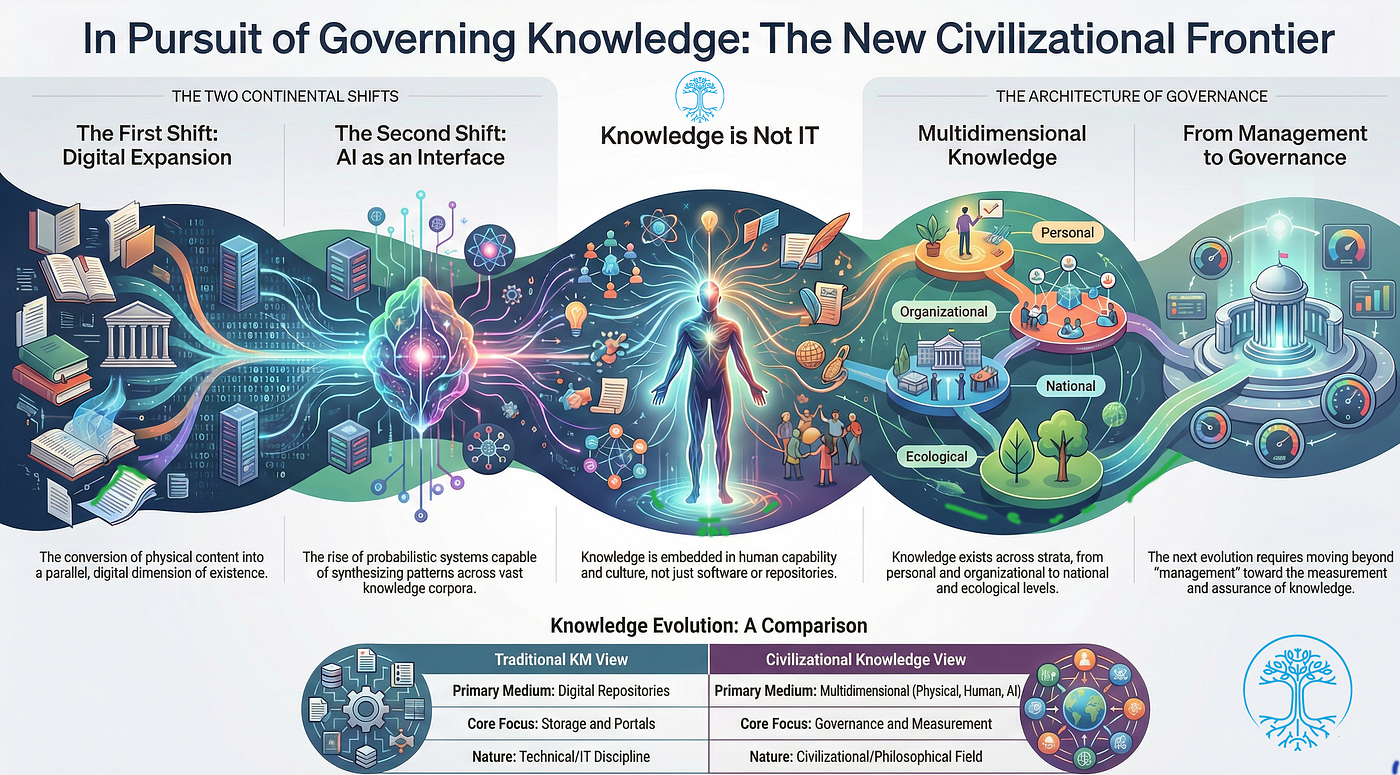
Knowledge Is Not IT — It Never Was
Decades ago, Peter Drucker introduced the idea of the knowledge worker. Michael Polanyi reminded us that “we know more than we can tell,” pointing to tacit knowledge. Ikujiro Nonaka later articulated how knowledge is continuously created through social interaction.
These thinkers made one thing clear:
Knowledge cannot be reduced to information systems.
Yet in practice, Knowledge Management was often interpreted as document repositories, portals, and IT infrastructure.
That interpretation was incomplete.
Knowledge is not software. It is not storage. It is not merely content.
It is embedded in human capability, culture, routines, institutions, and ecosystems.
Recognizing that “KM is not equal to IT” is only the first step.
The First Continental Shift: The Digital Dimension
The transition into the Information Age and the rise of digital transformation movements marked a structural shift in civilization.
Within one generation, physical content was converted into digital form.
Humanity effectively created a parallel informational dimension — a layer of existence beyond physical constraints.
Documents. Transactions. Communication. Memory.
All increasingly migrated into digital environments.
This was not just technological evolution.
It was ontological expansion.
Knowledge gained a new medium of existence.
The Second Continental Shift: AI as Knowledge Interface
The emergence of multimodal conversational AI represents another tectonic shift.
These systems are trained on vast portions of publicly available human-generated data — text, images, code, speech — across languages and domains.
For the first time in history, humanity has built probabilistic systems capable of synthesizing patterns across immense knowledge corpora.
This is not merely automation.
It is the creation of a new knowledge interface.
These two shifts — digitization and AI — have disrupted not only what we knew, but even what we did not know we did not know.
And yet, our frameworks for managing knowledge remain narrow.
Knowledge Across Dimensions
Knowledge must now be understood across dimensions:
- Physical
- Human
- Digital
- Institutional
- Societal
- Ecological
- Unknown Entities

From- “Design Knowledge management System”, Author: Santhosh Shekar
It must also be examined across strata:
- Personal Knowledge
- Team Knowledge
- Project Knowledge
- Organizational Knowledge
- Enterprise Knowledge
- Institutional Knowledge
- National Knowledge
- Humanistic Knowledge
- Nature-embedded Knowledge
Potentially — an infinite series of knowledge entities.
A Civilizational Field, Not a Technical One
This is not merely a technical discipline.
It is a civilizational one.
To approach it responsibly, we must transcend disciplinary silos. We must integrate philosophy, systems thinking, governance, economics, technology, culture, and ecology.
The realization that “Knowledge Management is not equal to IT” was only the beginning.
The next step is governance. The next step is measurement. The next step is assurance.
Humanity learned to measure time. Now, we are In Pursuit of Governing Knowledge
And this moment — right now — is when that architecture must be built.
KnowledgeManagement #KM #ArtificialIntelligence #AI #AIGovernance #KnowledgeGovernance #AIKNowledgeGovernance #KMDefination #AIEthics #AIapplication #AIManagement #AIKNowledgeEnterprises
메타데이터
- post_id
- 56d2fc6496fc
- slug
- in-pursuit-of-governing-knowledge-56d2fc6496fc
- url
- https://medium.com/@santhoshshekar/in-pursuit-of-governing-knowledge-56d2fc6496fc
- canonical_url
- https://medium.com/@santhoshshekar/in-pursuit-of-governing-knowledge-56d2fc6496fc
- author_url
- https://medium.com/@santhoshshekar
- status
- ok
- fetched_at
- 2026-06-21 19:25:17




