From Automation to Advantage: Building Operational Leverage Through Engineering
By Tobias Sjölin, CTO Boozt Fulfilment & Logistics
From Automation to Advantage: Building Operational Leverage Through Engineering
By Tobias Sjölin, CTO Boozt Fulfilment & Logistics
Automation at Boozt began as a way to handle growth, but it has evolved into something much larger. It is now a framework for building long-term efficiency and control through engineering. By combining automation, data intelligence, and in-house software, we have created a system that keeps improving itself and turns technology into a true competitive advantage.
“Automation isn’t the goal. The goal is to create a foundation to support exponential growth.”
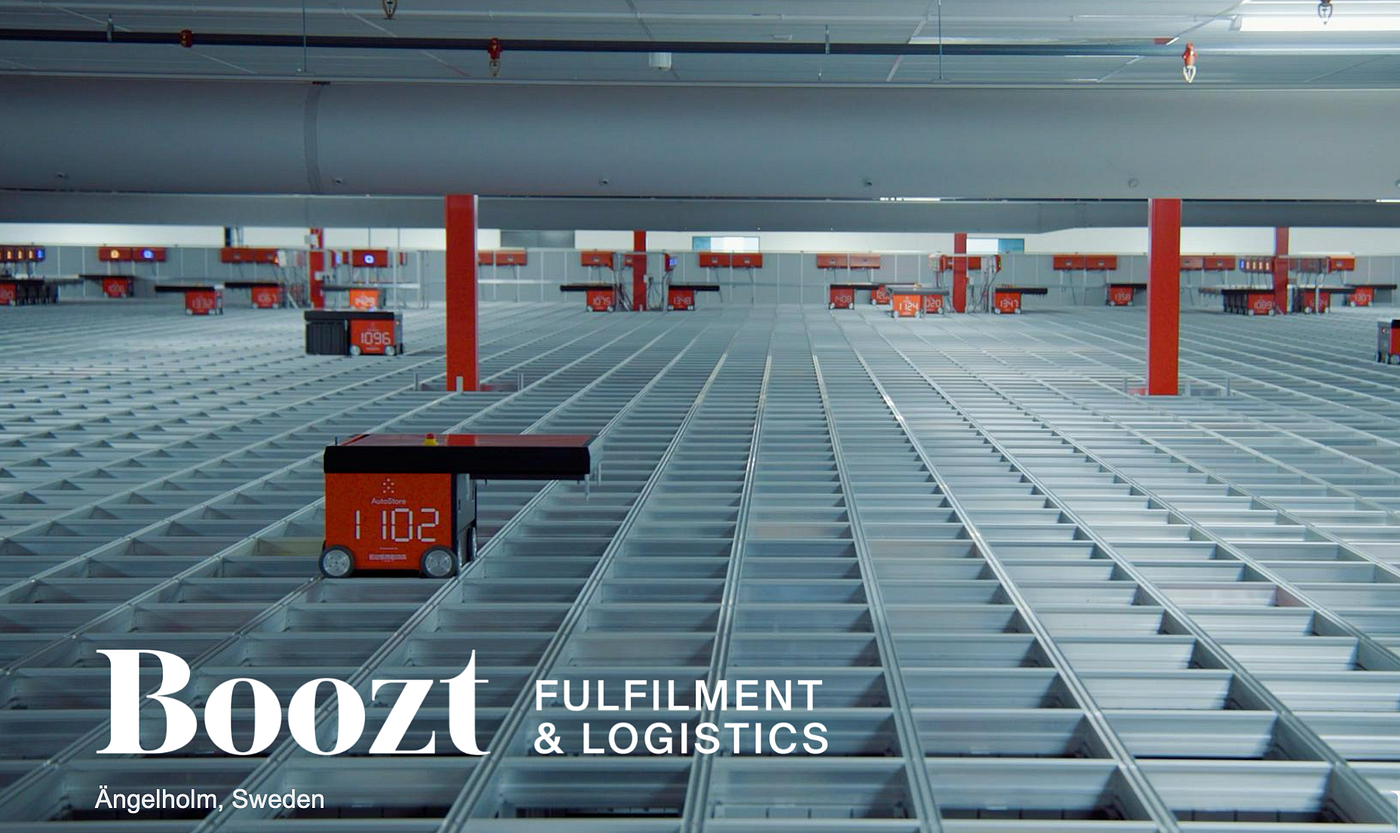
When you walk into the Boozt Fulfilment Centre in Ängelholm, Sweden, it can feel a bit overwhelming at first. The scale, the movement, and the quiet precision of everything happening at once take time to grasp. But that first impression says a lot about what it takes to build and maintain an operation of this size and complexity.
To understand our strategy, you need to know the story behind it. It is a story about technology and iteration, but even more about persistence and a practical mindset. Over time, this mix has turned automation from a helpful tool into a genuine advantage for how we run our business.
[embed]
The Evolution of Automation
Boozt began its automation journey in 2017 with its first AutoStore grid, featuring 131 robots managing 130,000 bins.
Today, that setup has grown to more than 1.2 million bins and over 1,200 robots, making it one of the largest AutoStore systems in the world.
Each expansion has increased capacity, but it has also required us to rethink how new automation connects with both current and future operations. We have learned that automation is never fixed. It is part of a living logistics ecosystem that keeps changing as we grow. Every addition brings new opportunities, but also new challenges.
When those challenges appear, we do not rush to buy more hardware. We look at how to use what we already have in smarter ways. That mindset has been key to keeping our systems efficient, flexible, and ready for what comes next.
Turning Challenges Into Leverage
Going from one AutoStore to two created a new challenge for us, consolidation. As the number of items per order increased, so did the chance that a single order would be spread across multiple grids.
The usual way to handle this is to pick items from both AutoStores and merge them in a separate sorter automation. We did not have the budget or the physical space for that. After many rounds of brainstorming, we realised we could make the AutoStore itself act as the sorter.
We began picking items from one grid and transferring them into the other. Once all items for an order were gathered in the same cube, the system released it to the operator for picking and packing. The outcome was a smaller footprint, a simpler flow, and tighter control of the automation stack.
This way of thinking, improving existing systems instead of adding new ones, became the foundation of what we call operational leverage.

Building a Smarter System, Not a Bigger One
Operational leverage is about reducing cost as volume increases. It ties directly to our strategy on unit economics, where we look at the smallest measurable unit and make sure every step is cost efficient. We achieve this by tuning our systems to deliver more output within the same physical footprint.
For those who read this with a sceptical eye, the manual solution we used earlier for moving items between AutoStores might raise questions. It worked for a while, but it was never meant to be permanent. When we added a third AutoStore, the consolidation volume grew exponentially. At that point, manual transfers were no longer sustainable, so we introduced automation to handle bin movement between cubes.
That new hardware was built to solve a specific problem, but it quickly became more valuable than expected.
- We could now move all orders into one AutoStore grid, allowing us to dedicate one grid to outbound and another to inbound operations, which reduced overhead during off-peak periods.
- We could reposition items to improve future consolidation and reduce unnecessary movement.
- And we could assign specific grids for special goods such as cold storage, items with expiration dates, or products requiring unique handling.
All of this is guided by software logic that continuously decides where to store, move, and pick items in the most efficient way. Each improvement adds to the next. Every software refinement, process adjustment, and automation upgrade builds on what came before and creates more value than its original purpose.
“The most powerful form of growth is when your system gets more efficient the more you use it.”
[embed]
Machine Learning in Motion
Automation alone is powerful, but automation combined with intelligence changes everything.
We have applied machine learning to predict and position inventory where it will be needed most, even before demand appears. By analysing robot movements, order history, and SKU patterns, we can:
- Predict which products are often bought together.
- Reduce unnecessary movements by placing related items closer to each other.
- Prepare fast-moving products in advance for seasonal or campaign peaks.
This is not about replacing human judgment. It is about giving people better insight and support to make decisions that keep the operation running at its best.
Software Control: The Hidden Multiplier
Behind all the physical automation stands Boozt’s own software platform, built and maintained by more than 175 developers across five tech hubs.
Owning the full stack gives us full control of performance, data, and the customer experience.
This independence allows us to:
- Integrate new automation ideas directly into daily operations.
- Experiment with machine learning models without relying on external vendors.
- Continuously adapt the system as conditions change.
Having control of our data also lets us turn it into intelligence through our own AI algorithms.
At Boozt, we do not just use software. We build it because we want to own and control all core technology and the data that drives it.

Tobias Sjölin, CTO Boozt Fulfilment & Logistics
AI Everywhere, but with Purpose
There is a lot of talk about the need to focus on AI. Considering what we have covered in this article, the better question for us at Boozt is this:
How can we create more value with what we already have?
AI becomes meaningful when it improves real operations, whether that is personalisation, forecasting, resource planning, or digital twins.
But the foundation remains the same:
- Business value comes first.
- Data control is non-negotiable.
- Quality matters more than scale.
Our philosophy is simple. AI is only as good as the operational problem it solves.
The Compound Effect of Smart Investments
Every great automation project should deliver more than its original business case. That is how we measure success.
At Boozt, we invest in automation, but we create value through software control, data intelligence, and continuous refinement. Each grid, robot, and software update strengthens the next, creating a system that grows more efficient and capable over time.
Operational leverage, at its core, is about making every new unit of effort both cheaper and more valuable than the one before.
Final Thoughts
Automation is not the end goal. It is the enabler.
What truly matters is how systems, software, and people connect to work in sync, learning from each other, adapting together, and growing in a sustainable way.
Our automation journey began as a response to growth. Over time, it has become a blueprint for how engineering and logistics can create lasting advantage.
In the end, we are not only moving products more efficiently. We are showing that with the right mindset, technology does not just follow growth. It drives it.

#Automation #Engineering #AI #Logistics #Innovation #OperationalLeverage #MachineLearning #WarehouseAutomation #Boozt
메타데이터
- post_id
- 56d3b027ecd2
- slug
- from-automation-to-advantage-building-operational-leverage-through-engineering-56d3b027ecd2
- url
- https://medium.com/boozt-tech/from-automation-to-advantage-building-operational-leverage-through-engineering-56d3b027ecd2
- canonical_url
- https://medium.com/boozt-tech/from-automation-to-advantage-building-operational-leverage-through-engineering-56d3b027ecd2
- author_url
- https://medium.com/@tobiassjolin
- status
- ok
- fetched_at
- 2026-06-10 22:22:12