Post-Quantum Polynomial Mod Operations in C#
Post-quantum algortithms like Kyber for example move away from integer factorisation and discerete logarithms and use lattice based methods…
Post-Quantum Polynomial Mod Operations in C
Post-quantum algortithms like Kyber for example move away from integer factorisation and discerete logarithms and use lattice based methods for generating private/public key pairings.
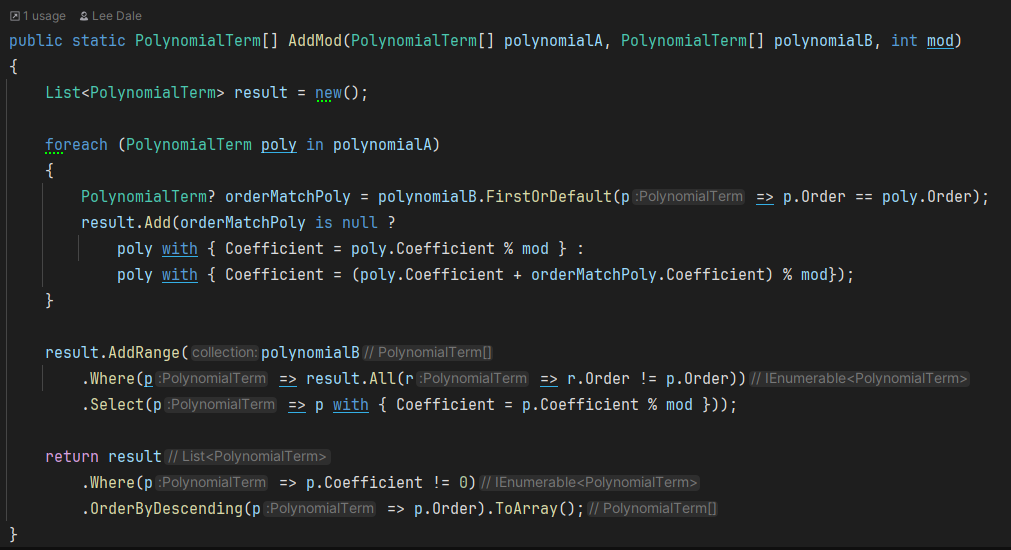
Kyber key generation is based on mod p operations using polynomial add and subtract methods. As a toy exercise, the code below is a simple mod P polynomial add operation in C# and would allow mod P additions of two polynomials.
For a deeper explaination of this head over to the great resources at https://asecuritysite.com/kyber/ and watch the video below.
[embed]
namespace QuantCrypt.Core.Math;

public record PolynomialTerm(int Coefficient, int Order);

public static class PolynomialOperations
{
    public static PolynomialTerm[] AddMod(PolynomialTerm[] polynomialA, PolynomialTerm[] polynomialB, int mod)
    {
        List<PolynomialTerm> result = new();

        foreach (PolynomialTerm poly in polynomialA)
        {
            PolynomialTerm? orderMatchPoly = polynomialB.FirstOrDefault(p => p.Order == poly.Order);
            result.Add(orderMatchPoly is null ?
                poly with { Coefficient = poly.Coefficient % mod } :
                poly with { Coefficient = (poly.Coefficient + orderMatchPoly.Coefficient) % mod});
        }

        result.AddRange(polynomialB
            .Where(p => result.All(r => r.Order != p.Order))
            .Select(p => p with { Coefficient = p.Coefficient % mod }));

        return result
            .Where(p => p.Coefficient != 0)
            .OrderByDescending(p => p.Order).ToArray();
    }
}
using QuantCrypt.Core.Math;
namespace QuantCrypt.Core.Tests;
public class MathTests
{
[Fact]
public void ModPolynomial_Add_Successful_Test()
{
// Arrange
PolynomialTerm[] polynomialA = new[]
{
new PolynomialTerm(2, 4),
new PolynomialTerm(3, 3),
new PolynomialTerm(10, 1),
new PolynomialTerm(3, 0)
};
PolynomialTerm[] polynomialB = new[]
{
new PolynomialTerm(3, 5),
new PolynomialTerm(14, 3),
new PolynomialTerm(10, 1),
new PolynomialTerm(4, 0)
};
// Act
PolynomialTerm[] actualResult = PolynomialOperations.AddMod(polynomialA, polynomialB, 17);
// Assert
PolynomialTerm[] expectedResult = new[]
{
new PolynomialTerm(3, 5),
new PolynomialTerm(2, 4),
new PolynomialTerm(3, 1),
new PolynomialTerm(7, 0)
};
expectedResult.OrderByDescending(p => p.Order);
Assert.True(expectedResult.SequenceEqual(actualResult));
}
}You can see the full code at https://github.com/leedale1981/infosec/tree/master/Cryptography
메타데이터
- post_id
- 56ec8fbbb78d
- slug
- post-quantum-polynomial-mod-operations-in-c-56ec8fbbb78d
- url
- https://medium.com/@lee-jdale/post-quantum-polynomial-mod-operations-in-c-56ec8fbbb78d
- canonical_url
- https://medium.com/@lee-jdale/post-quantum-polynomial-mod-operations-in-c-56ec8fbbb78d
- author_url
- https://medium.com/@lee-jdale
- status
- ok
- fetched_at
- 2026-06-25 07:00:49



