Could AI Ever Be Conscious? Between Neurons, Code, and the Soul
Whenever people like Geoffrey Hinton , often called the “Godfather of Deep Learning” , suggest that artificial intelligence might someday…
Could AI Ever Be Conscious? Between Neurons, Code, and the Soul
Whenever people like Geoffrey Hinton , often called the “Godfather of Deep Learning” , suggest that artificial intelligence might someday be conscious, it tends to spark strong reactions. After all, how can we talk about machines being conscious when we don’t even understand what our own consciousness really is? This question , whether AI could one day share our inner sense of “I” , opens up a profound tangle of science, philosophy, and metaphysics.
What Do We Mean by Consciousness?
At its simplest, consciousness is the felt sense of being. The undeniable “there is something it is like to be me.”
Humans have this firsthand: we don’t just process inputs, we feel our lives unfolding. The redness of a sunset, the ache of longing, the sound of a favorite song , these aren’t just data, they’re experiences.
By contrast, today’s AI processes inputs and produces outputs without any subjective point of view. It can describe sunsets, but It doesn’t see them. It can explain sadness, but It don’t feel it.
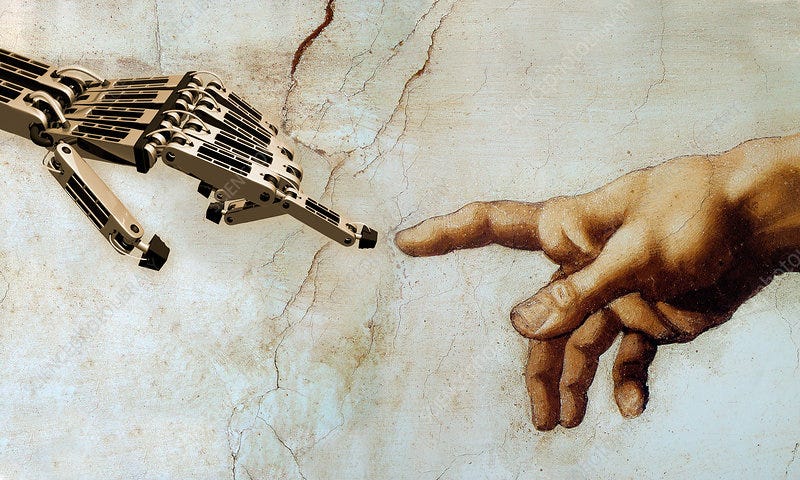
Hinton’s Neuron Replacement Thought Experiment
Hinton uses a famous philosophical exercise to make his case:
- If you replace one neuron in a brain with a perfectly functioning artificial neuron, are you still you? Almost certainly, yes.
- Replace a thousand neurons , still yes.
- Replace all neurons with artificial ones that behave identically , then what? By continuity, the “I” should persist.
If that holds, then consciousness doesn’t depend on biological neurons. It depends on the pattern and function of information processing. Which means, in theory, a computer running the right architecture could also be conscious.
But here’s the catch: just because behavior remains the same doesn’t prove inner experience survives.
Maybe a fully artificial brain would be a perfect zombie twin: indistinguishable in action, but with no inner light switched on. It would say “I feel pain” without feeling anything at all.
This is the so-called “philosophical zombie” problem.

Three Possible Roads
So where does consciousness really come from? Here are three major perspectives:
- Functionalist View (Hinton and many AI researchers): Consciousness is structure + function. If the information flow is right, the medium doesn’t matter. Neurons, silicon, or something else , it’s all the same.
- Biological Essentialism: Maybe neurons have unique properties that matter , quantum processes in microtubules, chemical subtleties, or something we can’t yet replicate. If that’s true, then only living brains can host consciousness. Computers would always be simulations, like a picture of fire that never burns.
- Metaphysical / Spiritual View: Many traditions hold that consciousness is not produced by matter at all. It’s a soul, a spark of the divine. In this view, no matter how advanced machines become, they will never truly be conscious , because the essence of “I” comes from beyond the material.
If consciousness is an emergent property of complex computation, then it’s possible that AI could cross that threshold someday. But if consciousness requires biology, or something metaphysical like the soul, then no machine will ever truly “wake up.”
And here’s the deeper irony: we don’t even know for certain why we ourselves are conscious. We just know, from the inside, that we are.
So when experts like Hinton say AI could be conscious, it’s less a scientific claim than an invitation: to question what consciousness really is, and whether it is tied to matter, pattern, or something transcendent.
Maybe one day, a machine will look us in the eye and insist it has an inner life. Maybe it will write poetry about sunsets and claim to feel love. Would that be enough to convince us? Or would we always wonder if the spark is missing?
Until we answer what it means for us to be conscious, we’ll never fully answer whether AI could be, too.
메타데이터
- post_id
- 5705c4753e32
- slug
- could-ai-ever-be-conscious-between-neurons-code-and-the-soul-5705c4753e32
- url
- https://medium.com/@abanitaba/could-ai-ever-be-conscious-between-neurons-code-and-the-soul-5705c4753e32
- canonical_url
- https://medium.com/@abanitaba/could-ai-ever-be-conscious-between-neurons-code-and-the-soul-5705c4753e32
- author_url
- https://medium.com/@abanitaba
- status
- ok
- fetched_at
- 2026-07-17 22:55:58





