Perfect Crown Hanbok: How the Squid Game Designer Made It Fashion
The costume designer behind Squid Game obsessed over invisible seams. In Perfect Crown, she made hanbok the lead.
Perfect Crown Hanbok: How the Squid Game Designer Made It Fashion
“Korea and the rest of the world are watching the same show. They’re just not watching the same thing.” Want to go deeper into the cultural mechanics behind K-drama’s global rise? KoreAtlas decodes exactly this — the invisible rules, the unspoken context, and the gap between what you see and what Korea actually means. Start here.
Perfect Crown doesn’t look expensive because of the palace. It looks expensive because of the hanbok.
Before viewers fall for the prince, they fall for the silhouette. The curve of a sleeve. A teal sash against white marble. Silk that wrinkles as the actor walks.
Forty-four countries put this show in the Disney+ Top 10, and the world it sells was built with needles, not scripts.
The designer behind those needles is Cho Sang-kyung. Oldboy. The Handmaiden. Squid Game. Two decades of the most iconic visuals in Korean cinema.
This time, she picked up hanbok.
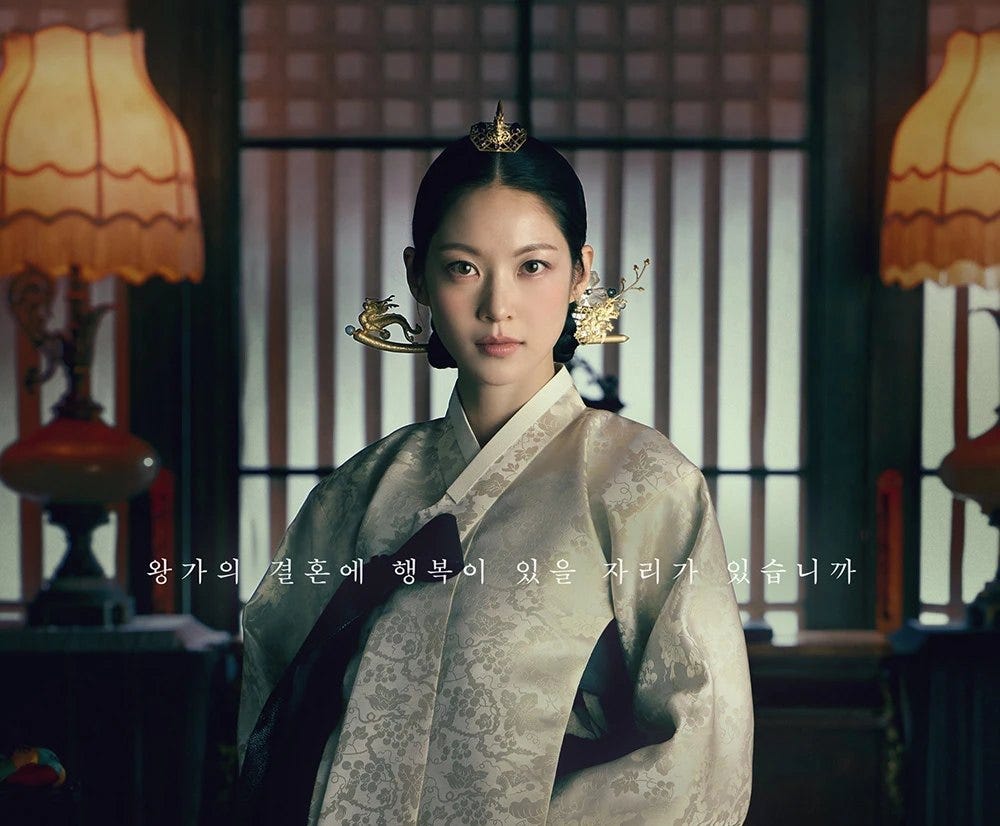
The queen dowager’s hanbok — tradition and modernity in one frame. (Courtesy of MBC)
The Design Philosophy
In a Korea Times interview, Cho laid out her rules. When a scene calls for traditional hanbok, she sticks to tradition. The curve of the sleeves, the hemline, the layered colors of the dangui (royal women’s garments).
She obsesses over the invisible details.
But she also pushed back against what she calls “trendy hanbok.” Too linear. Too body-conscious. That doesn’t fit the dignity of a royal family, she said. What she insisted on was the soft, elegant curves that define real hanbok.
Both hold. That’s what Perfect Crown ‘s wardrobe is.
Even the colors were calculated. She started with Korea’s traditional five cardinal colors and five secondary colors, then calibrated every shade against the actors’ skin tones and how each hue would read on screen.
The teal on Prince I-an’s ceremonial sash was her most carefully chosen tone. Too blue and it goes cold. Too red and it steals focus from the actor.
Some viewers might call it “Tiffany blue.” Cho calls it a deeply Korean color.
Three Scenes, Three Statements
Episode 1: The King’s Birthday Banquet
Prince I-an (Byeon Woo-seok) walks into a royal banquet wearing a cheollik (철릭). The script specified it. He’s just come from a hunt. Quick shower. No time to dress properly.
Here’s what most global viewers miss: a cheollik was traditionally worn under formal robes. Showing up to a banquet wearing only the cheollik is like arriving at a state dinner in your undershirt.
Deliberately underdressed. A little threatening. A little rebellious.
Cho told Korea Times she wanted that first step to show exactly how far this character is willing to go.

Prince I-an’s first entrance in a cheollik — deliberately underdressed for a king’s birthday banquet. (Courtesy of MBC)
Episode 6: The Palace Waltz
Seong Hee-joo (IU) in a chiffon gown. Prince I-an in a military-style uniform. A traditional court banquet and a modern ballroom dance, fused into one scene that pushed the show past 13.4% nationwide.

Chiffon gown meets military uniform — the Episode 6 waltz that hit 13.4% nationwide. (Courtesy of MBC)
Episode 7: The Royal Wedding
Cho’s favorite scene. Full traditional wedding attire. She told Korea Times she usually cares more about the emotions a scene evokes than the clothes. But this one? She wanted the costumes themselves to be beautiful.

Cho Sang-kyung’s favorite scene — full traditional royal wedding attire. (Courtesy of MBC)
THE GAP: Two Audiences, Same Wardrobe
Global fans on Reddit describe the costumes as “quiet luxury,” “not costume, actual fashion,” and “Disney princess vibe.”
Every one of those reactions is accurate. But they’re also incomplete.
Korean viewers know what a cheollik is. They know what dangkogit (collar), gorum (ribbon ties), and magoja (outer jacket) mean individually.
When I-an walks into a royal banquet wearing only a cheollik, Korean audiences instantly read how rude that entrance is.
Global audiences see “cool Korean outfit.”
For global viewers, it’s a look. For Korean viewers, it’s narrative.
The queen dowager’s (Gong Seung-yeon) hanbok is decorated with lace and sequins. Global viewers see “gorgeous.” Korean viewers feel the tension: lace on traditional hanbok?
That tension is what sells the fantasy. The clothes are doing the worldbuilding.
Cho drew a sharp comparison in her interview. Unlike the Chinese qipao or the Japanese kimono, women’s hanbok separates the jeogori (top) and chima (skirt). That separation creates far more room to mix and match.
Drape a jeogori over a sleeveless dress and you get instant hanbok elegance. Wear it loose and open, I-an style, and it reads like a trench coat.
That’s the difference between a costume and a fashion system.
The Cheollik Effect: From Screen to Gyeongbokgung
Perfect Crown ‘s impact didn’t stay on screen.
Days after Byeon Woo-seok’s cheollik went viral, a tourist wearing the same style was denied free admission to Gyeongbokgung palace, Korea Herald reported.
Seoul’s royal palaces offer free entry to visitors wearing hanbok. But the rule requires a jeogori (top) paired with pants or a skirt. A cheollik is a one-piece garment. It didn’t fit the definition.
A visitor in their 30s pushed back publicly, arguing that the image of hanbok shouldn’t be locked into a single form.
The numbers behind this debate are striking. Free hanbok admissions at Seoul’s four major palaces nearly doubled from 1.15 million in 2019 to 1.99 million in 2024.
Dozens of hanbok rental shops line the streets around Gyeongbokgung, Changdeokgung, Changgyeonggung, and Deoksugung. Anyone can rent one and walk the palace grounds for free. Tourists from all over the world. No reservation needed.

Source: Instagram @itssophiemilner
The drama’s hanbok walked off the screen and into the streets. And then it sparked a national debate about what hanbok actually is.
The costume designer’s choice of a cheollik for a fictional prince’s entrance forced Korea to reopen the question of how it defines its own traditional dress.
Korea Heritage Service said it would consider expanding its guidelines in the next revision.
WHY IT LANDS
Perfect Crown is not a hanbok documentary. The plot has holes. The pacing is still divisive.
But the show did one thing no K-drama has done at this scale.
It put hanbok on a runway instead of behind museum glass.
Cho summarized it in one phrase. She wants people to see hanbok as “quiet luxury.” Not loud. Not flashy. Just quietly, unmistakably refined.
The essence of old money — but through hanbok.
Korea’s modern hanbok market was already heading this direction. Daily-wear hanbok ( saenghwal hanbok), neo-hanbok, cheollik-based dresses for women. Brands like Tchai Kim have been translating traditional structures into contemporary silhouettes.
Perfect Crown just carried that movement into 44 million living rooms.
Perfect Crown ‘s hanbok isn’t a costume. It’s living fashion.
And right now, on the streets outside Seoul’s 600-year-old palaces, people are renting hanbok and walking the same stone paths the show’s cameras captured.
The palace on screen and the palace outside the window sit in the same city.
Want to go deeper into the cultural mechanics behind K-drama’s global rise? KoreAtlas decodes exactly this — the invisible rules, the unspoken context, and the gap between what you see and what Korea actually means. Start here.
Originally published at https://koreatlas.com on May 8, 2026.
메타데이터
- post_id
- 5709fdbcf554
- slug
- perfect-crown-hanbok-how-the-squid-game-designer-made-it-fashion-5709fdbcf554
- url
- https://medium.com/@drpj1225/perfect-crown-hanbok-how-the-squid-game-designer-made-it-fashion-5709fdbcf554
- canonical_url
- https://medium.com/@drpj1225/perfect-crown-hanbok-how-the-squid-game-designer-made-it-fashion-5709fdbcf554
- author_url
- https://medium.com/@drpj1225
- status
- ok
- fetched_at
- 2026-06-24 23:31:39





