AI in Pharma Industry: How We’re Implementing AI Across the Drug Development Lifecycle
Artificial intelligence is no longer a future initiative for pharmaceutical companies. Today, the AI in pharma industry is helping…
AI in Pharma Industry: How We’re Implementing AI Across the Drug Development Lifecycle
Artificial intelligence is no longer a future initiative for pharmaceutical companies. Today, the **AI in pharma industry** is helping organizations accelerate drug discovery, improve clinical development, strengthen regulatory compliance, and deliver better patient outcomes. Rather than replacing scientists and healthcare professionals, AI enables them to make faster, more informed decisions using data that would otherwise take weeks or months to analyze.
The pharmaceutical industry generates enormous amounts of information every day, including laboratory research, clinical trials, manufacturing systems, electronic health records, real-world evidence, and post-market surveillance. Turning this growing volume of data into meaningful insights has become one of the industry’s biggest challenges.
This is where AI-powered healthcare is creating measurable value. By combining machine learning, natural language processing, computer vision, and intelligent automation, pharmaceutical organizations can improve efficiency across the entire drug development lifecycle while maintaining scientific integrity and regulatory compliance.
Organizations are no longer asking whether AI belongs in pharmaceutical operations. The focus has shifted toward implementing AI responsibly, integrating it with existing systems, and generating measurable business outcomes.
Why AI in Pharma Industry Is Becoming a Business Priority
Developing a new medicine requires years of research, extensive clinical validation, strict regulatory oversight, and significant financial investment. Every stage generates massive amounts of data that must be reviewed, interpreted, and acted upon quickly.
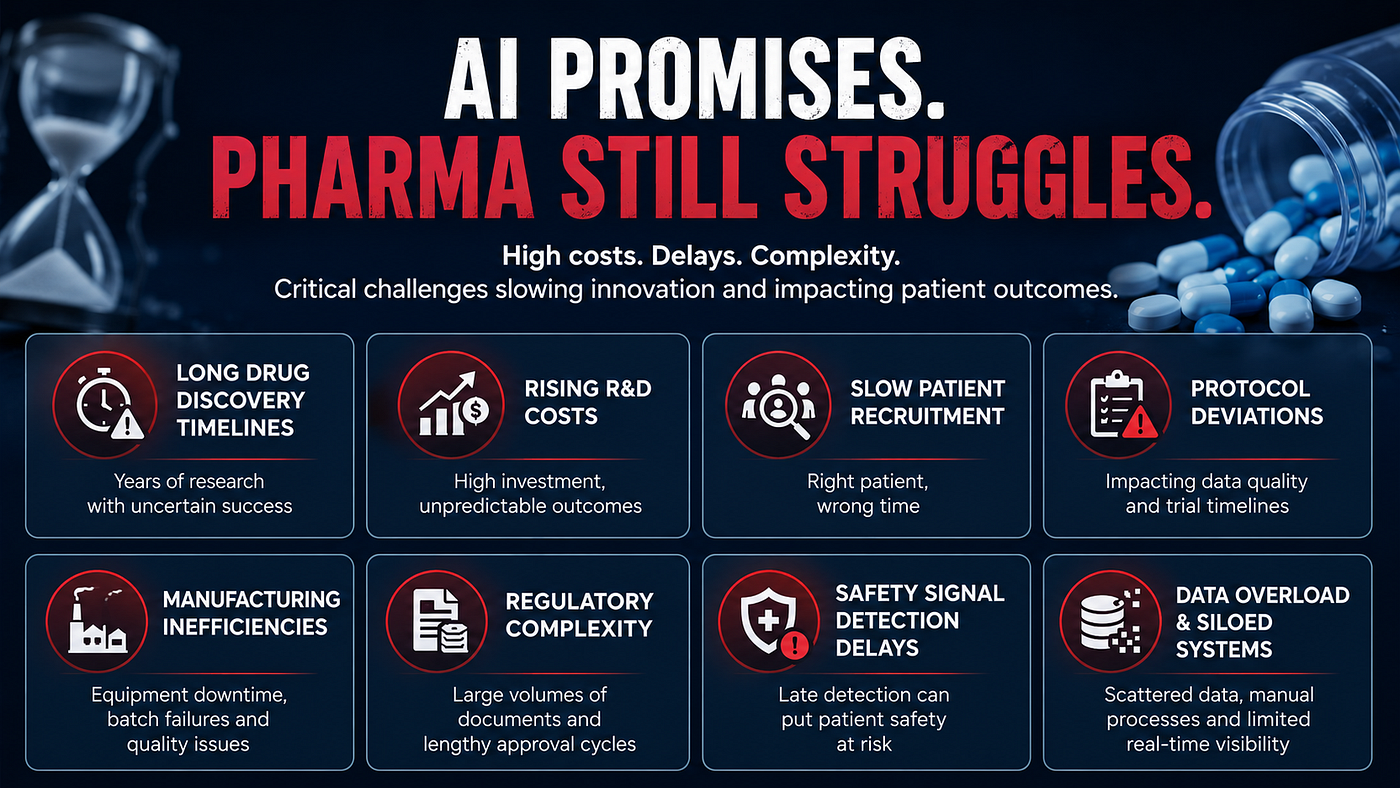
The AI in pharma industry is helping organizations address operational challenges such as:
- Long drug discovery timelines
- Rising research and development costs
- Slow patient recruitment
- Protocol deviations
- Manufacturing inefficiencies
- Regulatory documentation complexity
- Pharmacovigilance workloads
- Increasing volumes of unstructured data
Instead of relying solely on manual processes, pharmaceutical companies are using AI to improve decision-making, reduce repetitive work, and support researchers with data-driven insights throughout product development.
Accelerating Drug Discovery with AI-Powered Healthcare
Drug discovery has traditionally involved screening millions of compounds before identifying a handful of promising candidates. This process often requires years of laboratory work and significant investment.
Modern **AI-powered healthcare** platforms analyze molecular structures, protein interactions, genomic information, scientific literature, and biological pathways at remarkable speed. Researchers can identify potential drug targets earlier, evaluate candidate molecules more efficiently, and prioritize compounds with higher probabilities of success.
AI also helps researchers identify relationships that may not be obvious through conventional analysis. By shortening the discovery phase, pharmaceutical companies can focus their resources on therapies with stronger scientific potential and reduce the time required to move promising candidates toward clinical evaluation.
AI Predictive Analytics Solutions Improve Clinical Development
Clinical development involves thousands of patients, investigators, research sites, and operational activities. Small issues can quickly become expensive delays if they are not detected early.
This is where **AI predictive analytics solutions** provide significant value. By analyzing historical and real-time clinical data, AI helps organizations predict operational risks before they affect study performance.
Predictive analytics can help organizations:
- Forecast patient enrollment
- Identify high-risk research sites
- Predict participant dropout
- Detect protocol deviations
- Improve resource allocation
- Optimize study timelines
- Reduce operational delays
Rather than responding after problems occur, clinical teams can take proactive action that improves efficiency and protects study quality.
Improving Patient Recruitment and Retention
Patient recruitment remains one of the biggest reasons clinical trials experience delays.
AI analyzes electronic health records, diagnosis codes, laboratory values, physician notes, genomic information, and eligibility criteria to identify patients who may qualify for clinical studies. This significantly reduces the time required to locate suitable participants while improving recruitment accuracy.
Retention is equally important. AI evaluates attendance history, travel requirements, communication patterns, and patient engagement to identify individuals who may be at risk of leaving a study. Clinical teams can intervene early with personalized communication, scheduling flexibility, and additional support that helps participants remain engaged throughout the trial.
Enhancing Clinical Data Quality
Clinical trials generate millions of structured and unstructured data points. Reviewing every record manually consumes valuable time and increases operational costs.
AI continuously monitors incoming study data to identify:
- Missing information
- Duplicate records
- Inconsistent entries
- Laboratory abnormalities
- Unexpected trends
- Protocol deviations
- Data quality concerns
Automated reviews allow clinical data managers to concentrate on records requiring expert attention. This improves overall data quality while reducing database cleaning and review cycles.
Detecting Safety Signals Earlier
Patient safety remains the highest priority throughout clinical development.
AI continuously evaluates adverse event reports, laboratory findings, wearable device data, imaging studies, vital signs, physician observations, and clinical narratives to detect unusual patterns that may indicate emerging safety concerns.
Earlier identification allows pharmacovigilance teams to investigate potential issues faster, improve patient protection, and support regulatory reporting with greater confidence.
AI Predictive Analytics Solutions Improve Pharmaceutical Manufacturing
Manufacturing consistency is essential for delivering safe and effective medicines.
Modern AI predictive analytics solutions monitor production systems in real time to identify equipment performance issues, process variability, environmental conditions, and quality deviations before they affect manufacturing output.
AI supports pharmaceutical manufacturing by improving:
- Predictive maintenance
- Batch quality
- Production scheduling
- Inventory planning
- Supply chain forecasting
- Equipment utilization
- Quality assurance
By identifying operational risks earlier, manufacturers can reduce downtime, minimize waste, and improve production reliability.
Simplifying Regulatory Operations
Regulatory teams manage thousands of pages of documentation throughout every product’s lifecycle.
Protocols, investigator brochures, clinical study reports, informed consent documents, safety reports, and regulatory submissions require careful review before approval.
Generative AI assists regulatory professionals by:
- Summarizing lengthy documents
- Comparing document versions
- Identifying inconsistencies
- Highlighting missing information
- Supporting literature reviews
- Improving document quality
Human experts remain responsible for regulatory decisions. AI simply reduces repetitive administrative work and accelerates document preparation and review.
AI Chatbots Advance Healthcare For Patients and Providers
Another important application of AI-powered healthcare involves intelligent conversational assistants. Today, **AI Chatbots Advance Healthcare For Patients and Providers** by improving communication, accessibility, and patient engagement throughout the healthcare journey.
Patients can receive immediate answers to common questions, medication reminders, appointment notifications, and guidance during clinical trial enrollment. This improves access to information while reducing waiting times for routine support.
Healthcare providers also benefit from AI chatbots. These systems assist with appointment scheduling, patient education, documentation support, frequently asked questions, and communication between clinical teams and research participants. Administrative workloads decrease, allowing healthcare professionals to spend more time delivering patient care.
As conversational AI continues to mature, chatbots will become an increasingly valuable component of pharmaceutical services and patient engagement strategies.
Supporting Personalized Medicine
Every patient responds differently to treatment.
AI analyzes genomic information, biomarkers, disease progression, treatment history, and clinical outcomes to identify patient populations that are most likely to benefit from specific therapies.
This approach supports precision medicine by helping researchers develop more targeted treatments while improving clinical outcomes and reducing unnecessary interventions.
Personalized medicine represents one of the most promising long-term applications of the AI in pharma industry, allowing therapies to become more effective for individual patients.
Building Responsible AI in Pharmaceutical Organizations
Successful AI adoption requires more than advanced algorithms. Pharmaceutical organizations must ensure that AI systems remain transparent, secure, validated, and compliant with global regulatory expectations.
Successful implementation depends on:
- FDA and EMA compliance
- ICH-GCP adherence
- Data privacy and cybersecurity
- Explainable AI models
- Human oversight
- Continuous model validation
- Ethical AI governance
- Integration with existing enterprise systems
Organizations that balance innovation with governance will be better positioned to scale AI across research, development, manufacturing, and commercial operations.
The Future of AI in Pharma Industry
The future of the AI in pharma industry extends far beyond individual use cases. Artificial intelligence is becoming a foundational capability that connects research, clinical development, manufacturing, regulatory affairs, supply chain operations, and patient engagement into a more intelligent operating model.
As AI-powered healthcare continues to evolve, pharmaceutical companies will increasingly depend on AI predictive analytics solutions to forecast operational risks, improve decision-making, optimize clinical development, and accelerate innovation. At the same time, AI Chatbots Advance Healthcare For Patients and Providers by improving communication, increasing accessibility, and delivering faster support throughout the patient journey.
Organizations that achieve the greatest success will not simply adopt more AI technologies. They will implement AI strategically, combining advanced technology with scientific expertise, regulatory discipline, and operational excellence to create sustainable business value.
Final Thoughts
Artificial intelligence is changing every stage of pharmaceutical innovation. From drug discovery and clinical trials to manufacturing, regulatory operations, pharmacovigilance, and patient engagement, the AI in pharma industry is helping organizations improve efficiency, strengthen compliance, and make faster, data-driven decisions.
The greatest opportunities lie in combining intelligent automation with experienced researchers, clinicians, and operational teams. When implemented responsibly, AI-powered healthcare, AI predictive analytics solutions, and AI Chatbots Advance Healthcare For Patients and Providers will continue to shape a pharmaceutical industry that is more efficient, more connected, and better equipped to deliver life-changing therapies to patients around the world.
메타데이터
- post_id
- 5718c7080716
- slug
- ai-in-pharma-industry-how-were-implementing-ai-across-the-drug-development-lifecycle-5718c7080716
- url
- https://medium.com/@aimobileappdevelopment/ai-in-pharma-industry-how-were-implementing-ai-across-the-drug-development-lifecycle-5718c7080716
- canonical_url
- https://medium.com/@aimobileappdevelopment/ai-in-pharma-industry-how-were-implementing-ai-across-the-drug-development-lifecycle-5718c7080716
- author_url
- https://medium.com/@aimobileappdevelopment
- status
- ok
- fetched_at
- 2026-07-19 00:45:20