10 Daiso Items That Changed How I Organize My Home
Ten items from Daiso that bring Japanese minimalism into everyday life — practical, affordable, and rooted in teinei na kurashi.
10 Daiso Items That Changed How I Organize My Home
[The 100-yen store secret that Japanese women have known for decades]
Originally published in Quiet & Simple Japan, a weekly Substack newsletter on Japanese minimalism and slow living.
There I was, standing in the organizational aisle of a Daiso in Sydney, jet-lagged and slightly overwhelmed, when something shifted. I reached for a small plastic tray – the kind with three neat compartments – and felt my shoulders drop. I knew this tray. I had owned this exact tray in my apartment in Kyoto, where it lived on my bathroom shelf holding cotton rounds, hair ties, and a single lip balm. Nothing remarkable. And yet holding it again felt like running into an old friend on a foreign street. A whisper of the life I had built there, contained in 100 yen of considered plastic.
Why Daiso Is Different
I want to be careful here, because it would be easy to dismiss what I’m about to share as a roundup of cheap finds. That’s not what this is.
Daiso is not about cheap. It’s about precision in the ordinary. Japanese design culture – even at the most everyday level – operates on the belief that a well-made mundane object is a form of respect: for your space, for your time, for yourself. This connects deeply to the philosophy of teinei na kurashi (丁寧な暮らし), which translates loosely as “a careful, attentive way of living.” It doesn’t mean expensive. It means intentional. Every item Daiso makes is engineered to solve one small problem, cleanly and completely. That specificity is the point. That specificity is, in fact, the luxury.
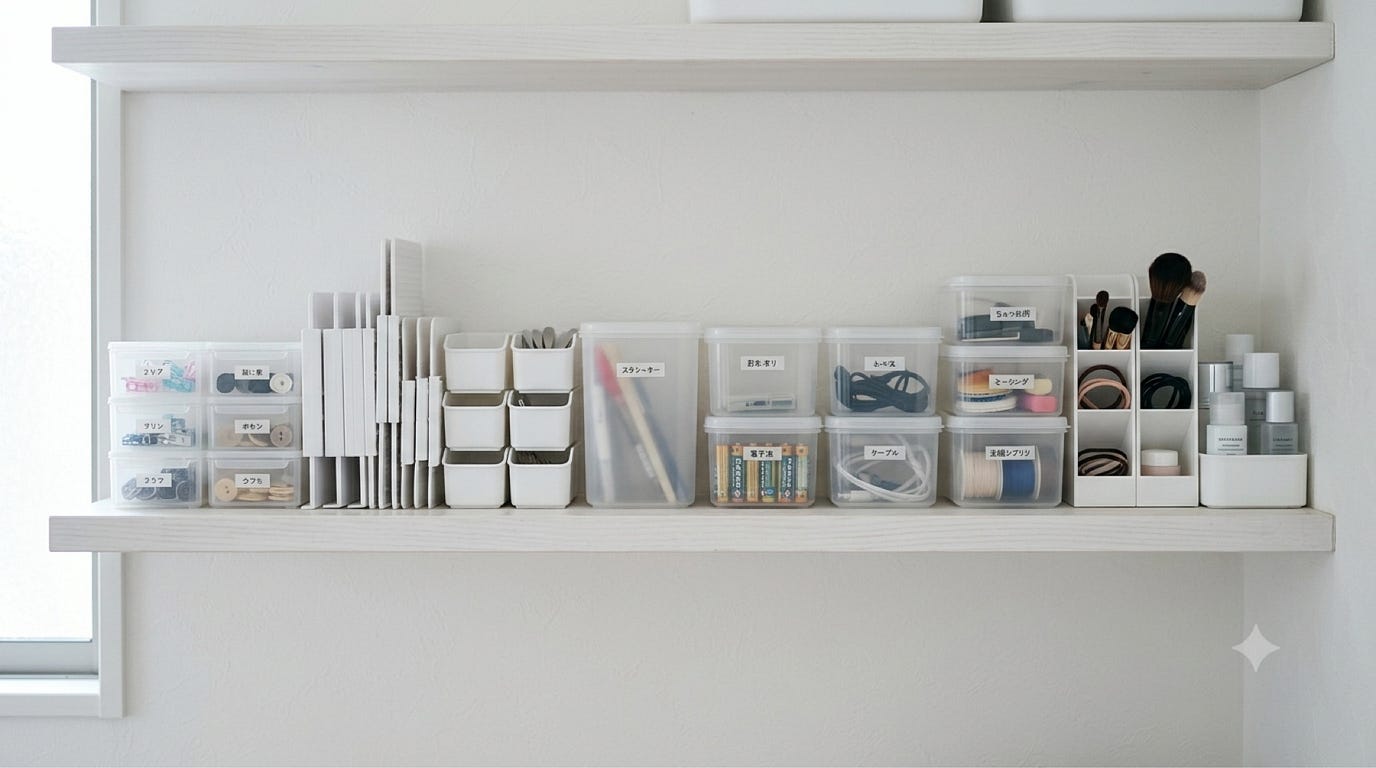
The 10 Items
① Small Organizing Tray – 仕切りトレイ (Shikiri Torei)
Mine lives in the top drawer of my bathroom cabinet. Before it, that drawer was a quiet disaster – lip balm rolling into eyeliner, bobby pins escaping into nothing. The tray has three fixed compartments, slightly deeper than they look, with rounded interior corners that make wiping them clean effortless. I now open that drawer and see exactly what I have. That sounds minor. It has not felt minor.
② Drawer Dividers – 引き出し仕切り (Hikidashi Shikiri)
These are adjustable, which is where they become quietly genius. Two small plastic pieces that tension against each other inside any drawer, creating sections you actually need rather than sections someone guessed you might need. I use them in my kitchen cutlery drawer and my desk drawer. The desk one changed how I work – when your space is clear, your thinking follows.
③ S-Hooks – S字フック (Esu-ji Fuku)
Small, smooth, matte-finished. I have seven of them. Two hang my measuring cups inside a cabinet door. One holds a small basket of dishcloths below the sink. One lives behind the bathroom door holding a robe. S-hooks are the solution to all the things you keep putting down in wrong places because there’s nowhere logical to put them. Give something a home, and it stops becoming a problem.
④ Tension Rods – 突っ張り棒 (Tsuppari Bou)
The Japanese home depends on these. A tension rod requires no drilling, no commitment, no damage to walls – and it creates vertical storage where there was none. I use one inside my under-sink cabinet to hang cleaning spray bottles from their triggers, keeping the cabinet floor completely clear. Another sits across a deep shelf, dividing it into front and back zones so nothing disappears into the back permanently.
⑤ Cloth Wipes – 布巾 (Fukin)
In Japan, the fukin is a kitchen cloth elevated to quiet ritual. Daiso’s version comes in plain white or simple stripes, slightly textured, fast-drying. I replaced all my paper towels with these over the course of one week and never looked back. There’s something about wiping down a counter with a proper cloth – wringing it out, folding it over the tap – that makes the act feel complete rather than just functional. Small ceremony, every evening.

⑥ Ceramic Dish for Keys and Rings – 小皿 (Kozara)
No Japanese name needed – you’ll know it when you see it. A small, shallow ceramic dish in white or pale grey, rough-edged in the way that suggests it was made by hands. Mine sits on the entryway shelf. Keys go there. The ring I take off to cook goes there. It sounds so simple it barely warrants mentioning, and yet the alternative – things scattered, things lost, that low-grade daily friction – is the thing that actually wore me down. One dish. Done.
⑦ Small Broom and Dustpan Set – ほうきとちりとり (Houki to Chiri-tori)
Compact enough for a kitchen corner, precise enough to pick up a single sesame seed (I have tested this). The dustpan lip is rubber-edged, so it lies completely flush against the floor. No debris escapes around the sides. I use this daily and feel something close to satisfaction every time. It is a very small thing to feel satisfied about. I’m claiming it anyway.
⑧ Incense and Holder – お香 (Okou)
Daiso’s incense selection is modest but genuine – cedar, sandalwood, hinoki. The holders are simple, either wooden or ceramic, and catch ash cleanly. I light one when I sit down to read in the evening. The act of lighting it tells my body: this part of the day is different now. Slower. Yours. This is teinei na kurashi at its most direct: a small, intentional signal to yourself.
⑨ Single-Stem Vase – 一輪挿し (Ichirin-zashi)
Ichirin-zashi – literally, “one-flower insert.” The philosophy of Japanese flower arrangement, ikebana, holds that a single stem, placed with attention, says more than a bouquet. Daiso’s version is a narrow glass or ceramic cylinder, minimal and unassuming. I keep mine on the kitchen windowsill with whatever is in season – a sprig of rosemary, one ranunculus, a branch cut from the garden. Proof that abundance is not the point.
⑩ Wooden Tray for Morning Routine – 木製トレイ (Mokusei Torei)
This one changed my mornings. A small rectangular wooden tray – pale, smooth, honest – now holds everything I use before 8am: hand cream, the ceramic ring dish, my vitamins, a small candle. Corralling these objects onto a tray transforms a scatter of things into something that looks deliberate. The tray itself costs almost nothing. What it gives back is a morning that begins with a small sense of order. That order is not nothing.

【My Story】
I should be honest: I cannot point to a single first time with Daiso, because Daiso has simply always been there. Growing up with Japan as my everyday, the hundred-yen shop was as unremarkable as a convenience store – until the day I actually stopped to notice what I was holding.
It was a set of storage baskets and a few kitchen organizers. I bought them expecting the kind of thing you replace in six months, the way you replace anything cheap. They lasted years. That was the moment the penny dropped: this was not about price. This was about design that took the ordinary seriously.
Finding a Daiso abroad felt different – quieter, somehow more significant. The first time I walked into one outside Japan, I felt something I can only describe as recognition. The same white labels. The same measured proportions. The same quiet logic on every shelf. The selection was smaller, the prices higher, and none of that mattered, because the feeling was the same: someone thought carefully about this.
I still do what I suspect many Japan-lovers do: I make Daiso one of my first stops whenever I travel back. I have stood in that organizational aisle with a basket, methodically working through drawer dividers and tension rods and ceramic dishes, knowing that by the time I reach the checkout, my suitcase will be heavier and my home, somehow, will feel more like itself. There are worse problems to have.
For those of us who don’t live near a Daiso, Japanese marketplace apps and international shipping have made it easier than it once was. But if you ever find yourself in Japan, go. Spend an hour. Notice what it feels like to be in a store where even the cheapest things were made with care.
On Tools for Attention
None of these items are luxuries. You can find near-equivalents in IKEA, in thrift stores, in your grandmother’s kitchen drawer. The point is not the brand.
The point is the noticing. Teinei na kurashi is not about owning the right objects – it’s about paying the right attention to the objects you already have. Daiso, at its best, makes that easier. Its items are designed for clarity: one function, done well, nothing extra. They don’t ask you to admire them. They ask you to use them, and in using them, to be a little more present in the ordinary moments that make up most of a life.
In the next letter, I want to take you somewhere smaller still – into the Japanese practice of ma (間), the art of meaningful empty space, and what it might mean for your home and your mind.
Until then, tend to something small today.
片付けは、自分を大切にする行為です。
“Tidying is an act of caring for yourself.”
Come find me there → quietsimplejapan.substack.com
Quietly yours,
Lara
메타데이터
- post_id
- 571ea171982b
- slug
- 10-daiso-items-that-changed-how-i-organize-my-home-the-100-yen-store-secret-that-japanese-women-571ea171982b
- url
- https://medium.com/@misora1102/10-daiso-items-that-changed-how-i-organize-my-home-the-100-yen-store-secret-that-japanese-women-571ea171982b
- canonical_url
- https://medium.com/@misora1102/10-daiso-items-that-changed-how-i-organize-my-home-the-100-yen-store-secret-that-japanese-women-571ea171982b
- author_url
- https://medium.com/@misora1102
- status
- ok
- fetched_at
- 2026-08-08 02:38:30