The Mathematics of Unforgiven Debt: Decoding Japan’s Most Famous Ghost and Her Missing Plate
The Story Behind the Legend
The Mathematics of Unforgiven Debt: Decoding Japan’s Most Famous Ghost and Her Missing Plate
The Story Behind the Legend
Here’s the tale in its simplest form. In the Banchō district of Edo, a samurai named Aoyama Tessan keeps ten precious porcelain plates as a treasured family heirloom. His maidservant, Okiku, is entrusted with their care, but one day, a single plate goes missing — depending on the version, she breaks it, loses it, or is framed for a crime she never committed. Furious, Aoyama tortures her and, in the cruelest tellings, kills her himself before throwing her body down the household well. From that night on, her ghost rises from the water and counts the plates aloud, “One… two… three…” all the way to nine, before the count breaks off into a scream where the tenth plate should be. The plate is never found. The count never finishes. And Okiku, trapped between an unresolved accusation and an uncounted plate, keeps returning, night after night, for centuries.
That’s the shape of the story everyone already knows. What’s worth digging into is why it was built this way — why a missing plate, of all things, could cost a woman her life, and why the specific mechanics of her haunting have kept audiences unsettled for four hundred years.
A Fortune Made of Clay
Every haunted house needs a reason to be haunted, and in the case of Japan’s most famous ghost story, that reason is a stack of dinnerware. Okiku was a maidservant in the household of a samurai named Aoyama Tessan, and one day she was accused of the unthinkable: losing, or perhaps breaking, one of ten precious imported porcelain plates that had been in the family for generations. It sounds like a strangely small crime to build a centuries-old legend on. But in Edo-period Japan, those plates were never just dishes.
Porcelain imported from China or the Netherlands during this era functioned less like tableware and more like gold bars with a glaze on top. Samurai households didn’t eat off these things — they displayed them, guarded them, and used them as collateral in the invisible economy of prestige. A complete set of ten matched plates signaled that a family had reach: trade connections, foreign contacts, the kind of wealth that couldn’t be easily counterfeited. Losing one wasn’t a broken teacup. It was a visible crack in a family’s claim to power, and in a rigidly hierarchical society, visible cracks were dangerous. Okiku’s alleged carelessness wasn’t treated as an accident. It was treated as an act that threatened the entire architecture of her master’s status, and she paid for it with her life — tortured, killed, and thrown down the household well.
The Well That Never Stops Counting
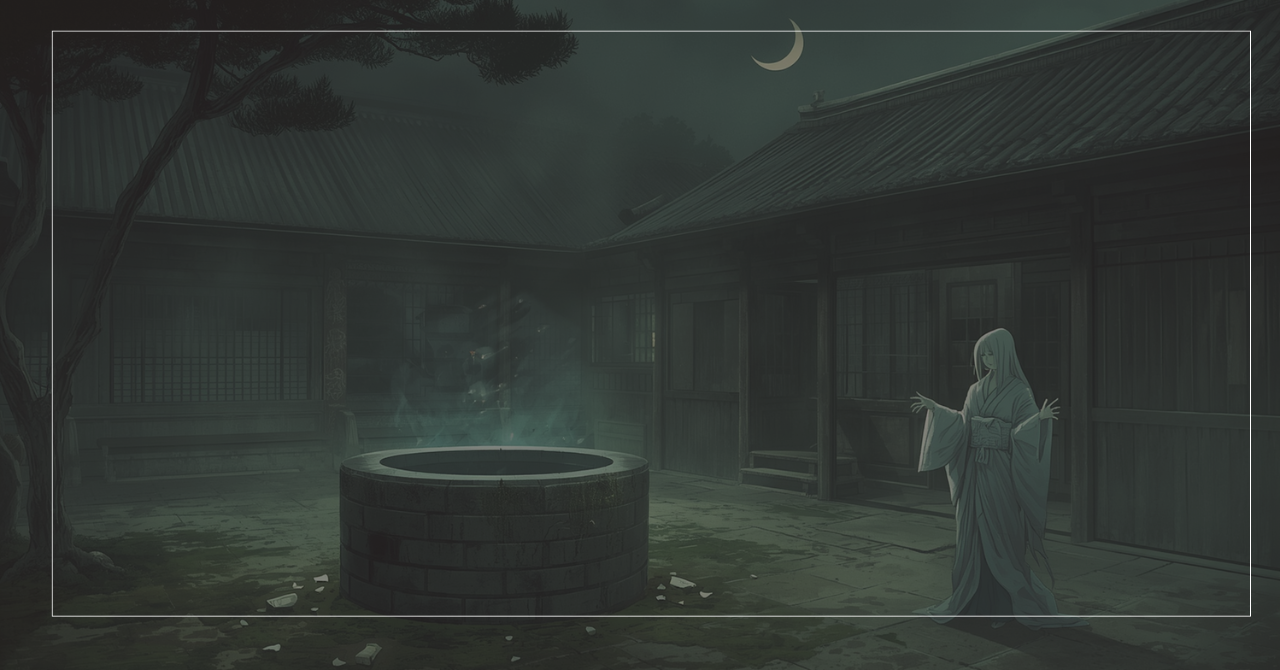
This is where the story stops being a tragedy and becomes something stranger. Okiku’s spirit didn’t move on. Instead, night after night, she rises from the water at the bottom of that well and counts. “One… two… three…” all the way up to nine, and then, instead of the tenth plate, there’s only a wail that echoes through the house.
To understand why this detail is so unsettling to Japanese audiences, it helps to know what a well actually represents in the folk imagination. In Shinto-Buddhist animism, a well isn’t just a hole that produces water — it’s a vertical seam in reality, a direct line running from the ordinary human household straight down into the underworld and the realm of water spirits. It’s already a liminal object before anyone dies in it. Throwing Okiku’s body down there didn’t just dispose of evidence; it opened a permanent channel between the living world and whatever comes after.
And then there’s the counting itself, which is arguably the most psychologically brutal detail in the entire legend. A ghost that screams is frightening in an obvious way. A ghost that conducts a nightly audit — methodically, reliably, always stopping one short — is frightening in a much colder way. Her counting isn’t chaos; it’s arithmetic. It’s an unfinished transaction that refuses to close, an eternal statement of a debt that was never settled and a contract that was never honored, replayed forever because nobody with power was ever forced to make it right.
A Ghost Story Everyone Wanted to Keep Telling
A story this vivid doesn’t stay contained in one household’s well for long, and Okiku’s certainly didn’t. Over the following centuries, her tale migrated out of local rumor and into the biggest entertainment stages of the era — Kabuki theater, Bunraku puppet plays, and eventually the entire modern Japanese horror genre that would later give the world its own catalog of vengeful spirits with unfinished business.
What’s worth noticing is what kind of ghost Okiku became along the way. Japanese spectral folklore rarely produces monsters that destroy at random; far more often, the ghost is a kind of enforcer of memory. Okiku isn’t out to terrorize just anyone unlucky enough to cross her path. She exists specifically because of what was done to her, and her haunting is aimed, however indirectly, at the fact that violence from the upper class against a powerless servant was allowed to happen without consequence. In that sense, these stories work like a cultural filing system, preserving grievances that official records were never going to bother writing down.
The Debt That Outlives the Debtor
Strip away the supernatural elements and what’s left is a strangely modern idea: that some kinds of harm generate a debt so unresolved, so structurally protected from ever being paid, that the only place it can go is folklore. Okiku’s count never reaches ten, and it was never going to. The story isn’t really about a missing plate. It’s about what happens to injustice when the people with power over the outcome are also the people who get to write the official version of events — it goes underground, literally, and it waits.
Shirankedo. That’s a bit of Osaka slang, roughly “who knows, though” — a good-natured way of tossing out a claim while cheerfully refusing to stand behind it.
This article was written with the assistance of AI and edited by the author.
메타데이터
- post_id
- 5737d17b586d
- slug
- the-mathematics-of-unforgiven-debt-decoding-japans-most-famous-ghost-and-her-missing-plate-5737d17b586d
- url
- https://medium.com/@izmeel/the-mathematics-of-unforgiven-debt-decoding-japans-most-famous-ghost-and-her-missing-plate-5737d17b586d
- canonical_url
- https://medium.com/@izmeel/the-mathematics-of-unforgiven-debt-decoding-japans-most-famous-ghost-and-her-missing-plate-5737d17b586d
- author_url
- https://medium.com/@izmeel
- status
- ok
- fetched_at
- 2026-07-28 19:40:03