My Brother’s Assignment
By Robert Leonard Berkowitz
My Brother’s Assignment
By Robert Leonard Berkowitz
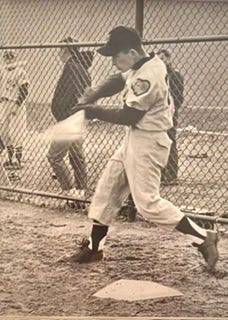
Author at home plate in high school baseball game — Spring 1965
It happened just after I graduated from high school and a few months before I was to begin my freshman year at Rutgers University in the fall of 1965. My older brother Howard and I shared a cramped upstairs bedroom in our modest VA-financed Cape Cod home in the town of West Orange, seven miles west of Newark, New Jersey.
Sometime in the late ’50s or early ’60s my father added a small dormer to the bedroom to make space for a home study for me and my brother. Along two short walls at right angles to each other were two connected desks my father built to my brother’s specifications. His was the longer one with a window view. Mine was far shorter and faced a wall from which hung a tiny bulletin board. On another longer wall my father built two sets of floor-to-ceiling recessed bookcases, also to my brother’s exact specifications — the much wider one designated for Howard and the far narrower one for me.
My brother’s justification for his more spacious accommodations for his “great books” was that he was the serious student and I was, in his words, a “suburban philistine.” There was certainly a degree of justification for the unequal division of the real estate of the study. His intellectual acumen and breadth of knowledge were astonishing, and his library collection staggering in numbers, range of topics, erudition, and contemporary relevance. His library encompassed works across every imaginable field: ancient history, modern and contemporary history, philosophy, anthropology, psychology, science, drama, art, literature, and current affairs. One shelf was almost entirely lined with Will Durant’s multi-volume Story of Western Civilization. Reflecting the intellectual gravitas of his choice of books all were hardback, which consumed far more shelf space than the paperback editions whose flimsy covers and bindings and shorter life expectancy, he contemptuously dismissed as unworthy of the weighty and eternal thoughts they lamely bound.
And then there were the countless magazine subscriptions: The Saturday Review, The New Republic, The Atlantic Monthly, The American Scholar, Daedalus, Commentary, The New Yorker, I.F. Stone’s Weekly to name just a handful — each meticulously stacked with countless back issues in perfectly-aligned rows that took up his bottom two extra-high shelves.
Nature abhors a vacuum and so too did my brother — fiercely so. His treasured acquisitions quickly captured every square inch of his bookshelves, and like a highly-disciplined and single-minded imperial army, unrelentingly and shamelessly colonized mine, which were thinly and meagerly populated by the Encyclopedia Britannica, a Webster’s Dictionary (so I could look up the definition of words like philistine), a Roget’s Thesaurus, and a handful of adventure and sports books gifted to me over the years as birthday presents.
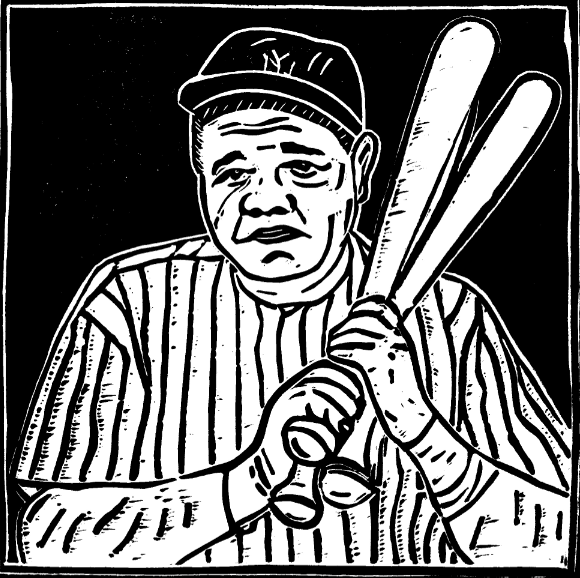
And then there were my several dozen coveted baseball and bowling trophies — including one for winning the prized decathlon at summer camp three years earlier, and another for being the MVP of our high school baseball team. The gold-plated trophies took up most of the space of my dwarf-size bookshelves. However, my brother was firmly of the opinion that sports trophies should not be displayed in bookcases let alone in our house which, borrowing from the title of a book by the esteemed Columbia University Professor Jacques Barzun that sat intimidatingly on the top shelf of his bookcase, he declared to be “The House of Intellect,” and not “The House that Ruth Built.” I was a dyed-in-the-wool Yankee fan who fancied himself the next Mickey Mantle.
In short, if sports trophies were members of a rigid caste society that my brother reigned over as absolute sovereign, they would be ranked at the very bottom of the hierarchical order, stripped of all rights and privileges and designated as untouchable outcasts exiled to a suburban philistine gulag, with me as their curator.
It was June 1965, a week or so after high school graduation. I was working as a lifeguard at a high-rise luxury apartment building in East Orange. When I arrived home one early evening and made my way into the bedroom my jaw dropped. It was as if Ajax’s White Tornado and Proctor and Gamble’s Mr. Clean had teamed up and executed a clean sweep of every item and object on my desk, bulletin board, and ever-shrinking section of my allotted half of the recessed bookshelves. Everything in the middle of my desk had been removed, except a note conspicuously clipped to a New Yorker magazine and prominently displayed.
I could instantly tell the note had been written by my brother. The lettering on the yellow, legal-sized slip of paper was meticulously penned in his rigid and erect handwriting, and inked with a finely-edged black-inked fountain pen — his signature writing implement that he proudly wielded like a medieval lance. The note, which my mother had inexplicably saved, and which I discovered rummaging through her files after her death, began as impersonally and belittling as it ended:
R:
A desk is an area of intellectual stimulation, not a shit heap. As yours has persistently been the latter, this morning I took liberty to make it the former:
I. I cleaned your bulletin board.
II. I cleaned your desk.
III. I stuffed all papers in your drawers [for you to throw out].
IV. I put the high school laurels in the attic trophy box [you’re no longer a kid; you’re a college man].
The desk is now set for serious reading and thinking: sit down and get intellectually stimulated.
H.

Preface to My Brother’s Assignment (Original Note)
Yes, he decimated my bulletin board, desk and bookshelves. The news clippings from local and regional papers of my feats on the ballfield and the numerous athletic award certificates were all removed from my bulletin board. The clutter of paper on my desk — homework assignments, drafts of final papers, and scraps of study notes for my final exams — were stuffed so tightly in my desk drawer that it nearly took a crowbar to open. And to accommodate my brother’s burgeoning collection of high-brow, hardback books, my bookshelves were vacated of every one of my prized-sports trophies.
Then came the imperiously-mandated assignment:
I: Read article beginning pg 60 in the attached New Yorker [“The Ex-Untouchables” by Harold Isaacs].
II: Write the following essay
A: On the conditions of the Untouchables in the past, present, & prospects for the future.
B. Comparing the Untouchables with the American Negro before & after emancipation.
[At least three sides in length]

My Brother’s Assignment (Original Note)
My first instinct was to heave his hundreds of books and neatly-stacked piles of magazines out the dormer window, which conveniently overlooked a concrete platform housing the family refuse bins. However, fear got the better of me and I wisely decided otherwise. My fear was that I would never get past my first year at Rutgers, even though I had consistently made the honor roll in high school, was in the top ten percent of my class, had received early acceptance at Rutgers, and, just weeks before, had gotten a laudatory “A” grade on a twenty-eight-page paper on the Paris Peace Conference of 1919.
What fanned the flames of my fear was that during my junior year in high school, I sat at a lunch table with all seniors, most of whom were quite bright and went on to Rutgers. Half of them never made it past their freshman year. Accordingly, my fear of following in the footsteps of my former high school lunchmates and Rutgers flunkouts got exponentially compounded by the self-doubts fueled by my brother’s lashing note. I was, as far as I was concerned, a doomed college student, and if I failed to get academically serious and smarten-up, I would end up rehabilitating my father’s Jewish deli-on-wheels business, which he had long ago ditched for a more remunerative and less grueling job as a real estate property manager.
After my parents made my brother apologize and retrieve my exiled trophies from our unfinished-attic gulag, I dutifully carried out the assignment, retrieving from my brother’s library the Swedish economist Gunnar Myrdal’s 1944 book An American Dilemma: The Negro Problem and American Democracy, the Fortune magazine editor Charles Silverman’s 1964 book Crisis in Black and White, as well as other research sources, including C. Van Woodward’s The Strange Career of Jim Crow. I also drew on my insights and observations from my experience working in the Congress of Racial Equality’s Newark office as a math tutor.
I have no regrets that I dutifully carried out the assignment. My only regret is that I didn’t gift him one in return. I’ve ruminated over the years as to what such an assignment would be, but none struck a nerve until I recently stumbled on a quote from a 1954 book by Jacques Barzun entitled God’s Country and Mine, and the suitable counter assignment struck like a thunderbolt.
Dear Howard,
I. Write an essay with your beloved razor-sharp black-inked fountain pen reflecting on the following quote by the towering intellectual and Columbia University Professor Jacques Barzun:
“Whoever wants to know the heart and mind of America had better learn baseball.”
II. [At least three sides in length]
III. Swing for the fences!
I look forward to reading your disquisition when I too cross the rainbow bridge and join you once again in the heavenly house of intellect.
Fondly,
Your brother
메타데이터
- post_id
- 574e88653395
- slug
- my-brothers-assignment-574e88653395
- url
- https://medium.com/@rlberko-42995/my-brothers-assignment-574e88653395
- canonical_url
- https://medium.com/@rlberko-42995/my-brothers-assignment-574e88653395
- author_url
- https://medium.com/@rlberko-42995
- status
- ok
- fetched_at
- 2026-07-16 04:20:45