Conviction-Hybrid Oracles: The Settlement Infrastructure Bet Behind the Next Phase of Prediction…
Wintermute’s May 29 move into prediction markets mattered less because it added another liquidity provider, and more because it clarified…
Conviction-Hybrid Oracles: The Settlement Infrastructure Bet Behind the Next Phase of Prediction Markets
Wintermute’s May 29 move into prediction markets mattered less because it added another liquidity provider, and more because it clarified what the sector has become. The firm announced it is now providing two-sided liquidity across event contracts on leading venues and framed prediction markets as a segment that had already surpassed $60 billion in 2026 trading volume, with leading venues collectively doing more than $20 billion per month.
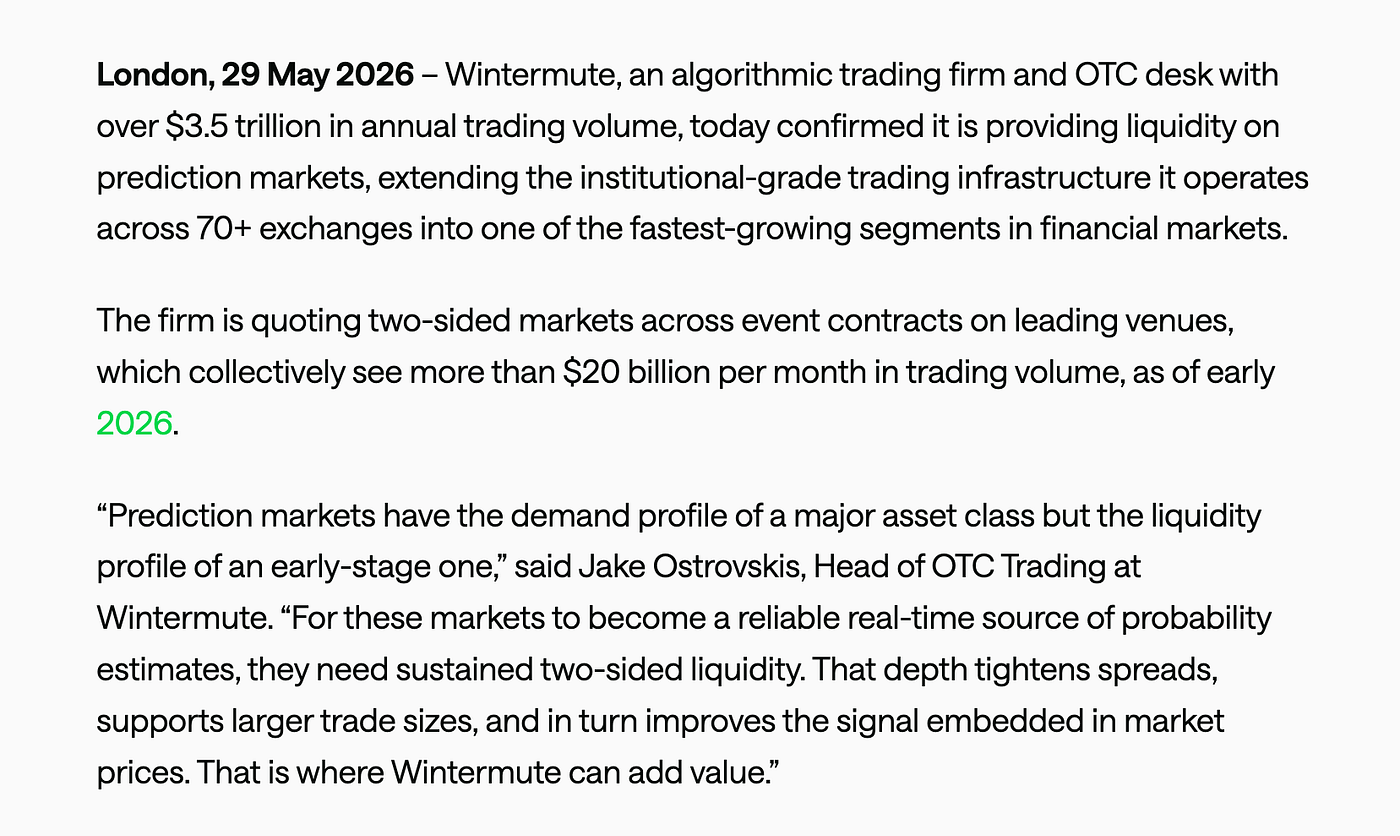
Source: Wintermute, May 29 2026
That is not niche behavior. That is institutional market structure arriving.
Jake Ostrovskis put the problem succinctly: prediction markets have “the demand profile of a major asset class but the liquidity profile of an early-stage one.” He is right, but the next step is to ask why. The lazy answer is “not enough LPs.” The better answer is that LPs will only scale as fast as settlement quality allows. A market maker is happy to warehouse spread risk for seconds or minutes. It is much less happy to warehouse semantic ambiguity, resolution delay, and dispute risk for days.
That distinction matters because the data now says demand is already solved. Combined Kalshi and Polymarket monthly turnover rose from under $5 billion in September 2025 to about $24 billion in April 2026, and the two platforms crossed $150 billion in lifetime volume by April. Institutional observers are reading the same tape: Citadel Securities’ president highlighted the “sound industrial logic” and real hedging use cases, while Bernstein projected roughly $240 billion of 2026 volume and a path to $1 trillion annually by 2030.
So the question is no longer whether event contracts deserve to exist. The question is what part of the stack captures value as they professionalize.
My view is blunt: the next defensible bet is not another front end. It is the settlement layer.
That is why the most interesting subscale case study is not Polymarket or Kalshi, but a challenger like Myriad. Myriad’s current metrics (as of early June 2026) expose the bottleneck clearly: approximately $483k in TVL, ~$3.1 million in 30-day DEX volume, and annualized fees in the low six figures. Those numbers imply activity, but not depth. Monthly notional turnover is more than 11 times TVL, which is evidence of speculative use, not evidence that the platform has solved institutional confidence. The fee profile is also superficially attractive, but fees do not tell you whether professional liquidity will stay through adverse conditions. Settlement quality does.
Myriad is useful precisely because it operates where the hard oracle problem is more visible. Its own documentation and onboarding materials show a product spanning crypto, sports, politics, economy, gaming, and culture, with both CLOB and AMM market types.

Source: DefiLlama, 5 June 2026
That matters because objective markets and subjective markets are not the same business. Myriad has already adopted Chainlink as official oracle infrastructure for its crypto, stock, commodity, and RWA-style markets, explicitly to enable faster, fairer, near real-time payouts.
That should not weaken the oracle thesis. It strengthens it.
It tells us the industry is already bifurcating. Objective, machine-readable outcomes are moving toward high-speed data feeds and orchestration layers. The unresolved frontier is the opposite category: markets where truth is semantic, contextual, contested, or socially legible before it is numerically legible. Gaming, culture, creator events, long-tail governance outcomes, and many forms of “did this actually happen in the way the market intended?” all sit here.
This is where most oracle discussions are still too shallow. People talk about accuracy, decentralization, and latency as if those were separate product features. For a professional LP, they collapse into one economic variable: finality confidence. If I cannot estimate when and how a market resolves, I cannot price inventory risk cleanly. If I cannot price inventory risk cleanly, I quote wider, size smaller, or avoid the market entirely.
That is the bottleneck my conviction-hybrid oracle is trying to address.

Source: Public GitHub repo (submitted to Conviction Markets Request for Builders)

Source: Public GitHub repo (submitted to Conviction Markets Request for Builders)

Source: Public GitHub repo (submitted to Conviction Markets Request for Builders)
The Hybrid Agentic-Optimistic Oracle (publicly available on GitHub: https://github.com/vishal10menon/conviction-hybrid-oracle-proposal) starts from the right diagnosis: pure futarchy fails in thin, long-tail markets because price becomes a bad proxy for truth when liquidity is weak and reflexive. The proposal explicitly identifies “reflexive veto” and speculative manipulation as the two failure modes.
The key move is architectural separation. A verifier agent produces an initial assertion and an auditable proof-of-reasoning trace against a defined evidence schema. This assertion then enters an optimistic challenge window, with passive finalization if uncontested and escalation to a decentralized human dispute layer if challenged.
Pure agentic systems are fast but brittle. Pure optimistic systems are economically robust but semantically dumb. The hybrid design treats machine reasoning as the provisional layer and bonded social challenge as the constitutional layer. In plain English, it lets LPs warehouse market risk without also warehousing unresolved semantic risk.
Competitive Landscape: Why a Hybrid Design Wins
Pure-play solutions each have fatal flaws for professional LPs in long-tail markets:
- Optimistic oracles (e.g. UMA): Economically robust with bonded disputes, but slow and expensive on subjective or entertainment events where disputes become frequent.
- Data aggregators (e.g. Chainlink, Pyth): Excellent for objective, machine-readable outcomes, but semantically shallow when truth is contextual or contested.
- Pure agentic/AI oracles: Fast at reasoning, but lack economic finality mechanisms and are vulnerable to manipulation or hallucination.
A conviction-hybrid oracle combines the best of both worlds: machine reasoning provides speed and semantic depth on the provisional layer, while the optimistic challenge window + bonded dispute process delivers economic finality and auditability. This is the only design that simultaneously compresses settlement time and reduces tail risk for market makers like Wintermute.
That is why I think the venture angle here is stronger than most people realize. Wintermute Ventures does not need a grandiose “prediction markets replace everything” thesis to care. Its mandate is already the right one: backing early-stage companies at the intersection of financial and enterprise technology, including data oracles, compliance, analytics, exchanges, tokenization, and stablecoins. It has backed more than 100 companies and protocols since 2020 and positions itself as a strategic infrastructure investor.
A production-grade conviction-hybrid oracle fits that mandate cleanly. It sits at the overlap of oracle design, analytics, compliance-like auditability, and market-enablement infrastructure. More importantly, it addresses the exact friction Wintermute’s trading arm just described: not lack of interest, but insufficient depth and insufficient confidence in the information embedded in prices.
Investment Thesis: Bull / Base / Bear
The settlement layer represents the clearest asymmetric bet in the prediction-market stack.
- Bull case: Conviction-hybrid (or similar hybrid) oracles become the de-facto standard for subjective and long-tail markets. Dispute rates drop materially, capital efficiency improves dramatically, and professional LPs flood into niche venues. Prediction markets evolve from retail-heavy to a true institutional asset class — exactly the outcome Wintermute’s trading desk and Ventures arm have signalled they want. Early infra projects in this category see 10–20× upside.
- Base case: Incremental adoption tightens spreads and improves liquidity across the board. Dominant platforms (Polymarket, Kalshi) benefit most, but challengers carve sustainable niches. Steady, high-conviction returns for infra-focused VCs.
- Bear case: Implementation friction, regulatory uncertainty around oracles, or slow developer adoption keeps liquidity concentrated in the top two venues. Hybrid designs remain interesting experiments rather than category-defining primitives.
Wintermute Ventures already invests at the intersection of oracles, analytics, and market infrastructure. A production-grade conviction-hybrid system fits their mandate perfectly and directly solves the “early-stage liquidity profile” problem their own trading team just highlighted.
My strongest opinion here is simple. The industry is currently overvaluing distribution and undervaluing finality. Everyone wants to own the venue where users click “buy yes.” Fewer people are asking which protocol makes that click institutionally legible. Over time, the second layer will matter more than the first.
Prediction markets become a serious asset class only when participants can trust not just price discovery, but dispute-minimized, low-latency, economically intelligible resolution. Until then, the category remains structurally retail-heavy, even if headline volumes look institutional.
That is why the most important infrastructure bet in prediction markets may not be the next exchange. It may be the system that makes exchange-level liquidity finally scalable across the long tail.
Note: This piece reflects my personal research and open-source work on GitHub. Any future collaborative pieces with partners will be clearly marked as such.
메타데이터
- post_id
- 574fbef9dfe9
- slug
- conviction-hybrid-oracles-the-settlement-infrastructure-bet-behind-the-next-phase-of-prediction-574fbef9dfe9
- url
- https://medium.com/@itsvishalmenon/conviction-hybrid-oracles-the-settlement-infrastructure-bet-behind-the-next-phase-of-prediction-574fbef9dfe9
- canonical_url
- https://medium.com/@itsvishalmenon/conviction-hybrid-oracles-the-settlement-infrastructure-bet-behind-the-next-phase-of-prediction-574fbef9dfe9
- author_url
- https://medium.com/@itsvishalmenon
- status
- ok
- fetched_at
- 2026-06-09 15:37:30



