SOLID Design Principles in App Development: A Comprehensive Guide
A Deep Dive into Building Robust, Maintainable Applications
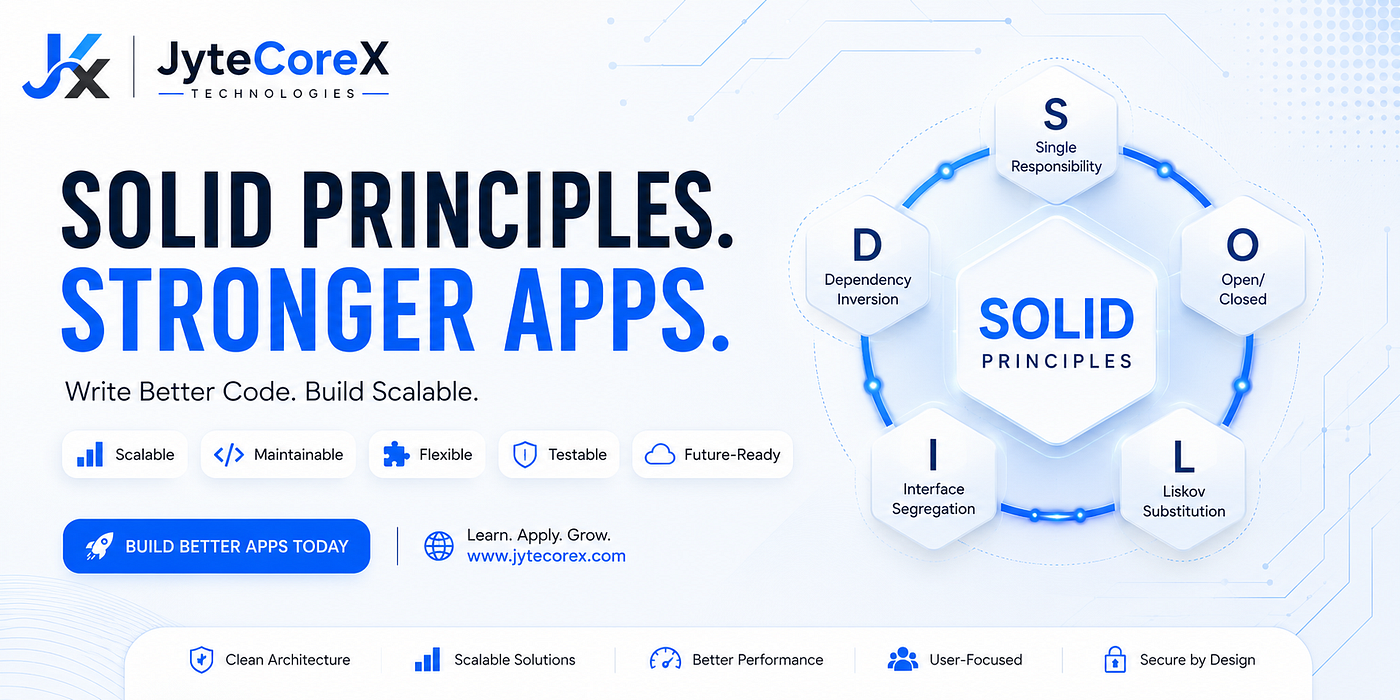
SOLID Design Principles in App Development: A Comprehensive Guide
A Deep Dive into Building Robust, Maintainable Applications
Introduction
In the ever-evolving landscape of software development, creating applications that stand the test of time is both an art and a science. As applications grow in complexity, developers face mounting challenges: code becomes brittle, features become difficult to add, and bugs become increasingly hard to track down. Enter the SOLID principles — five fundamental guidelines that transform chaotic codebases into well-structured, maintainable masterpieces.
First introduced by Robert C. Martin (Uncle Bob) in the early 2000s, these principles have become the cornerstone of object-oriented design. Whether you’re building a mobile app, a web platform, or enterprise software, SOLID provides a roadmap to architectural excellence.
The Historical Context: Why SOLID Matters
Before diving into each principle, it’s crucial to understand the problem SOLID solves. Traditional software development often falls into the trap of:
- The Big Ball of Mud: Where everything is tangled together
- The God Object: Single classes that do everything
- Copy-Paste Programming: Duplicate code across the codebase
- Fragile Base Class Problem: Changes in parent classes break everything
SOLID emerged as a response to these anti-patterns, providing developers with a shared vocabulary and framework for discussing and implementing good design.
Principle 1: Single Responsibility Principle (SRP)
“A class should have one, and only one, reason to change.”
Principle 2: Open/Closed Principle (OCP)
“Software entities should be open for extension but closed for modification.”
Principle 3: Liskov Substitution Principle (LSP)
“Objects of a superclass should be replaceable with objects of a subclass without affecting program correctness.”
Principle 4: Interface Segregation Principle (ISP)
“Clients should not be forced to depend on interfaces they do not use.”
Principle 5: Dependency Inversion Principle (DIP)
“High-level modules should not depend on low-level modules. Both should depend on abstractions.”
Common Pitfalls and How to Avoid Them
1. Over-Engineering
Problem: Applying SOLID principles to everything, creating unnecessary complexity.
Solution: Apply SOLID when:
- The code will be reused
- The code is likely to change
- The code is mission-critical
- The code is being extended frequently
2. Premature Abstraction
Problem: Creating abstractions before understanding the problem.
Solution: Start with concrete implementations, then refactor toward abstractions when patterns emerge.
3. Interface Bloat
Problem: Creating too many tiny interfaces that are hard to understand.
Solution: Balance granularity with practicality. Interfaces should represent meaningful concepts.
4. Dependency Injection Overuse
Problem: Everything becomes a dependency, making code hard to follow.
Solution: Use dependency injection for important cross-cutting concerns, but allow simpler constructors for straightforward classes.
5. YAGNI Violations
Problem: “You Ain’t Gonna Need It” — Adding flexibility that’s never used.
Solution: Implement only what you need now, but structure code so it can be extended later without modification.
SOLID in Different Programming Paradigms
Best Practices for Implementing SOLID
1. Start Small
Begin with one principle at a time. SRP is often the easiest to implement first.
2. Refactor Iteratively
Don’t try to fix everything at once. Each refactoring should be small and testable.
3. Write Tests First
TDD naturally encourages SOLID principles. Tests force you to think about coupling.
4. Code Reviews
Use code reviews to discuss SOLID compliance. This educates the team and catches issues early.
5. Use Design Patterns
SOLID and design patterns go hand in hand:
- Strategy: Implements OCP and DIP
- Factory: Implements DIP
- Adapter: Implements DIP
- Composite: Implements LSP and OCP
6. Document Architecture
Create architecture decision records (ADRs) to document why SOLID was applied.
Further Reading Books
- “Clean Code” by Robert C. Martin
- “Clean Architecture” by Robert C. Martin
- “Refactoring” by Martin Fowler
- “Design Patterns” by Gamma, Helm, Johnson, and Vlissides
Online Resources
- Refactoring.Guru — Excellent visual explanations
- SourceMaking — Design patterns and principles
- Martin Fowler’s Blog — Architecture insights
Practice Projects
- Build a small e-commerce system
- Create a task management application
- Design a banking system
- Implement a social media feed
메타데이터
- post_id
- 576f4de85fea
- slug
- solid-design-principles-in-app-development-a-comprehensive-guide-576f4de85fea
- url
- https://medium.com/@janardanborada76/solid-design-principles-in-app-development-a-comprehensive-guide-576f4de85fea
- canonical_url
- https://medium.com/@janardanborada76/solid-design-principles-in-app-development-a-comprehensive-guide-576f4de85fea
- author_url
- https://medium.com/@janardanborada76
- status
- ok
- fetched_at
- 2026-08-08 16:47:33




