Scientific Machine Learning: Not Better AI, but Respect for Reality
In science, a model is not expected to merely produce accurate predictions. It must also respect the fundamental laws that govern nature.

Scientific Machine Learning: Not Better AI, but Respect for Reality
In science, a model is not expected to merely produce accurate predictions. It must also respect the fundamental laws that govern nature.
While correct predictions are considered a success in machine learning, in science they can be a serious mistake.
Scientific Machine Learning (SciML) emerges precisely from this distinction. Its goal is not just to be right, but to be faithful to reality.
Why Classical Machine Learning Falls Short in Science?
Classical machine learning has achieved remarkable success in many practical applications. However, when applied to scientific problems, it encounters fundamental limitations.
Most ML models operate as black boxes. They learn statistical patterns from data, but they have no inherent knowledge of the physical, chemical, or biological laws underlying those patterns.
As a result, they may produce outputs that violate energy conservation, momentum laws, or even causality. From the model’s perspective, this is not an error — because its objective is not to obey physics, but to minimize prediction error.
In other words, classical ML models do not understand the rules of the universe. When they encounter situations not represented in the training data, physical consistency is no longer guaranteed.
Why Physical Models Alone Are Not Enough?
The problem is not that physical models are wrong. The problem is that reality is often too complex to model perfectly.
Computational cost, unknown parameters, and missing physics limit what we can simulate. For example, accurately simulating airflow around an aircraft wing requires enormous computational resources. In practice, simplified or averaged equations are used, reducing precision.
Machine learning can approximate these complex computations in seconds. But as mentioned earlier, this speed comes at the cost of scientific consistency.
SciML: Where Two Worlds Meet
Scientific Machine Learning emerges between these two extremes: physical correctness on one side, computational feasibility on the other.
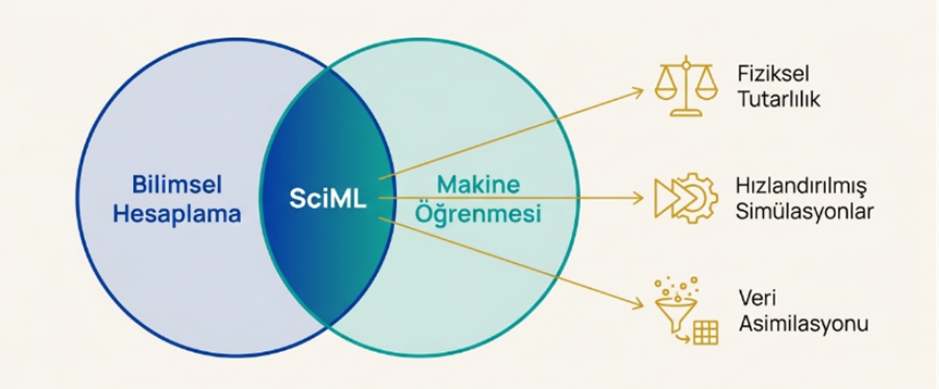
SciML combines data-driven learning with physical knowledge. Differential equations, conservation laws, and physical constraints are embedded into the learning process.
Importantly, SciML is not a single algorithm. It spans a broad research landscape — from equation discovery methods like SINDy, to operator-learning architectures such as DeepONet and Fourier Neural Operators (FNO).
At a fundamental level, however, the integration of physics into machine learning follows two main strategies.
Soft Constraints: Physics-Informed Learning
The first approach introduces physical laws as soft constraints, typically by adding them to the loss function. These models are commonly known as physics-informed methods.
The most well-known example is Physics-Informed Neural Networks (PINNs).
In the PINN framework, a neural network is trained as a surrogate model representing the solution of a differential equation:
- The model takes spatial and temporal coordinates (x, y, t) as inputs.
- It outputs physical quantities such as temperature or velocity (u).
- During training, derivatives of the network output are computed using automatic differentiation and substituted into the governing equations.
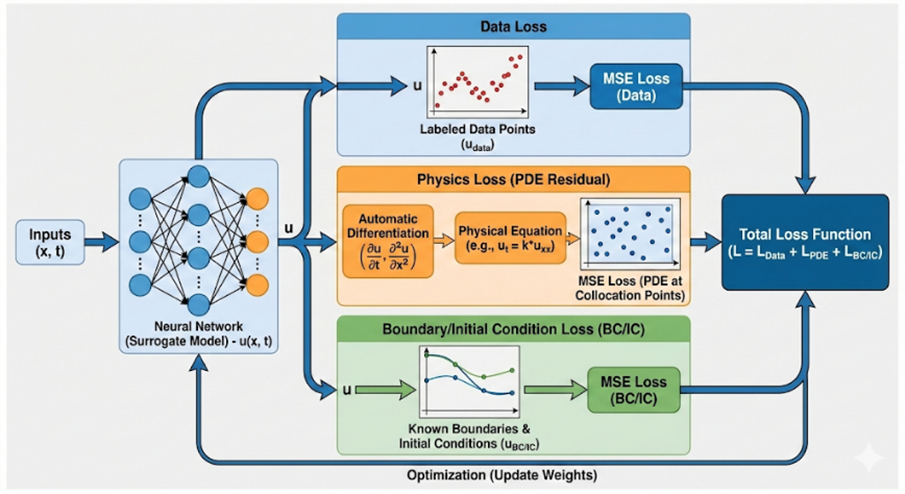
In this way, physical knowledge is directly injected into the learning process. This prior information allows PINNs to generalize well even with limited data, often using highly differentiable activation functions such as tanh or sigmoid (which is why ReLU is typically avoided).
A small but important note: this power comes at a cost. PINNs are often slow to train, and their loss functions combine multiple competing terms (data error, physics residuals, boundary conditions). Balancing these objectives is delicate, making PINNs theoretically elegant but practically fragile.
Hard Constraints: Physics by Design
In alternative approaches, physical structure is embedded directly into the model architecture or variable representation. These are known as hard constraints.
Here, learning is still present, but physically meaningless solutions are prevented by design. The model is simply not allowed to violate the underlying laws.
Conclusion: The Science of Tomorrow
Scientific Machine Learning is an attempt to train artificial intelligence not only with data, but also with the known boundaries of nature.
Scientific progress is often less about learning everything — and more about not learning the wrong things.
For this reason, SciML is not merely a technical method. It represents a scientific stance.
Although difficult to train and scale, SciML holds the key for domains where errors are unacceptable: climate modeling, biophysics, and nuclear fusion, among others.
It may seem like a niche field today. But tomorrow’s scientific AI will almost certainly be built on this philosophy.
Because SciML is not “what everyone uses today” but “what we will be forced to use tomorrow.”
메타데이터
- post_id
- 57780fa92bc5
- slug
- scientific-machine-learning-not-better-ai-but-respect-for-reality-57780fa92bc5
- url
- https://medium.com/@zsoyler80/scientific-machine-learning-not-better-ai-but-respect-for-reality-57780fa92bc5
- canonical_url
- https://medium.com/@zsoyler80/scientific-machine-learning-not-better-ai-but-respect-for-reality-57780fa92bc5
- author_url
- https://medium.com/@zsoyler80
- status
- ok
- fetched_at
- 2026-07-13 06:23:13




