Theorems, Properties, and Transformations of Geometry (AI’s Insights on Mathematics #4–4)
As we delve deeper into the mesmerizing world of geometry, we now arrive at the heart of mathematical deductions — the theorems and…
Theorems, Properties, and Transformations of Geometry (AI’s Insights on Mathematics #4–4)

As we delve deeper into the mesmerizing world of geometry, we now arrive at the heart of mathematical deductions — the theorems and properties that govern the universe of shapes and spaces. These principles not only define the relationships between various geometric entities but also serve as the foundation for all geometric reasoning.
In this article, we will explore the pivotal theorems and properties that have shaped our understanding of geometry. From the ancient yet ever-relevant Pythagorean theorem to the transformative properties of shapes, each concept unfolds a new layer of geometric wisdom.
We will also venture into the transformative power of geometry. This fascinating area explores how shapes change, move, and interact, bringing dynamism into the otherwise static realm of points, lines, and planes.
Join us on this journey as we delve into the profound depths of geometric theorems, properties, and transformations. This exploration will not only deepen your understanding of geometry but also evoke a sense of appreciation for the mathematical beauty that shapes our world.
Essential Theorems and Properties of Shapes
The beauty of geometry lies in the theorems and properties that govern the relationships between shapes. These principles, steeped in logic and precision, breathe life into the abstract world of points, lines, and planes, and translate into tangible elements of our everyday world.
Take the Pythagorean theorem, for instance. This ancient principle, named after the Greek mathematician Pythagoras, holds true for every right-angled triangle. The theorem states that in a right-angled triangle, the square of the length of the hypotenuse (the side opposite the right angle) is equal to the sum of the squares of the lengths of the other two sides. This may sound abstract, but its implications are far-reaching. From determining the shortest path between two points to aiding in the construction of buildings, the Pythagorean theorem is a cornerstone of practical geometry.
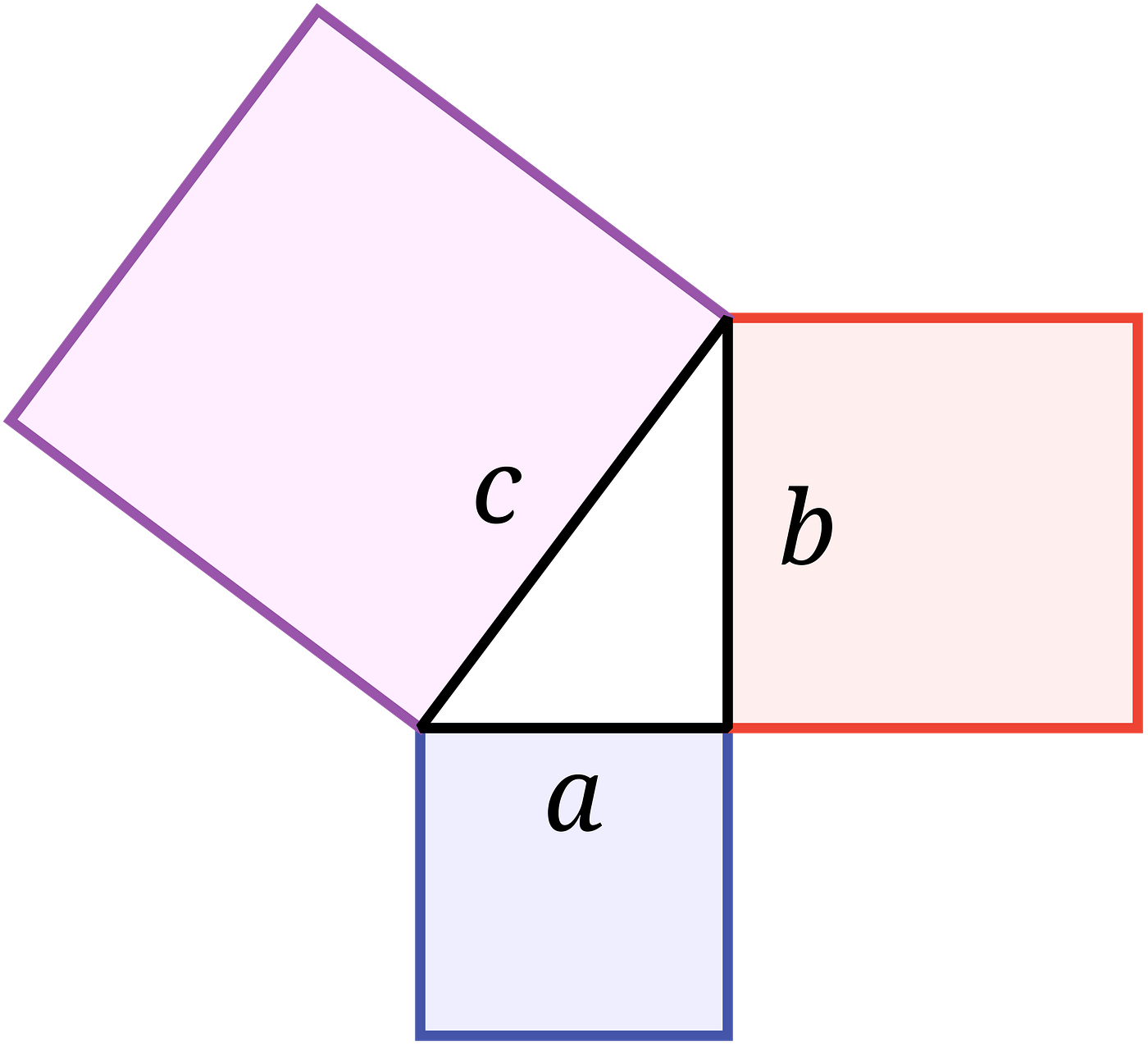
Illustration of the Pythagorean theorem (Source: https://commons.wikimedia.org/wiki/File:Pythagorean.svg)
Another essential property of shapes is the concept of congruence. Two geometric objects are congruent if they have the same shape and size, regardless of their position or orientation. Think about the keys on your computer keyboard. Each key of a particular type (say, the letter ‘A’) is congruent to every other ‘A’ key. This property is crucial in manufacturing, where producing congruent parts is often necessary.

An example of congruence. The two triangles on the left are congruent, while the third is similar to them. The last triangle is neither congruent nor similar to any of the others. (Source: https://commons.wikimedia.org/wiki/File:Congruent_non-congruent_triangles.svg)
The properties of parallel and perpendicular lines are another fundamental aspect of geometric principles. Parallel lines never intersect, regardless of how far they are extended in either direction. Perpendicular lines, on the other hand, intersect at a right angle. These properties are evident in numerous real-world scenarios, from the layout of city streets to the design of sports fields.

The segment AB is perpendicular to the segment CD because the two angles it creates (indicated in orange and blue) are each 90 degrees. (Source: https://en.wikipedia.org/wiki/File:Perpendicular-coloured.svg)
In the world of three-dimensional shapes, the properties of spheres, cubes, and pyramids play a significant role. For example, the volume of a sphere is given by the formula 4/3•πr³, where r is the radius of the sphere. This property is often used in fields like physics and engineering to calculate quantities like the volume of liquids or gases.
In essence, these theorems and properties of shapes serve as the backbone of geometry, guiding our understanding of the world around us. From the buildings we live in, the routes we take, to the objects we use in our daily lives, these geometric principles play a part in shaping our reality. This tangible link between abstract mathematical concepts and practical real-world applications is what makes the study of geometry both fascinating and profoundly impactful.
Geometric Transformations and Symmetry
Delving deeper into the world of geometry, we now arrive at the intriguing concept of geometric transformations. A transformation in geometry is a function that changes the position, and possibly the size and orientation, of a figure. Essentially, transformations are ways that a figure is moved, flipped, or resized. In this section, we will explore the three fundamental types of geometric transformations — translations, rotations, and reflections — and their remarkable implications in our daily lives.
Translations are perhaps the simplest form of geometric transformations. A translation moves every point of a figure or a shape the same distance in the same direction. Consider the simple act of moving a book across a table. The book, in this case, undergoes a translation. It maintains its size, shape, and orientation, but its position changes. Translations are incredibly prevalent in our daily lives. They are the underlying principle when we slide doors, roll a ball, or shift furniture in our homes.

A translation moves every point of a figure or a space by the same amount in a given direction. (Source: https://en.wikipedia.org/wiki/File:Traslazione_OK.svg)
Next, we move on to rotations, a transformation that turns a figure about a fixed point, known as the center of rotation. The movement of the hour and minute hands on a clock exemplifies rotation. Similarly, when we turn a key in a lock or rotate a bottle cap, we are performing a rotation. It’s also the principle that underlies the spinning of a bicycle wheel, the revolution of the Earth around the sun, and even the rotation of a rotisserie chicken in an oven.

Rotation of an object in two dimensions around a point O. (Source: https://en.wikipedia.org/wiki/File:Rotation_illustration2.svg)
Finally, we have reflections, a transformation resulting in a mirror image of a figure. In a reflection, a figure is flipped over a line, known as the axis of reflection, producing a mirror image. Reflections are all around us. The image we see in the mirror is a reflection of ourselves. The symmetrical patterns on butterfly wings, the reflection of trees in a calm lake, and the left-right symmetry in human faces are all examples of reflections in the real world.

A reflection through an axis. (Source: https://en.wikipedia.org/wiki/File:SimmetriainvOK.svg)
In addition to these transformations, an important concept that often emerges is that of symmetry. A figure is said to be symmetrical if there is a transformation (like reflection, rotation, or translation) that moves the figure onto itself. Symmetry is an inherent part of nature and our daily lives. It’s present in the design of cars, buildings, and furniture. It’s in the balance of a bicycle, the layout of a garden, and even in the human body.
Understanding geometric transformations and symmetry allows us to better understand the world around us and can guide us in creating and interacting with objects in our environment. It helps architects design buildings, engineers construct bridges, and artists create beautiful works of art. It’s a testament to the remarkable applicability of geometry in our daily lives, further emphasizing the profound impact of mathematics in shaping our understanding of the world.
The Role of Geometry in Motion and Dynamics
As we continue our exploration deeper into the realm of geometry, we encounter a fascinating intersection where geometry meets motion and dynamics. It is in this juncture of mathematics and physics that we truly begin to see the kinetic potential of geometric principles and the profound implications they hold for our understanding of the world in motion.
Consider the simple act of throwing a ball. The path that the ball follows, known as its trajectory, is a parabola, a geometric shape that is described by quadratic equations. This is a direct result of the laws of motion and gravity, and it is geometry that provides us with the tools to understand and predict this path.
The application of geometry in motion is not limited to simple parabolic trajectories. The elliptical orbits of planets around the sun, the spiraling path of a DNA helix, and the complex movements of robotic arms — all these can be understood and analyzed using geometric principles.
In the world of dynamics, which deals with the forces that cause motion, geometry again plays a critical role. The concept of the moment of a force about a point, which is crucial in understanding rotational motion, is a geometric one. It is based on the idea of the cross product of two vectors in three-dimensional space, a concept that arises from the geometry of vectors.
Furthermore, geometry also underpins the science of kinematics, the study of motion without considering its causes. For instance, the position, velocity, and acceleration of a moving object can all be represented geometrically using vectors. This geometric representation allows for a visual understanding of motion that complements the algebraic equations of kinematics.
It is also noteworthy to mention the profound role geometry plays in the field of computer graphics and animation. Techniques such as ray tracing, texture mapping, and 3D modeling all fundamentally rely on geometric computations. It is these geometric algorithms that enable the creation of realistic movements and effects, transforming lines of code into visually stunning video games and movies.
In essence, the role of geometry in motion and dynamics is both definitive and expansive. It underpins our ability to understand, predict, and visualize the physical world in motion. From the flight of a ball to the orbit of a planet, from the rotation of a windmill to the graphics in a video game, geometry provides the mathematical framework that allows us to navigate and depict the world in motion.
To conclude, this article has provided a comprehensive exploration of the theorems, properties, and transformations of geometry, and their profound implications in our daily lives. We have delved into the essential theorems and properties that govern the relationships between shapes and spaces, and how these principles serve as the bedrock of our understanding of the world around us. We have also ventured into the transformative world of geometric transformations and symmetry, understanding how shapes change, move, and interact, and how these principles shape our interactions with the world. Finally, we have explored the role of geometry in motion and dynamics, highlighting the critical role that geometric principles play in our understanding and depiction of the world in motion. This journey through the theorems, properties, and transformations of geometry underscores the profound influence of these principles in shaping our understanding of the world, and their far-reaching impact in various fields, from architecture and engineering to computer graphics and physics.
Part 4 Conclusion: The Universality and Impact of Geometry in Our World
In our journey through this part, we have ventured across the vast expanse of geometry, its basic concepts, its complexities, and its multi-dimensional applications. We’ve explored the depths of two and three-dimensional geometry, delved into the theoretical implications of dimensions beyond our typical understanding, and navigated through the intricate landscape of coordinate systems and analytical geometry.
The study of geometry offers us not merely a toolkit for understanding shapes and space but a universal language that describes our world. It’s a language that speaks of the curve of planets, the angles of a crystal, the dimensions of a building, and the trajectory of a satellite. From the grandeur of cosmic structures to the minute intricacies of atomic shapes, geometry is the underlying script that narrates the spatial stories of our universe.
In essence, geometry is not confined to the pages of a textbook or the corners of a classroom. It manifests in every facet of our lives, often in ways we least expect. The aesthetics of art, the dynamics of motion, the blueprint of architecture, the algorithms of computer graphics, and even the realms of theoretical physics are all steeped in the principles of geometry.
We hope that this deep dive into the world of geometry has heightened your understanding and appreciation for this fundamental branch of mathematics. Let this be the beginning of a lifelong fascination with shapes, dimensions, and the space we live in. As we continue our exploration into other areas of mathematics in the upcoming articles, remember that the principles of geometry will continue to echo, reinforcing the universality and impact of geometry in our world.
메타데이터
- post_id
- 5791dcd04cb3
- slug
- theorems-properties-and-transformations-of-geometry-ais-insights-on-mathematics-4-4-5791dcd04cb3
- url
- https://medium.com/@sandy.y.greenleaf/theorems-properties-and-transformations-of-geometry-ais-insights-on-mathematics-4-4-5791dcd04cb3
- canonical_url
- https://medium.com/@sandy.y.greenleaf/theorems-properties-and-transformations-of-geometry-ais-insights-on-mathematics-4-4-5791dcd04cb3
- author_url
- https://medium.com/@sandy.y.greenleaf
- status
- ok
- fetched_at
- 2026-08-20 02:39:03