CAP Theorem Explained (with Diagrams)
A clear, beginner-friendly breakdown of consistency, availability, and partition tolerance — and why you can’t have all three at once.
CAP Theorem Explained (with Diagrams)
A clear, beginner-friendly breakdown of consistency, availability, and partition tolerance — and why you can’t have all three at once.
What This Blog Covers
- What the CAP theorem is
- Consistency, availability, partition tolerance
- Why you choose two
- CP vs. AP databases
- The PACELC extension
- How interviews use it
The CAP theorem is one of those topics that sounds intimidating until someone explains it plainly. It comes up constantly in system design interviews, and a shaky answer here is an easy way to lose credibility.
The good thing is that the core idea is genuinely simple once you strip away the jargon.
This guide explains it, shows the picture behind it, and gives you the database examples and interview framing you actually need.
It is written for junior developers and fresh graduates preparing for system design interviews in 2026. By the end, you will be able to define CAP, classify a real database, and justify a design choice with confidence.
If you want this concept tied into a full framework of worked problems, Grokking the System Design Interview walks through exactly these trade-offs on real systems.
What Is the CAP Theorem?
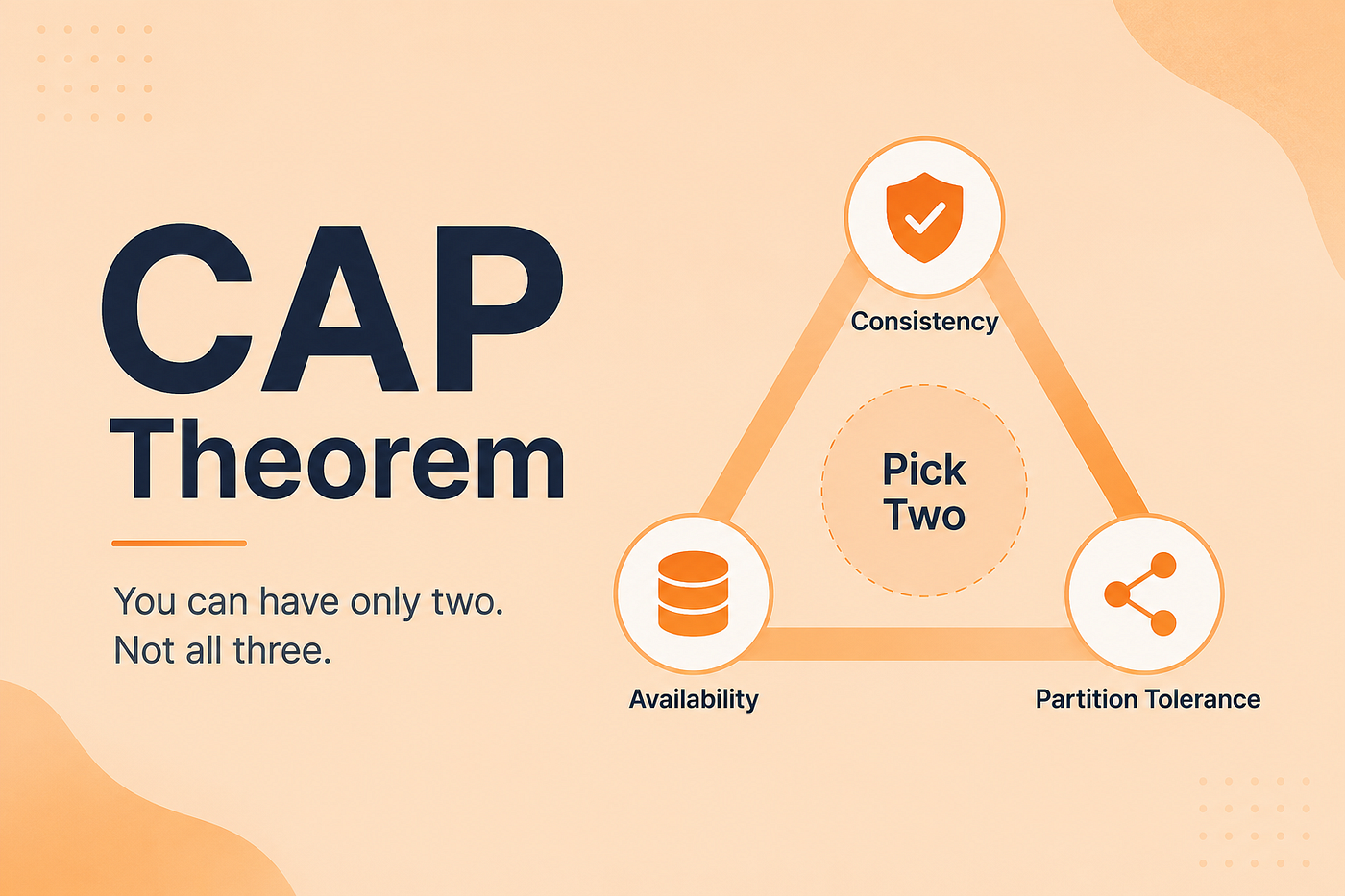
The CAP theorem, introduced by computer scientist Eric Brewer, states a simple but powerful limit on distributed systems: a distributed data store cannot simultaneously guarantee all three of consistency, availability, and partition tolerance.
When something goes wrong on the network, you have to give one of them up.
The three letters stand for:
- C — Consistency: every read receives the most recent write, or an error. All nodes show the same data at the same time.
- A — Availability: every request receives a non-error response, though not necessarily the most recent data. The system always answers.
- P — Partition tolerance: the system keeps working even when the network drops or delays messages between nodes, splitting them into groups that cannot talk to each other.

The headline result is that you cannot have all three together.
The subtler and more useful version is what comes next.
The Three Properties, One at a Time
Before the trade-off, make sure each term is crisp.
A quick way to internalize any concept is to state what it is, why it exists, and when it matters; let’s do that here.
Consistency means all clients see the same data at the same moment. If you write a new value and immediately read it back from any node, you get the new value. A bank balance is the classic case: if you deposit money, every subsequent read must reflect it. Reading a stale balance is unacceptable.
Availability means the system always responds to requests, even if some nodes are down. The response might not be the very latest data, but you never get a hard failure. A social media timeline is a good example — if the feed is a few seconds out of date, no one is harmed, but an error page is a real problem.
Partition tolerance means the system survives a network partition: a situation where nodes cannot communicate with each other because of a dropped connection, a failed switch, or network congestion. In any system spread across multiple machines or data centers, partitions are not a hypothetical — they will happen.
Why You Can Only Pick Two (The Honest Version)
Here is the part most simplified explanations get slightly wrong.
CAP is not really a free “pick any two of three” buffet.
In a distributed system, partition tolerance is not optional; networks fail, so any real distributed data store must tolerate partitions. That means the genuine choice is between consistency and availability, and only when a partition is happening.
Picture two database nodes in different regions holding copies of the same data.
The network link between them breaks. A write arrives at one node.
Now the system faces a fork in the road:
- Choose consistency: refuse to serve reads (or the write) on the other node until the partition heals, so no one ever sees stale data. The system sacrifices availability — some requests get errors.
- Choose availability: let both nodes keep serving requests, accepting that they may temporarily disagree until they reconcile. The system sacrifices consistency — some reads are stale.
That is the entire trade-off.
When there is no partition, a well-designed system can offer both consistency and availability; the dilemma only appears during the partition.
Understanding this nuance is what separates a memorized answer from a real one, and it is precisely the kind of reasoning Grokking the System Design Interview trains you to articulate.

The Three Categories with Real Databases
Systems are commonly grouped by which pair they prioritize. Knowing a few real examples for each makes your interview answers concrete.

A note on CA: a system that gives up partition tolerance is essentially a single-node or tightly-coupled system that simply cannot survive a network split.
Once you distribute data across machines that can be partitioned, CA stops being a realistic option — which is why real-world distributed databases are effectively either CP or AP.
Treat CA as the special case that proves the rule, not a design you would choose for a large-scale service.
Being able to classify a database and justify the choice from requirements is a frequent interview moment, and the worked problems in Grokking the System Design Interview give you repeated practice doing exactly that.
A Worked Example: Choosing for Two Real Systems
The theorem only matters if you can apply it.
Consider two systems with opposite needs.
A payment or inventory system: Correctness is non-negotiable You cannot sell the same concert seat twice or let an account go negative. During a partition, you would rather reject some requests than risk inconsistent data. This is a CP choice: prioritize consistency, accept reduced availability.
A social news feed: Here, showing a post a few seconds late is invisible to users, but an unavailable feed drives them away. During a partition, you keep serving, even if different users briefly see slightly different versions of the timeline. This is an AP choice: prioritize availability, accept eventual consistency.
Notice that the requirements drove the decision.
That is exactly what an interviewer wants to see — not a recited definition, but a justified choice.
When you reach harder, senior-level scenarios where these trade-offs get genuinely subtle, Advanced System Design Interview, Volume II digs into how real distributed databases implement and tune these guarantees.
Beyond CAP: The PACELC Extension
CAP only describes what happens during a partition, which is a small fraction of a system’s life.
PACELC fills the gap and signals to an interviewer that you are current.
It reads: if Partition (P), choose Availability (A) or Consistency (C); Else (E), choose Latency (L) or Consistency (C).
In plain terms, even when the network is perfectly healthy, a distributed system still trades off between responding faster and staying perfectly consistent, because keeping every replica in sync takes time.
A system can be described, for example, as “PA/EL” (favoring availability during partitions and latency otherwise) or “PC/EC” (favoring consistency in both cases).
You do not need to memorize every classification. You need to understand the idea: consistency has a cost in latency during normal operation, not just an availability cost during failures.
Mentioning PACELC naturally is a small touch that makes an answer sound genuinely up to date.

Common Misconceptions to Avoid
A few traps catch candidates repeatedly:
- “You permanently pick two of three.” No — the consistency-vs-availability choice only bites during a partition. The rest of the time you can have both.
- “Partition tolerance is optional.” Not for a real distributed system. Networks fail, so P is a given, which is why the real choice is C vs. A.
- “Consistency here means the same as in ACID.” They are related but distinct. CAP consistency is about all nodes agreeing on the latest value; ACID consistency is about a database moving between valid states under transactional rules. Conflating them is a common slip.
- “Eventual consistency means broken.” Eventual consistency is a deliberate, valid design choice — replicas converge to the same value once communication is restored. It powers many of the largest systems in the world.
If these distinctions feel slippery, building the underlying fundamentals first with Grokking System Design Fundamentals makes CAP click far more easily, because it grounds you in replication and consistency before you have to reason about them under pressure.
How CAP Shows Up in Interviews
In a 2026 system design interview, you will rarely be asked to recite the CAP theorem outright.
Instead, it surfaces inside a larger problem, usually as a pointed follow-up: “Would you favor consistency or availability here, and why?” The interviewer is testing judgment, not memorization.
To handle it well: identify whether the system tolerates staleness, state your choice (CP or AP) in one clear sentence, justify it from the requirements, and acknowledge the cost of your choice.
For a messaging app you might reason that message ordering and delivery matter, leaning toward stronger consistency for a conversation; for a “trending topics” widget you might happily choose availability and accept slightly stale counts.
Showing that you can reason both ways, rather than reflexively reaching for one answer, is the signal that earns marks.
This is the heart of trade-off thinking, and it appears throughout the worked problems in Grokking the System Design Interview, where every design forces an explicit, defended decision rather than a memorized template.
The Bottom Line
The CAP theorem, stripped of jargon, says this: when a network partition splits your distributed system, you must choose between staying consistent and staying available, because you cannot do both at that moment.
Partition tolerance is a given in any real distributed system, so the practical choice is consistency versus availability — and PACELC reminds you that consistency also costs latency even when nothing is broken.
Master the core idea, memorize a couple of CP and AP database examples, and practice justifying the choice from a system’s requirements. Do that, and CAP shifts from an intimidating piece of theory into one of the easiest places to demonstrate real judgment.
To turn that understanding into fluent, interview-ready reasoning across dozens of real systems, work through it inside Grokking the System Design Interview.
메타데이터
- post_id
- 57a591de4e91
- slug
- cap-theorem-explained-with-diagrams-57a591de4e91
- url
- https://medium.com/@arslan-ahmad/cap-theorem-explained-with-diagrams-57a591de4e91
- canonical_url
- https://medium.com/@arslan-ahmad/cap-theorem-explained-with-diagrams-57a591de4e91
- author_url
- https://medium.com/@arslan-ahmad
- status
- ok
- fetched_at
- 2026-06-26 21:52:29