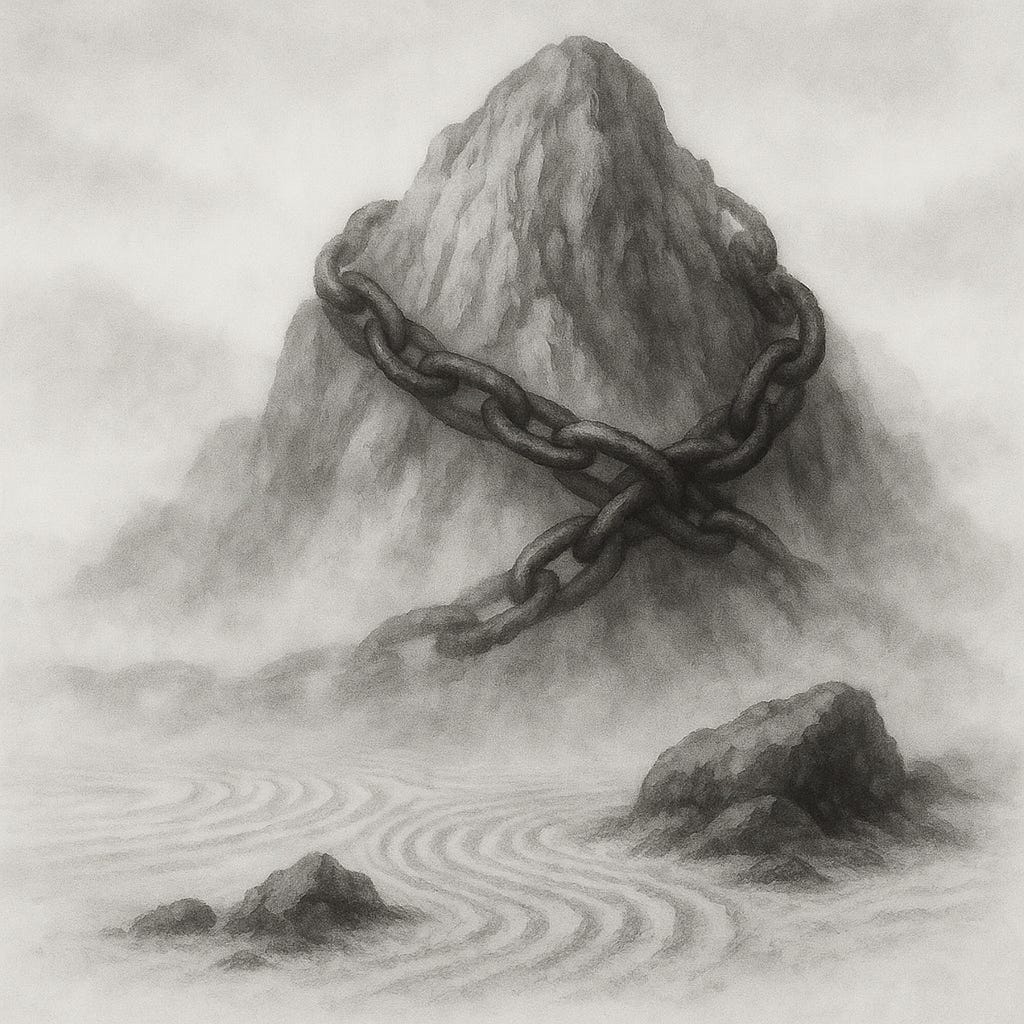
Saguṇa and Nirguṇa — Brahman
Two sides of the same coin
Saguṇa and Nirguṇa — Brahman
Two sides of the same coin

Introduction: The Problem of Binary Thinking
In the Astika Hindu tradition, numerous disputes have occurred between different schools of thought, leading to the evolution of an immensely sophisticated system of healthy debate over the past millennia. The concept of Saguṇa Brahman and Nirguṇa Brahman has also been a part of this debating tradition. However, in recent times, perhaps due to the influence of echo chambers present in various social media platforms, people have developed a binary perspective of things. For most it has become Saguna Brahman vs. Nirguna Brahman as opposed to Saguna Brahman and Nirguna Brahman as two harmonious concepts that coexist and define the same reality. So let us explore this thought and discover whether the framework that is emitted as a result is coherent and logical enough to be a part of this discourse or not.
(Please note that the primary aim of this article is not to indoctrinate you into a certain school of thought, but to provide an argument for an unpopular school of thought).
Note: another philosophy that holds this view is (Trika or) Kashmiri Shaivism.
What Does “Guna” Mean?
To begin, we must first understand the meaning of the words Saguna and Nirguna. What is Nirguṇa? The prefix “Nir” simply means “without”, “not” or “not having”. We can safely conclude that in this context it means “not having guna”.
But… What does Guna even mean?
The introduction to Tantra Shastra dives the deepest into this question amongst the modern spiritual commentaries that I have read. It says:
‘The functions of sattva, rajas, and tamas are to reveal, to make active, and to suppress respectively. Rajas is the dynamic, as sattva and tamas are static principles.’ — Introduction to Tantra Shastra Page 18 Paragraph 1.
That is to say that sattva and tamas cannot suppress or reveal without the action being rendered by rajas. To avoid making things too complicated, we can simply conclude by saying that Nirguna means that which is without sattva, tamas or rajas.
What is Saguṇa?
If Nirguṇa means “without guṇas,” then Saguṇa simply means “with guṇas.” In Hindu philosophy, this generally refers to Brahman as experienced through the realm of manifestation, where names, forms, attributes, divine qualities, and relationships become possible. It is the Brahman worshipped as Shiva, Vishnu, Devi, Ganesha, Surya, and countless other manifestations.
At this point many people assume they have arrived at a contradiction. If Nirguṇa Brahman is beyond the guṇas, and Saguṇa Brahman possesses guṇas, then surely they must be two different realities? However, we are yet to explore the positions of Nirguna and Saguna properly, so let us not be too excited here, for we will look at this contradiction again, when we stand on the firm ground of a clear understanding.
The Nirguna Position: Protecting the Infinite
The claim that Brahman is fundamentally Nirguṇa seems to be taking up a lot of space in the minds of the modern munis. It is one that is not at all devoid of logic or sound reasoning. It is very convincing to say that the ultimate truth is beyond all forms and shapes, beyond all conceptions and thought, for if it is bound, what is so ultimate about it, what is so infinite about it? The Nirguna position (TNP) exists as a force that defends the intuitive idea of the infinite, that which is inconceivable by the mind, whose body knows no end when the human eye gazes it, whose knowledge is only written in the book which has no start and no end. It is hence here that a man is forced to admit that the ultimate reality, the lord of the lords, the source of all is beyond every form that we can conceive of, and even beyond the gunas that create those forms, hence it is Nirguna.
The Saguna Position: Protecting the Fullness of Reality
The Saguṇa position (TSP) is a the product of a force that seeks to defend the idea of bhakti and devotion towards Saguna Brahman, which it sees as a target by the Nirguna position. TSP does this by claiming that forms and gunas in their combinations and permutations are infinite, hence there are Acintya (inconceivable) combinations of primary attributes (kalyana gunas) attached with brahman.
The direct attack on TNP by TSP begins by first claiming that something beyond gunas cannot be known, as something without gunas will be indistinguishable from nothingness (shunya). TSP makes an even stronger and convincing argument, by asking a simple question, how can someone that does not consist of the gunas give birth to the gunas? TNP usually collapses into a strictly keval Advaita position and claims that the world is an illusion. Here TSP gives a counter argument on some line that dismisses the idea of an illusion or asks how does this illusion come about, and the battle goes on for about a thousand years.
These are the broad positions of the two sides, and I apologise if I have not done full justice to every argument advanced by either tradition. But that doesn’t matter, what matters is that we have a a clear understanding of what they are, in their “essence”, as opposed to their position on the other, because then we might have a chance of showing how they are two sides of the same coin.
The Category Problem: Is the Argument Itself Limited?
Now we find ourselves faced with a difficult task. At the beginning of this article, I suggested that a reconciliation between these two seemingly contradictory positions may exist. But before attempting to reconcile them, we must first ask a more fundamental question: are they actually contradictory?
The reason I ask this question is because the important word in my original statement is seemingly. This word is not merely a choice of language; it is the foundation upon which this entire discussion rests. For if the two positions are genuinely contradictory, then no reconciliation can ever occur. However, if the contradiction arises due to the limitations of the framework through which we are viewing them, then perhaps another possibility emerges.
Let us first examine something both positions appear to share. Both the Nirguṇa and Saguṇa positions are ultimately attempting to preserve the infinity of Brahman. Yet they appear to do so by arguing that their own understanding attributes something greater, something wider, or something more complete to Brahman than the other. The Nirguṇa position argues that Brahman cannot be limited by qualities, forms, or distinctions. The Saguṇa position argues that Brahman cannot be reduced to an abstract reality devoid of the fullness, consciousness, and divine qualities that allow manifestation itself to exist.
But before deciding which position gives the “greater” definition of Brahman, we must ask a more fundamental question: Can Brahman be fully contained within any definition at all?
If Brahman is bound, then it is not truly the infinite reality that both traditions claim it to be. But if Brahman is genuinely unlimited, then we must examine whether the act of defining Brahman itself introduces a limitation. Let us first return to the Nirguṇa position. The argument that Brahman is beyond the guṇas is deeply compelling. If the guṇas are the principles through which manifested existence operates, then Brahman, as the ultimate ground of existence, cannot simply be another object operating within that same framework. In this sense, Nirguṇa protects the transcendence of Brahman.
However, we must ask a subtle question. When we say that Brahman is fundamentally Nirguṇa, what exactly are we doing? Are we merely removing false limitations from Brahman, or are we placing Brahman into another conceptual category? The human mind naturally understands reality through distinctions. We divide things into categories, organise information, and create conceptual frameworks that allow us to understand the world around us. This process is not a flaw; it is the very mechanism through which ordinary knowledge becomes possible.
Yet the question arises: Does the same dividing mechanism that allows us to understand finite reality also allow us to completely understand the Infinite? When we say “Brahman is Nirguṇa,” the mind naturally creates a distinction between two domains:
• the realm of guṇas, where qualities, forms, and distinctions exist;
• Brahman, which is understood as beyond that realm.
The intention behind this statement is not necessarily to create a limitation. Rather, it is to remove the limitations that belong to manifestation. However, the question remains whether the human mind has simply created another framework through which it attempts to grasp that which is beyond all frameworks. The issue, therefore, is not whether Nirguṇa is a valid description of Brahman. It clearly reveals something profound: that Brahman cannot be reduced to finite qualities. The deeper question is whether this description can itself become a complete definition of the Absolute. Now we must apply the same examination to the Saguṇa position.
TSP argues that Brahman is not an empty abstraction, but the fullness of existence itself. The infinite divine qualities, forms, and manifestations of Brahman are not limitations, because they are not finite qualities in the way worldly qualities are finite. Rather, they represent the infinite possibilities of divine expression.
However, a similar question arises. Even if Brahman possesses infinite forms and qualities, are these forms and qualities still operating within the framework of the dividing mind? An infinite number of forms may be beyond human calculation, but they remain forms. Infinite qualities may be beyond human comprehension, but they remain qualities. Therefore, just as Nirguṇa risks reducing Brahman to the category of “that which is beyond qualities,” Saguṇa risks reducing Brahman to the category of “that which possesses infinite qualities.” Both positions are attempting to preserve the infinity of Brahman, yet both approach that infinity through conceptual structures created by the mind. This does not mean that either position is false. Rather, it raises a deeper possibility: Perhaps the problem is not that one side has correctly defined Brahman and the other has failed. Perhaps the difficulty arises because the Infinite cannot be exhausted by any finite framework used to describe it.
The Key Philosophical Proposal: The Infinite Cannot Be Exhausted by Categories
The key idea that can bind both TNP and TSP is that Brahman cannot be exhausted by any category at a fundamental level. From the fundamental point of view, the dividing mind itself becomes the limitation through which we attempt to understand the Absolute. This does not mean that categories are useless. Without categories, ordinary knowledge itself becomes impossible. The human mind requires distinctions in order to navigate reality. We understand through opposites, relationships, and definitions.
However, the question is whether the same method that allows us to understand the finite can completely comprehend the Infinite. To say that Brahman cannot be exhausted by categories does not mean that Brahman is a meaningless concept where anything can be said about it. It does not mean that Brahman can be a three-sided square or any other meaningless combination of words. Such examples do not represent transcendence; they represent the collapse of language itself. A square with three sides is not a higher form of geometry beyond human understanding. It is simply a contradiction because the definition of a square already excludes the possibility of having three sides. The case of Brahman is different.
The problem is not that Brahman contradicts all categories. Rather, the problem is that the categories themselves may not be sufficient to fully contain Brahman. When we say Brahman is Nirguṇa, we are pointing towards the truth that the Absolute cannot be limited by the guṇas which govern manifested existence. When we say Brahman is Saguṇa, we are pointing towards the truth that the Absolute is not an empty abstraction but the fullness from which manifestation, consciousness, and divine qualities emerge.
The mistake occurs when one takes either of these descriptions and treats it as a complete definition of Brahman itself. A finger pointing towards the moon is not the moon itself. Yet the finger is not useless, because without it one may fail to notice where to look. In a similar manner, Saguṇa and Nirguṇa can be understood as two different ways through which the human mind approaches the Infinite, without either becoming a complete limitation upon it. The question therefore changes.
Instead of asking: “Is Brahman Saguṇa or Nirguṇa?”
perhaps we should ask: “How can the Infinite be approached through categories without being reduced to those categories?”
It is here that Tantra provides a particularly interesting perspective.
Tantra: The Relationship Between Brahman and Śakti
Tantric philosophy provides one of the most fascinating approaches to this relationship between transcendence and manifestation. Rather than viewing the manifested world as something separate from the Absolute, Tantra often presents manifestation as the expression of the Absolute’s own power. This power is Śakti.
Śakti is not merely an external force acting upon Brahman. She is understood as the dynamic aspect of the Supreme Reality itself. The Introduction to Tantra Shastra explains creation through the relationship between the unmanifest state of Prakṛti and the disturbance of equilibrium among the guṇas. Before manifestation, the guṇas exist in a state of balance. When this equilibrium is disturbed, the universe emerges.
This presents an important philosophical possibility. The appearance of qualities does not necessarily require Brahman to become limited by those qualities. Rather, qualities can be understood as the means through which the Absolute expresses itself. A person does not become less because they express themselves through speech, action, or creativity. Expression does not necessarily reduce the source; it reveals something about it. Similarly, Tantra does not view the manifestation of the divine through forms and qualities as a fall away from the Absolute. Instead, manifestation is the play (līlā) of the Absolute through its own power.
This is why Devī occupies such a unique position within Tantric traditions. She is simultaneously understood as the highest reality beyond all limitation and as the force through which all limitation appears. She is beyond the guṇas, yet she is also the source of the guṇas. She is beyond form, yet she appears through infinite forms.
At first glance, this appears contradictory. But within the framework we have developed, the contradiction arises only if manifestation is assumed to be a limitation of the Absolute. If manifestation is instead understood as an expression of the Absolute, then Saguṇa and Nirguṇa are no longer opposing realities. They become two aspects of the relationship between the Infinite and the manifested universe.
Sri Aurobindo: The Failure of the Dividing Mind
Interestingly, Sri Aurobindo arrives at a remarkably similar conclusion, though through a different route. Throughout his writings, Sri Aurobindo repeatedly challenges the tendency of the human intellect to divide reality into opposing categories. Personal and Impersonal. Static and Dynamic. Form and Formless.
According to Sri Aurobindo, these oppositions appear irreconcilable because the ordinary human mind understands reality through separation. The mind creates distinctions because distinctions are necessary for ordinary thought. However, the existence of a distinction does not necessarily mean that the two sides are ultimately separate realities.
He writes:
“These things are to the dimensional mind irreconcilable opposites, but to the constant vision and experience of the supramental Truth-consciousness they are so simply and inevitably the intrinsic nature of each other that even to think of them as contraries is an unimaginable violence.” — *The Synthesis of Yoga — I: The Object of Knowledge*
The important point here is not that contradictions should simply be accepted. Sri Aurobindo is not arguing that logic should be abandoned. Rather, he is arguing that some oppositions exist because of the limitations of the framework through which reality is being viewed.
The ordinary mind asks:
- “Is Brahman personal or impersonal?”
- “Is Brahman with form or without form?”
- “Is Brahman static or dynamic?”
But perhaps these questions assume that the Infinite must operate according to the same divisions that govern finite existence. If Brahman is truly infinite, then restricting Brahman to only one mode of being would itself become a limitation. A Brahman is fundamentally without form would exclude form from the Infinite. A Brahman that fundamentally a form would exclude formlessness from the Infinite. The Absolute must therefore transcend the opposition itself. This does not mean that Saguṇa and Nirguṇa become meaningless. Rather, it means that they are partial approaches to a reality greater than either description. The Nirguṇa experience reveals the transcendence of the Divine. The Saguṇa experience reveals the immanence of the Divine. The mistake is not in either experience. The mistake is assuming that one experience must eliminate the other.
Conclusion: Beyond the Conflict of Saguna and Nirguna
Perhaps the question is not whether Saguna Brahman is greater than Nirguna Brahman, or whether Nirguna Brahman is greater than Saguna Brahman. Such a question already assumes that they are two competing realities. Yet the deeper philosophical examination reveals another possibility. Nirguna protects the Infinite from being reduced to the limitations of manifestation. Saguna protects the Infinite from being reduced to an empty abstraction. One reminds us that Brahman exceeds all forms. The other reminds us that all forms are capable of revealing Brahman. The same Reality which transcends the guṇas may also express itself through the guṇas.
The same Reality beyond all forms may appear through countless forms. The same Devī who is described as beyond all manifestation may also be worshipped through infinite manifestations. Like one moon reflected in countless waters, the One appears as many without ever ceasing to be One. Perhaps then Saguṇa and Nirguṇa are not enemies locked in philosophical conflict. Perhaps they are not two opposing definitions fighting for supremacy. Perhaps they are two ways of beholding the same Infinite Reality — two perspectives that become contradictory only when the human mind attempts to force the Infinite into the limitations of its own categories.
메타데이터
- post_id
- 57ddf85592b2
- slug
- saguṇa-and-nirguṇa-brahman-57ddf85592b2
- url
- https://medium.com/@dharmasankalp108/sagu%E1%B9%87a-and-nirgu%E1%B9%87a-brahman-57ddf85592b2
- canonical_url
- https://medium.com/@dharmasankalp108/sagu%E1%B9%87a-and-nirgu%E1%B9%87a-brahman-57ddf85592b2
- author_url
- https://medium.com/@dharmasankalp108
- status
- ok
- fetched_at
- 2026-07-28 19:00:09