TestMu AI: LambdaTest Reborn for the AI Era
Reborn is a strong word. It implies something ended and something new began. That’s not quite what happened when LambdaTest became TestMu…
TestMu AI: LambdaTest Reborn for the AI Era
Reborn is a strong word. It implies something ended and something new began. That’s not quite what happened when LambdaTest became TestMu AI — and understanding the distinction matters.
The right framing is closer to metamorphosis than rebirth. The foundation didn’t go away. The company didn’t restart. The same engineers, the same infrastructure, the same customer relationships, the same mission — all of it carried forward. What changed was the form: from a cloud testing platform built for an era when the hard problem was running tests at scale, to an agentic AI quality engineering platform built for an era when the hard problem is keeping quality pace with AI-accelerated development.
LambdaTest is now TestMu AI (formerly LambdaTest). And the “AI era” framing in the headline isn’t marketing language — it describes a specific, concrete shift in what software development looks like and what quality engineering has to do to keep up with it.
The Era That Made LambdaTest Necessary
To understand why TestMu AI exists, start with why LambdaTest existed.
In 2017, the dominant quality engineering challenge was cross-browser compatibility. The web had proliferated across browsers and operating systems faster than teams could manually test. Chrome behaved one way, Firefox another, Safari yet another, and Internet Explorer in ways that still give engineers nightmares. Testing all of these combinations was essential for any team shipping a web application to real users.
The solution LambdaTest provided was infrastructure: a cloud grid with thousands of browser and OS combinations, accessible without maintaining any of it yourself. For teams that had been spinning up local VMs, running manual cross-browser checks, or paying for expensive in-house browser farms, LambdaTest was a meaningful step forward.
That era is still relevant. Cross-browser compatibility still matters. But the central challenge of quality engineering has moved.
The Era That Made TestMu AI Necessary
The AI era of software development has a specific character: development velocity has increased faster than quality validation capacity. AI coding assistants generate entire features in hours that used to take weeks. Vibe coding — building by describing outcomes to AI systems and iterating on what comes back — lets founders and developers ship at a pace that makes traditional QE processes a bottleneck rather than a safeguard.
At the same time, the things being built are more complex. AI-native products — chatbots, voicebots, autonomous agents, AI-powered recommendation systems — don’t behave deterministically. You can’t write a static Selenium script to validate a conversational AI that produces different responses every time. The entire paradigm of assertion-based testing breaks down when the system under test has variable output by design.
Quality engineering needed to evolve to match both of these realities: faster development cycles and more complex systems to test.
TestMu AI is the platform built for that evolved problem. The world’s first full-stack Agentic AI Quality Engineering Platform, where AI agents plan, author, execute, analyze, and repair tests — working at the speed of AI-assisted development, validating the kinds of systems that AI-assisted development produces.
As Asad Khan, CEO and Co-Founder of TestMu AI (formerly LambdaTest), put it: “AI is fundamentally changing how software is built and shipped. Development cycles that once took weeks now take hours. But speed without quality is chaos.”
That framing — speed without quality is chaos — is the problem TestMu AI is built to solve.
What the AI Era Required from the Platform
The platform capabilities that define TestMu AI as an AI-era quality engineering platform are worth naming specifically, because “AI” is an easy word to attach to anything and mean nothing.
KaneAI is the world’s first GenAI-native end-to-end software testing agent. It authors test cases from natural language — you describe the scenario, KaneAI generates runnable, maintainable test code. It doesn’t require QE engineers to know Selenium syntax or Playwright API conventions. It requires them to clearly articulate what the product should do, and the agent produces tests that validate it.
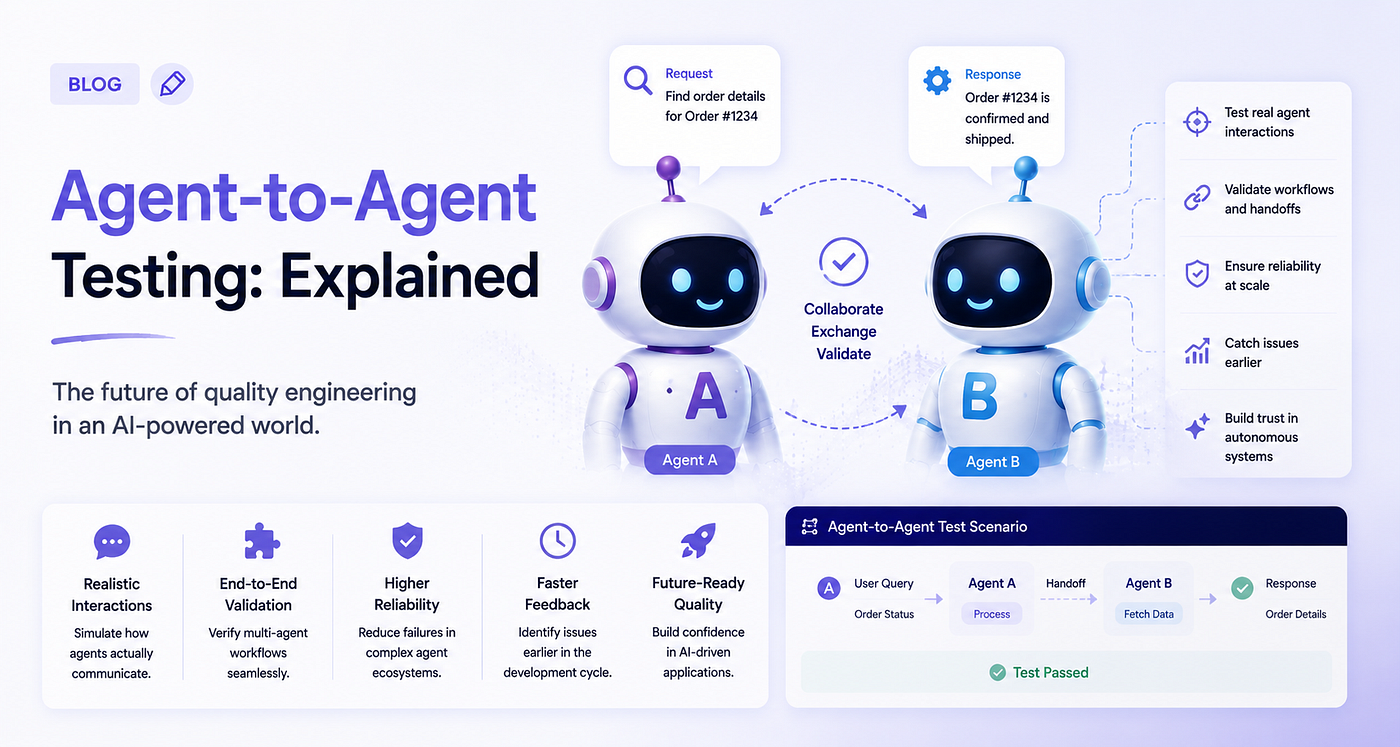
Agent-to-Agent Testing is the capability that makes testing AI-native products possible. It deploys AI agents to interact with chatbots, voicebots, and autonomous agents at scale — running thousands of conversation variations, adversarial inputs, and edge cases that no human tester could cover manually. It validates AI systems the way only AI can.
Auto Healing Agent solves one of the most expensive problems in QE: brittle tests that break every time a UI changes. The agent detects selector drift, identifies the correct element using contextual signals, and repairs the test automatically. Tests that used to require days of manual maintenance now heal themselves.
Root Cause Analysis Agent applies AI-native classification to test failures. Instead of a developer reading through 200 failure logs to find patterns, the agent groups related failures by root cause and surfaces an actionable list. What used to take hours takes seconds.
TestMu AI MCP Server connects the platform to AI agents operating inside developer IDEs through the Model Context Protocol. Triggering test runs, retrieving results, querying analytics — all from inside the development environment, without context-switching to a dashboard.
These aren’t features added to make a testing platform sound AI-adjacent. They’re a rearchitecture of what a quality engineering platform does — from infrastructure for running human-authored tests to an agentic system that handles the full testing lifecycle.
The Continuity Beneath the Transformation
The transformation is real. But it runs on top of a foundation that didn’t change.
The cloud infrastructure that LambdaTest spent nine years building — 3,000+ browser and OS combinations, 10,000+ real iOS and Android devices, HyperExecute’s parallel execution engine, 120+ integrations — is the infrastructure TestMu AI runs on. The agents operate at scale because the cloud underneath them has the capacity. KaneAI’s generated tests run on the same grid that LambdaTest’s customers were using before the rebrand.
This is what makes TestMu AI’s positioning as “LambdaTest reborn for the AI era” accurate rather than hyperbolic. The rebirth happened on top of a foundation — it wasn’t a new start.
The 2.8 million developers and quality engineers who used LambdaTest didn’t migrate to a new platform. They were already on the platform that became TestMu AI. Their scripts still run. Their accounts still work. Their pipelines didn’t break. The Gartner and Forrester recognition that arrived in 2025 validated capabilities that were built incrementally on top of what LambdaTest had already proven.
What Changes for QE Teams in the AI Era
The platform evolved to match the AI era. Quality engineering teams need to evolve alongside it — but the shift is more of an upgrade than a reinvention.
Quality engineers who used LambdaTest to run automation suites can now direct KaneAI to author tests in natural language, use the Auto Healing Agent to eliminate maintenance overhead, and rely on the Root Cause Analysis Agent to triage failures faster. The mechanical work that consumed significant engineering cycles gets handled by agents. The strategic work — deciding what to test, reviewing what agents produce, interpreting results in the context of business risk — becomes the primary job.
Teams building AI-native products can now use Agent-to-Agent Testing to cover the validation gap that static scripts can’t fill. The platform that used to test your web app can now test your chatbot.
This is what quality engineering for the AI era looks like: agents handling the execution, humans handling the judgment, and infrastructure that can scale across both.
The Same Name That the Community Already Used
The name “TestMu AI” wasn’t invented for the rebrand. It was adopted from the community.
The TestMu Conference had already built a following of more than 100,000 quality engineers over four years. That community had been having the AI-in-testing conversations that the broader industry is now catching up to. “TestMu” meant something in the quality engineering world before it became the company name.
Adopting it was a decision to let the community’s name become the company’s name. Lambda (λ) to Mu (μ) — the next Greek letter, the next evolution, the name the community had already chosen for what was coming next.
LambdaTest is now TestMu AI. Not because the company changed, but because the company grew into what the name always suggested it would become.
메타데이터
- post_id
- 57f9b54c0fea
- slug
- testmu-ai-lambdatest-reborn-for-the-ai-era-57f9b54c0fea
- url
- https://medium.com/@queenithmontei1/testmu-ai-lambdatest-reborn-for-the-ai-era-57f9b54c0fea
- canonical_url
- https://medium.com/@queenithmontei1/testmu-ai-lambdatest-reborn-for-the-ai-era-57f9b54c0fea
- author_url
- https://medium.com/@queenithmontei1
- status
- ok
- fetched_at
- 2026-06-09 15:37:30