He Told the Truth About Black Queer Love Decades Before Anyone Else Dared
Richard Bruce Nugent is the man who wrote desire out loud
Queer history: An almost forgotten founder of the Harlem Renaissance
He Told the Truth About Black Queer Love Decades Before Anyone Else Dared
Richard Bruce Nugent is the man who wrote desire out loud
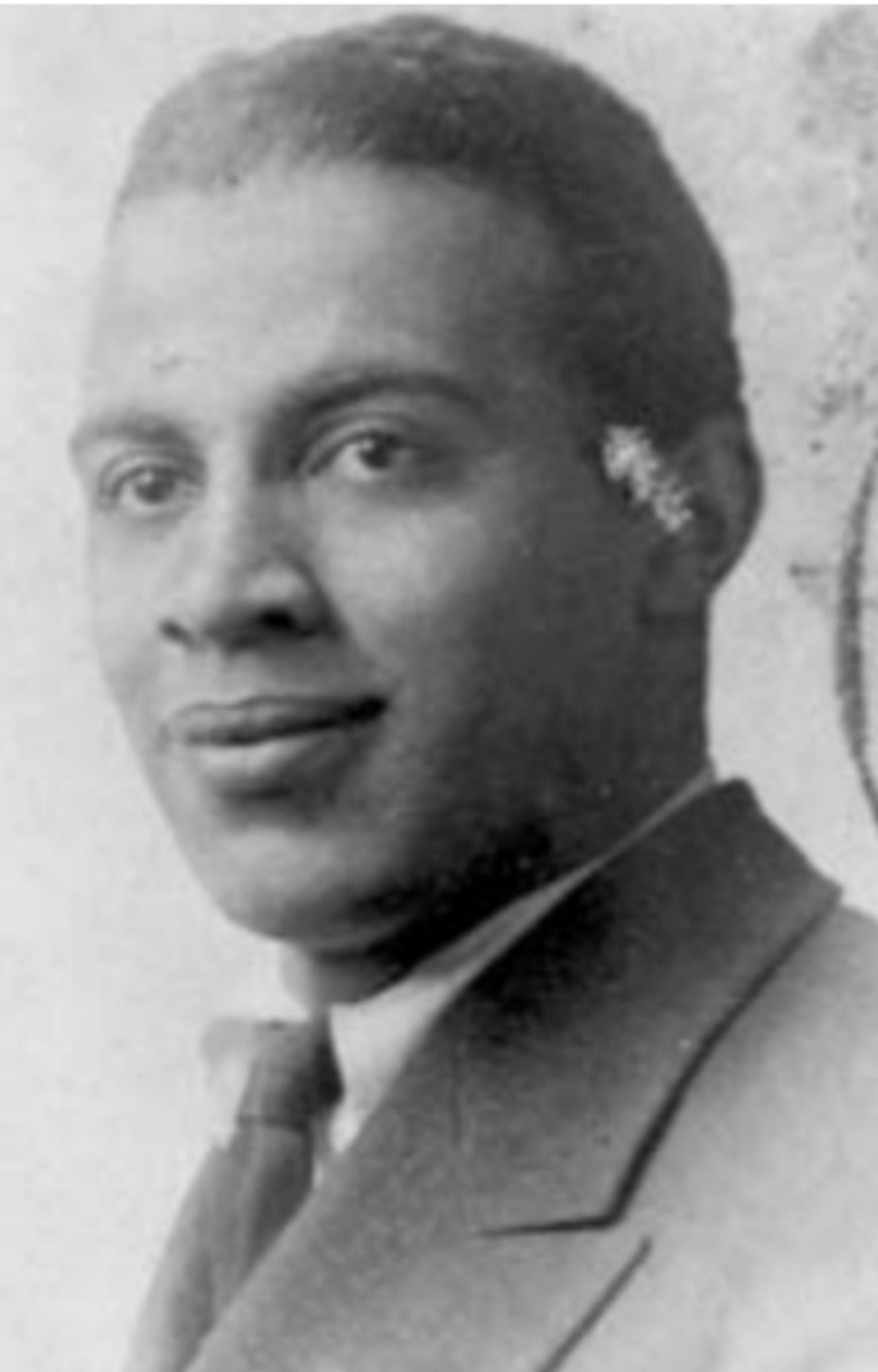
Photo of Richard Bruce Nugent taken for English Certificate of Registration while touring with Porgy and Bess. Source: Wirth (2002)
In 1926, a twenty-year-old Black writer sat down in Harlem and wrote a story that almost no one around him was willing to make public. Black men have long been taught to bury desire and vulnerability behind a performance of toughness, an idea bell hooks explores at length in her book on Black men and masculinity.
Nugent’s story refused that mask outright, naming desire without disguise. His name was Richard Bruce Nugent, and the work was Smoke, Lilies and Jade, which scholars widely describe as the first work of fiction by a Black American author to openly explore homosexual desire.

Schomburg Center for Research in Black Culture — New York Public Library
Nugent lived to be eighty years old. He outlived nearly all the major figures of the Harlem Renaissance, a cultural, artistic, literary movement of the 1910s through the 1930s. Yet for much of his life he remained a marginal figure in the very movement he helped shape.
That marginality was not a simple accident of memory. It reflected a culture that celebrated Black artistic brilliance while still demanding discretion, restraint, and respectability from the people producing it.
That tension is the real story of Richard Bruce Nugent’s life. He was not merely a talented writer who happened to be queer. He was a Black queer artist who refused to treat his own life as a secret, and for that refusal he was both indispensable and inconvenient.
A life outside respectability
Richard Bruce Nugent was born in Washington, D.C., in 1906. After his father died, his mother moved the family to New York in search of stability, but Nugent gravitated toward art and bohemian life rather than steady employment.
Concerned, his mother eventually sent him back to Washington to live with his grandmother, though he returned to New York in 1925 and quickly entered the circle of artists who would define the Harlem Renaissance, according to the Amistad Research Center.
Langston Hughes introduced him to Zora Neale Hurston and Wallace Thurman. Alain Locke, often called the architect of the Harlem Renaissance, took an early interest in his work.
Nugent moved in with Thurman in a boarding house the group nicknamed Niggerati Manor, a wry and self-aware name that reflected both their ambition and their resistance to the norms of respectability that hovered over Black cultural production in the 1920s.
This was a generation making art under pressure. Black writers were expected to be uplifting, respectable, and legible to white patrons as well as Black elites. They were expected to represent the race well, which usually meant representing it in ways that made other people comfortable.
Nugent had little interest in that kind of performance. He wanted to write what was true.
The magazine that burned

Schomburg Center for Research in Black Culture, New York Public Library
In 1926, Nugent, Thurman, Hughes, and Hurston launched FIRE!!, a magazine intended to showcase a younger and more experimental generation of Black artists.
It was a declaration of independence from the literary caution that had governed so much of Black publishing. The project was meant to make room for modern life, sexuality, race, and artistic freedom without asking permission from older gatekeepers.
Only one issue ever appeared. It sold poorly, received harsh criticism, and left the founders in debt. Then, in a detail almost too perfect to be believed, surplus copies were reportedly destroyed in a fire while being stored in a basement, giving the magazine a literal ending that seemed to echo its cultural reception, according to LGBTQ Nation.
Inside that single issue was Nugent’s Smoke, Lilies and Jade.
The story follows Alex, a young man moving through Harlem while wrestling with desire for both a man and a woman. Its form is fragmented and modernist, drawing on the literary experimentation of the period, but its radicalism lies in its directness. It does not hide queer longing inside euphemism. It does not displace desire into abstraction. It simply names it.
That alone made it exceptional.
In a literary culture where Black same-sex desire was often coded, implied, or left unspoken, Nugent wrote as if the truth of it should not require translation. That act still feels startling because it was not a private confession hidden in a diary. It was published, publicly, under his name.
The price of visibility
That openness came at a cost. Alain Locke, who had helped mentor Nugent, publicly criticized the story for what he called its effeminacy and decadence.
The criticism matters not only because Locke was an influential gatekeeper, but because it exposes the impossible conditions under which Black queer artists were being asked to create. Locke himself was gay, but he lived by the rule many Black queer intellectuals of the era understood all too well: discretion was survival.
Locke’s demand for discretion was not just a personal preference. It was an early version of an argument that still circulates today:
that queer people, and especially queer people of color, gain acceptance by policing their own visibility and language.
That argument has resurfaced recently in a much-debated op-ed calling for a retreat from the word queer itself and a return to quieter, more palatable self-presentation.
Nugent’s life is a direct answer to that argument, decades before it was being made. He did not believe respectability was the price of being taken seriously, and he did not pay it.
Nugent refused that rule. According to archival materials at the Amistad Research Center, he never regarded his sexuality as shameful and did not consider it anyone else’s business. That attitude made him unusual for his time and, in many circles, deeply inconvenient.
Later scholarship has emphasized just how unusual that openness was. Duke University Press, in Gay Rebel of the Harlem Renaissance, describes Nugent as the only African American writer of his era willing to state his homosexuality clearly in print rather than encode or conceal it.
That claim should be read carefully, but its larger point is hard to miss: Nugent occupied a rare position in Black literary history, one defined by candor rather than strategic silence.
It is also why his marginalization should not be mistaken for obscurity alone. He was not simply forgotten. He was made difficult to include in the canon that later solidified around the Harlem Renaissance.
That canon often favored the brilliant but legible, the radical but containable, the artist who could be praised without forcing a reckoning with sexual truth.
An art ahead of its moment
Nugent’s visual art carried the same directness as his writing. His erotic drawings drew on Art Deco and European modernism, but he placed Black bodies and Black desire at the center of that aesthetic world. He was not merely borrowing from the avant-garde. He was revising it.
That revision matters. European modernism had plenty of experimentation, but it rarely made space for the erotic interior lives of Black people. Nugent’s work did not ask permission to enter that conversation. It inserted Black queer presence where it had been absent.

Schomburg Center for Research in Black Culture, New York Public Library
He continued to write for decades, though much of his work remained unpublished during his lifetime. His novel *Gentleman Jigger* did not appear in print until 2008, long after his death. That delay says less about the value of the work than about the narrowness of the market that first received it. In other words, the problem was not merely that Nugent was ahead of his time. The problem was that the time itself was unwilling to receive him.
Nugent also worked across performance and theater. He appeared on Broadway, joined the Federal Theatre Project during the Depression, and maintained a multifaceted artistic life even as the Harlem Renaissance receded from public memory. He was not a one-story figure. He was a working artist whose life moved across genres, scenes, and eras.
Marriage, loss, and complexity
In 1952, Nugent married Grace Marr. The marriage did not erase his attraction to men, and by most accounts did not pretend to. That fact complicates any simple reading of his life, but it also reflects the realities of many queer lives in the mid-twentieth century, when marriage could coexist with desire, secrecy, companionship, and social pressure.
His close friend Thomas Wirth later wrote that Grace loved Nugent deeply and hoped, as many spouses of that era did, that love might change him. It did not. The marriage lasted until Grace’s death by suicide in 1969, a loss that shaped the later decades of Nugent’s life in ways biographers have not always treated with the depth they deserve.
The point is not to flatten Nugent into a symbol of queer triumph. It is to recognize that his life, like many lives, contained contradiction, affection, grief, survival, and refusal all at once. He did not live as an abstract argument. He lived as a person making art inside the constraints of his century.
Rediscovery at last
By the 1980s, a new generation of Black gay writers and filmmakers was searching for its own history and finding almost nothing. Nugent was still alive, still willing to talk, and suddenly indispensable.
He was interviewed for the 1984 documentary Before Stonewall. His story appeared, transformed, in Isaac Julien’s *Looking for Langston, an elegiac meditation on Black queer desire during the Harlem Renaissance. Joseph Beam included Nugent’s work in the landmark 1986 anthology [In the Life](https://www.goodreads.com/en/book/show/1341743.In_the_Life),* introducing him to an entirely new audience of Black gay readers who had never heard his name.
That rediscovery was not just a matter of biography. It was part of a larger cultural recovery project, an effort to reconstruct a history that had been fragmented by homophobia, institutional neglect, and the tendency of archives to preserve what institutions considered respectable.
Nugent died in 1987 in Hoboken, New Jersey, of congestive heart failure, just as this rediscovery was gaining momentum. He was one of the last surviving members of his generation, and one of the few people still able to speak firsthand about what it had meant to be young, Black, gay, and unwilling to hide in 1920s Harlem.
Why his name still matters
Ask most people to name the central figures of the Harlem Renaissance and they will likely say Langston Hughes, Zora Neale Hurston, Countee Cullen, maybe Alain Locke. Richard Bruce Nugent rarely makes the list, despite having done something none of them did in quite the same way: he made Black queer desire explicit, in print, under his own name.
That omission is not just a gap in popular memory. It is the result of a historical process in which institutions and historians often treated him as a side note rather than a founder, because his honesty made him difficult to absorb into a polished story of Black art and progress.
His erasure also reveals how selective cultural memory can be. The Harlem Renaissance is often celebrated as a flowering of Black creativity, but the version most people inherit is still narrowed by what can be comfortably narrated.
Nugent disrupts that story. He reminds us that the movement was not only about uplift and racial artifice. It was also about desire, experimentation, and the refusal to let Black life be reduced to respectability.
That is why he remains important now. He wrote himself into the record without permission, and in doing so left behind a challenge that still resonates: history is not neutral when it forgets the people who tell the truth too plainly. It is selective.
Richard Bruce Nugent spent his life proving that Black queer love had always been part of the story.
If this piece changed how you think about who gets remembered and why, give it some claps. Richard Bruce Nugent spent his life being written out of the record he helped create. The least we can do now is make sure the read count says otherwise.
Further Reading
Gay Rebel of the Harlem Renaissance: Selections from the Work of Richard Bruce Nugent, edited by Thomas H. Wirth, Duke University Press, 2002.
Richard Bruce Nugent archival materials, Amistad Research Center.
Dylan Rowen, Cruising the Harlem Renaissance with Richard Bruce Nugent, The Modernist Review.
Richard Bruce Nugent, the Queer Rebel of the Harlem Renaissance, LGBTQ Nation.
메타데이터
- post_id
- 57fa7caddab2
- slug
- he-told-the-truth-about-black-queer-love-decades-before-anyone-else-dared-57fa7caddab2
- url
- https://medium.com/prismnpen/he-told-the-truth-about-black-queer-love-decades-before-anyone-else-dared-57fa7caddab2
- canonical_url
- https://medium.com/prismnpen/he-told-the-truth-about-black-queer-love-decades-before-anyone-else-dared-57fa7caddab2
- author_url
- https://medium.com/@jusbouey
- status
- ok
- fetched_at
- 2026-07-08 17:17:42