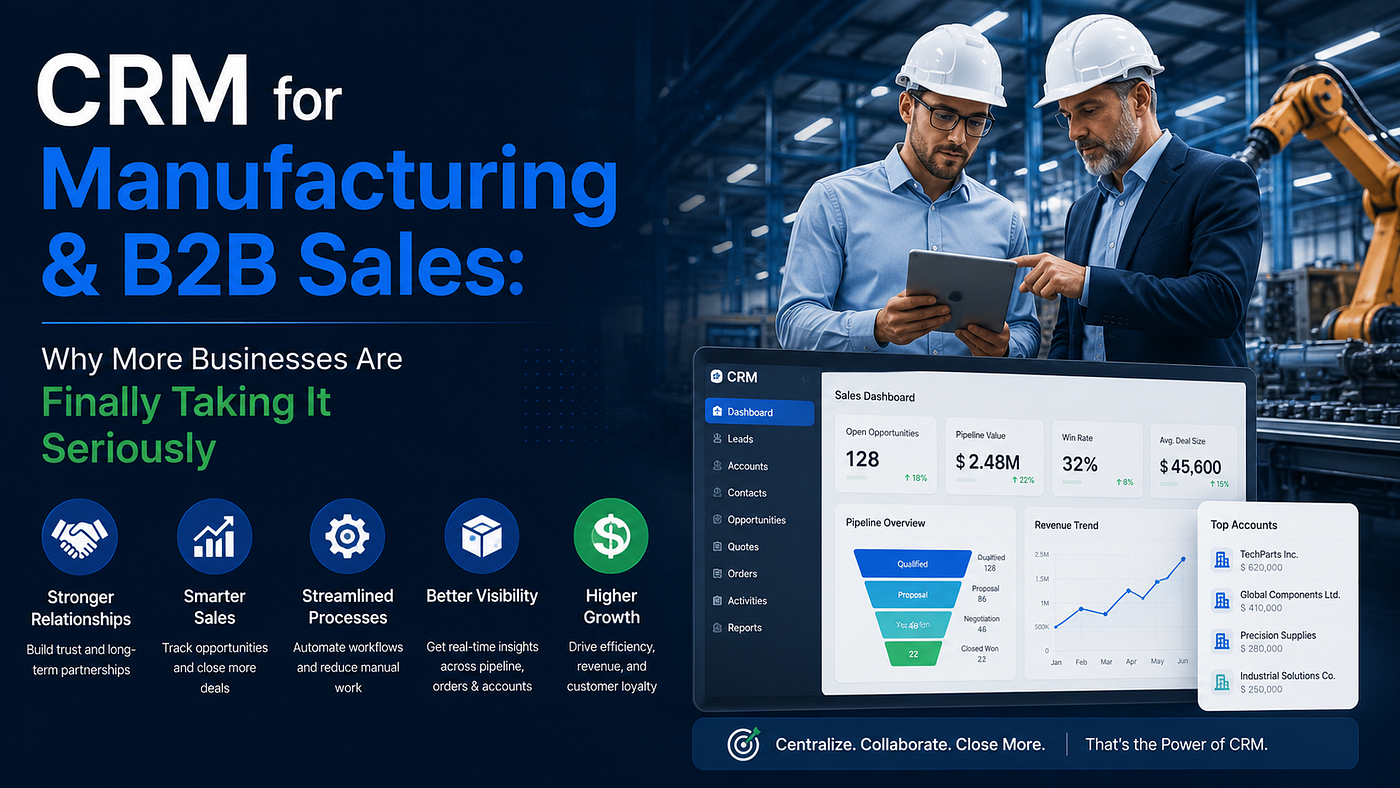
CRM for Manufacturing & B2B Sales: Why More Businesses Are Finally Taking It Seriously
If you work in manufacturing or B2B sales, you already know one thing: Closing a deal is rarely quick. A customer sends an enquiry. Then…
CRM for Manufacturing & B2B Sales: Why More Businesses Are Finally Taking It Seriously
If you work in manufacturing or B2B sales, you already know one thing: Closing a deal is rarely quick. A customer sends an enquiry. Then comes the quotation. A follow-up call. Maybe a product discussion. Sometimes samples are requested. Pricing gets negotiated. Another decision-maker enters the conversation. Weeks pass.
And after all that, the deal may still not close immediately.
That’s just how B2B sales work.
But here’s the problem many manufacturing businesses still face — they’re handling long sales cycles with systems that were never really built for it.
Spreadsheets for leads.
WhatsApp for conversations.
Emails for quotations.
Sticky notes for reminders.
And somewhere in between, important follow-ups quietly get missed.
Nobody plans for this to happen.
It just does.
The sales team gets busy, priorities change, and suddenly a promising lead goes cold simply because nobody followed up at the right time.
This is exactly why more businesses are now looking at CRM for manufacturing and B2B sales a lot more seriously.
Not because CRM is trendy.
Because manual tracking eventually stops working.
Why Manufacturing Businesses Struggle With Sales Tracking
Manufacturing sales are different from direct consumer sales.
People don’t usually place bulk orders after one conversation.
A buyer may compare suppliers for weeks. Procurement teams ask questions. Technical details need clarification. Pricing discussions happen multiple times.
Sometimes, the person who first contacted you isn’t even the final decision-maker.
That makes organisation extremely important.
But many businesses still rely too much on memory.
Someone says:
“I’ll call them next Tuesday.”
Then another urgent task comes up.
The follow-up gets delayed.
Meanwhile, another supplier responds faster.
And the opportunity slowly fades.
Honestly, this happens more often than companies realise.
The frustrating part?
Most businesses don’t even know exactly where they lost the deal.
Common Problems Manufacturing & B2B Teams Face
After a certain point, almost every growing manufacturing company runs into similar issues.
Follow-Ups Become Inconsistent
A customer asks for pricing.
The quotation gets shared.
Then… silence.
The team assumes the customer will respond if interested.
But B2B sales usually don’t work like that.
Buyers are busy. Decisions take time. Follow-ups matter.
Many deals are lost not because pricing was wrong, but because someone else stayed more consistent.
Sales Conversations Stay Scattered
One conversation happens on WhatsApp.
Another on email.
Someone discussed technical requirements over a phone call.
Quotation history is saved somewhere else.
After a few weeks, nobody has the full picture.
And when a customer reconnects, sales teams waste time trying to remember what happened earlier.
Managers Don’t Get Proper Visibility
This is another common issue.
A manager asks:
“What’s the status of this deal?”
And the answer sounds something like:
“We spoke recently… I think they’re still considering.”
That uncertainty creates problems.
Without visibility, forecasting becomes difficult and decision-making slows down.
How CRM Actually Helps in Manufacturing & B2B Sales
A lot of businesses hear the word “CRM” and immediately think it’s just another software.
But in reality, a good CRM solves very practical problems.
It helps teams stop depending completely on memory.
Instead of scattered communication, everything stays organised in one place.
For example, teams can easily track:
- enquiries from different sources
- quotation history
- follow-up timelines
- customer conversations
- deal stages
- pending opportunities
This sounds simple, but it changes daily operations more than most people expect.
Because now nobody has to ask:
“Did someone follow up with this client?”
The answer is already there.
Better Follow-Ups Without Constant Manual Effort
This is probably one of the biggest benefits.
In manufacturing and B2B sales, timing matters.
If a customer requested pricing last week, somebody should reconnect.
If a quotation was shared, there should be follow-up.
A CRM helps teams stay consistent without depending entirely on reminders in someone’s head.
And consistency matters.
Sometimes the supplier who follows up better wins — even when pricing isn’t the cheapest.
Better Relationship Management
B2B business is relationship-driven.
Customers usually buy repeatedly if the experience stays smooth.
A CRM helps teams maintain better communication and track customer history over time.
That becomes useful when:
- customers reorder products
- requirements change
- new products launch
- upselling opportunities appear
Long-term business becomes easier when customer information is organised.
How Groweon CRM Helps Manufacturing Businesses
For businesses handling multiple enquiries, quotations, and long sales cycles, **Groweon CRM** helps keep things organised.
Instead of switching between spreadsheets, WhatsApp chats, and scattered notes, teams can manage:
- leads and enquiries
- quotation follow-ups
- customer communication
- sales pipeline tracking
- WhatsApp engagement
- team coordination
inside one platform.
The idea is not to make work more complicated.
It’s actually the opposite.
To help teams stop missing opportunities simply because information was scattered.
Final Thoughts
Manufacturing and B2B sales are rarely fast.
Deals take time.
Customers compare vendors.
Decisions involve multiple people.
That means follow-up and organisation matter a lot more than many businesses realise.
At some point, manual systems stop being enough.
Not because teams are bad at sales.
But because growth creates complexity.
A good CRM for manufacturing & B2B sales helps businesses stay organised, improve visibility, and manage customer relationships more consistently.
And honestly, sometimes even a simple improvement in follow-up can make a noticeable difference in conversions.
메타데이터
- post_id
- 5807bbdf2402
- slug
- crm-for-manufacturing-b2b-sales-why-more-businesses-are-finally-taking-it-seriously-5807bbdf2402
- url
- https://medium.com/@lmsbabatracking/crm-for-manufacturing-b2b-sales-why-more-businesses-are-finally-taking-it-seriously-5807bbdf2402
- canonical_url
- https://medium.com/@lmsbabatracking/crm-for-manufacturing-b2b-sales-why-more-businesses-are-finally-taking-it-seriously-5807bbdf2402
- author_url
- https://medium.com/@lmsbabatracking
- status
- ok
- fetched_at
- 2026-07-11 09:13:54