Local LLM on iPhone: which runtime is actually fastest?
Four on-device runtimes, same models, same prompt, same harness — on a real iPhone 17 Pro.
Local LLM on iPhone: which runtime is actually fastest? I benchmarked MLX, llama.cpp, LiteRT-LM, and CoreML
Four on-device runtimes, same models, same prompt, same harness — on a real iPhone 17 Pro.
You want to run a local LLM on iPhone.
But there are several runtime options, and it’s genuinely not obvious which to pick.
And clear head-to-head benchmarks are hard to find. The contenders:
- MLX — Apple charging into the on-device LLM scene, all-in.
- llama.cpp — the name in local LLM: mature, well-worn, huge community.
- LiteRT-LM — Gemma-4-only, but Google’s purpose-built super-soldier.
- CoreML-LLM — runs on the Apple Neural Engine, the unit that’s been left out in this GPU/Metal era. I built this one… and, ah, can it even compete?
So — fine, let’s just do it.
On iPhone 17 Pro (A19 Pro), I ran the same models through all four on-device runtimes and measured decode speed and memory.
The verdict:
“For local LLM on iPhone, default to MLX.”
“For Gemma 4 specifically, LiteRT-LM is king.”
Conclusions first
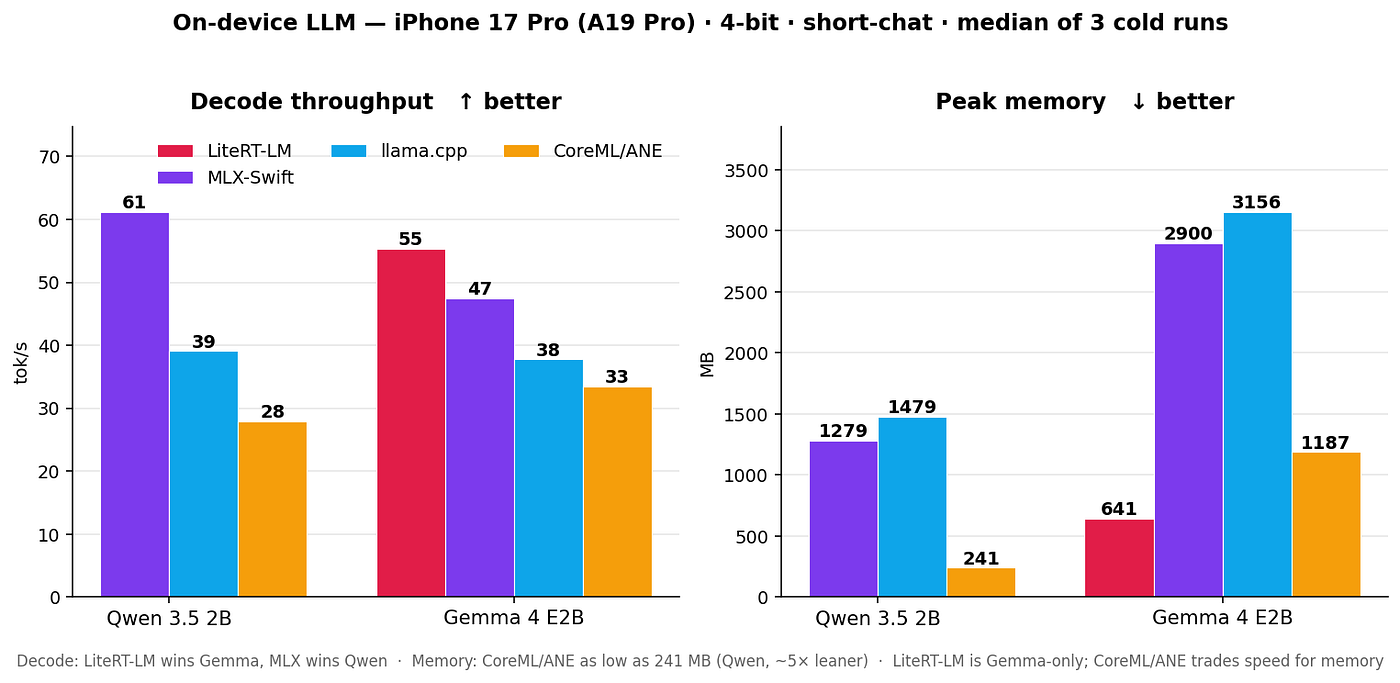
- Decode speed: Qwen 3.5 2B → MLX is fastest (61 tok/s). Gemma 4 E2B → LiteRT-LM wins decisively (55 tok/s).
- Memory: CoreML / ANE (Apple Neural Engine) wins big — Qwen 3.5 2B in just 241 MB (~1/5 of MLX). Slowest decode, but hey: nice work, CoreML.
- Use-case picks at the end.
Setup
- Device: iPhone 17 Pro (A19 Pro, iOS 26.4.2)
- Runtimes: MLX Swift / llama.cpp / LiteRT-LM / CoreML (ANE)
- Models: Gemma 4 E2B, Qwen 3.5 2B (4-bit class)
- Task: short-chat (128-token response)
- Aggregation: median of 3 cold runs
- Metrics: decode tok/s (higher = better), peak memory MB (lower = better)
Result 1 — Decode throughput (tok/s, higher is better)
- Gemma 4 E2B: 🔴 LiteRT-LM 55.4 🏆 · 🟣 MLX 47.5 · 🔵 llama.cpp 37.8 · 🟠 CoreML/ANE 33.4
- Qwen 3.5 2B: 🟣 MLX 61.2 🏆 · 🔵 llama.cpp 39.1 · 🟠 CoreML/ANE 27.9 · 🔴 LiteRT-LM — (Gemma-only)
On Gemma 4 E2B, LiteRT-LM wins by a clear margin. LiteRT-LM is Google’s on-device inference runtime, running Gemma in its native .litertlm (INT4-QAT) format on the Metal GPU. Their model × their runtime × their format — the optimization compounds. The Swift API was under construction for the longest time; whoever was on it, this is a strong result.
On Qwen 3.5 2B, MLX-Swift takes it at 61 tok/s. Apple’s on-device LLM push is the real deal. (LiteRT-LM doesn’t enter this row — its catalog is Gemma-only.)
Result 2 — Peak memory (MB, lower is better)
- Gemma 4 E2B: 🔴 LiteRT-LM 641 🏆 · 🟠 CoreML/ANE 1,187 · 🟣 MLX 2,900 · 🔵 llama.cpp 3,156
- Qwen 3.5 2B: 🟠 CoreML/ANE 241 🏆 · 🟣 MLX 1,279 · 🔵 llama.cpp 1,479
CoreML / ANE wins this, hard. Qwen 3.5 2B in 241 MB — about 1/5 of MLX (1,279) and llama.cpp (1,479). This is the chunked-MLKV path (Qwen35MLKVGenerator in CoreML-LLM): chunked weights + KV cache streamed through the Neural Engine.
If your binding constraint is RAM — running a 2B-class model on memory-tight iPhones, or letting your LLM coexist with the rest of your app without fighting over memory — the ANE is a very strong option.
Fairness notes
- CoreML / ANE is engineered for memory and power efficiency over raw throughput. First-load triggers ANE compilation, so load times are longer. The decode count is the number of streamed pieces (≈ tokens).
- LiteRT-LM has no per-call output cap, so it runs to EOS (a full ~458-token reply); the others stop at 128. Decode tok/s is a steady-state rate, so the comparison still holds. Numbers come straight from LiteRT-LM’s own benchmark counters (
getBenchmarkInfo). - All models are 4-bit class, but the quantization schemes differ slightly: MLX 4-bit / GGUF Q4_K_M / LiteRT INT4-QAT / CoreML INT4-palettized (Gemma) and INT8 (Qwen).
Which runtime should you use?
- Raw speed + a broad model catalog → MLX-Swift. Fastest on Qwen, dead-simple from Swift, and
mlx-communityhas the models. The default first pick for local LLM on Apple devices. - You’re on Gemma → LiteRT-LM. Best on both speed and memory for the Gemma family. Can’t beat it on its home turf.
- Memory-constrained / multi-purpose apps → CoreML / ANE.241 MB for a 2B-class model is wild. If your throughput budget is “human reading speed,” you get the memory and power efficiency for free.
- Portability across non-Apple platforms → llama.cpp. GGUF ecosystem, runs everywhere. No flashy peaks, but a dependable workhorse.
How I measured it (and how you can reproduce)
Every run is driven from a Mac via devicectl in fully-headless mode — nothing tapped on the phone. Models are side-loaded from Mac to device. The raw JSONL files and the chart all live in the repo. A pull request is one benchmark row: one runtime × one model × one device.
👉 **github.com/john-rocky/apple-silicon-llm-bench**
The engineering side — automating iPhone benchmarks end-to-end, the git-LFS skirmish, SwiftPM’s unsafe-flags rule,
*@preconcurrency*imports — is a story of its own. Separate post.
Wrap-up
iPhone local LLM, in one line: speed → MLX or LiteRT-LM; memory → CoreML / ANE.
Hope it helps with your own on-device LLM work! 🐥
Work & technical consulting
I provide development support across iOS / Android / LLM / CoreML / LiteRT / ARKit / LiDAR / camera & image recognition.
I’m especially good at the parts that get stuck on real devices and in production:
- On-device AI inference, CoreML conversion, and speedups on mobile
- Recognition apps combining Camera / Vision / YOLO / OCR / CLIP
- 3D coordinate estimation, measurement, and on-site scanning with ARKit / LiDAR
- Taking over PoCs, performance work, and pre-delivery technical rescue
- Rethinking “works in the demo, flaky in the field” AI apps
Beyond proof-of-concept, I help land things in an actually-usable form — factoring in real-world constraints, UX, and operations.
If you’re stuck on something similar, reach out at rockyshikoku@gmail.com, or via X / LinkedIn.
메타데이터
- post_id
- 58096685481e
- slug
- local-llm-on-iphone-which-runtime-is-actually-fastest-58096685481e
- url
- https://medium.com/@rockyshikoku/local-llm-on-iphone-which-runtime-is-actually-fastest-58096685481e
- canonical_url
- https://medium.com/@rockyshikoku/local-llm-on-iphone-which-runtime-is-actually-fastest-58096685481e
- author_url
- https://medium.com/@rockyshikoku
- status
- ok
- fetched_at
- 2026-07-27 22:41:22