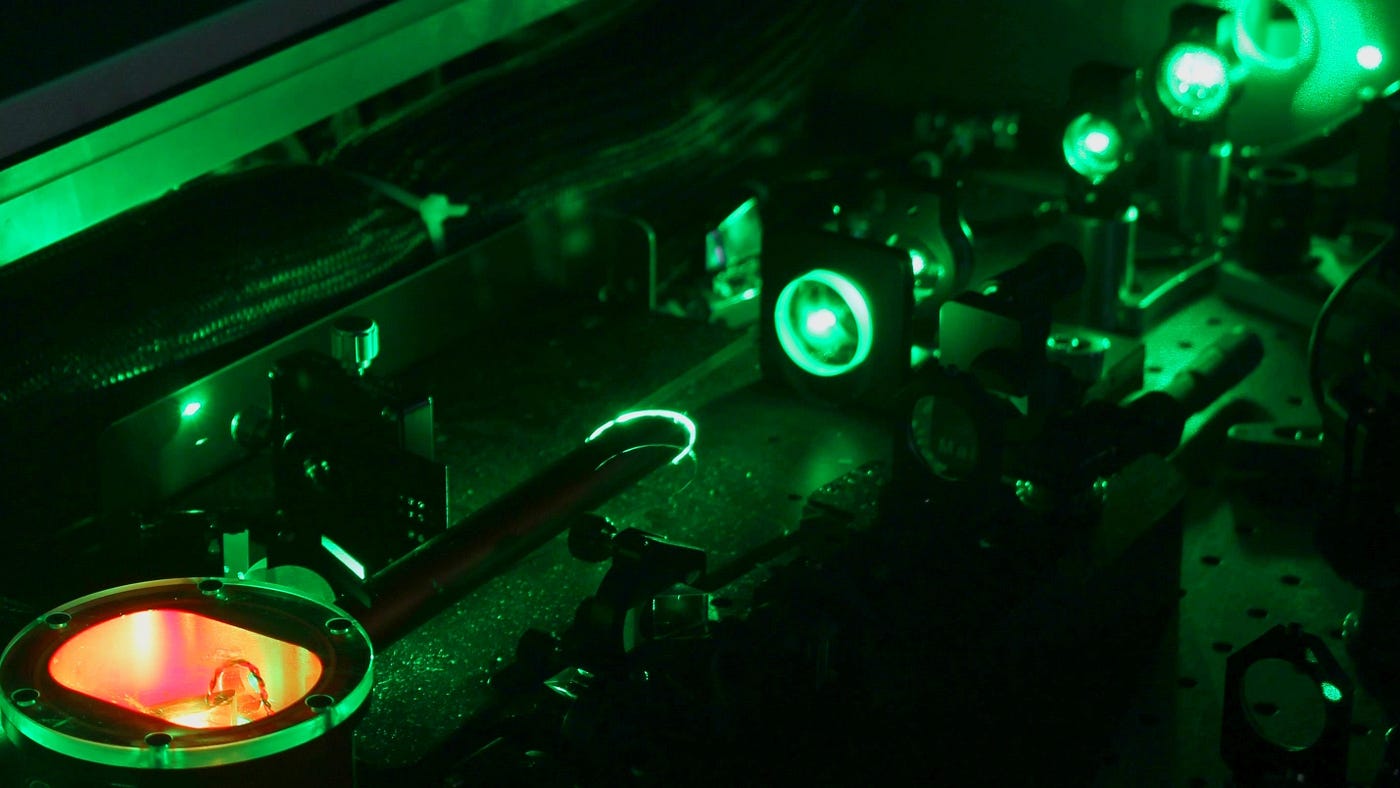
ELECTROMAGNETISM AND EM WAVEs
Electromagnetism is the fundamental force and is important for our daily lives. We shall discuss about the basics and study about EM waves…
ELECTROMAGNETISM AND EM WAVES
Electromagnetism is the fundamental force and is important for our daily lives. We shall discuss about the basics and study about EM waves and this concept in detail.
The Basics of Electromagnetism
Electromagnetism encompasses the study of electric fields, magnetic fields, and the interactions between them. At the heart of electromagnetism is the relationship between electricity and magnetism, which were initially thought to be separate forces. However, in the 19th century, scientists like James Clerk Maxwell unified these forces through a set of equations that describe how electric and magnetic fields interact with each other and with charged particles.
Maxwell’s equations describe the behavior of electric and magnetic fields, and they have profound implications for our understanding of light, energy transmission, and the nature of electromagnetic waves.
- Electric Fields: These arise from the presence of electric charges. A positive charge creates an electric field that points away from it, while a negative charge generates a field that points toward it.
2. Magnetic Fields: These are produced by moving electric charges (currents) or by certain materials (like magnets). A magnetic field is associated with the motion of charged particles and always forms a closed loop.
ELECTRIC CHARGE
Electric charge is a fundamental property of matter that causes it to experience a force when placed in an electric and magnetic field. It is one of the basic building blocks of electromagnetism, and understanding it is crucial to understanding how electrical and magnetic phenomena work.
Types of Electric Charges
There are two types of electric charges:
- Positive Charge: Typically associated with protons, which are positively charged particles found in the nucleus of an atom.
- Negative Charge: Typically associated with electrons, which are negatively charged particles orbiting around the nucleus of an atom.
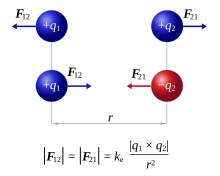
Like charges repel each other, while opposite charges attract. This principle is known as Coulomb’s Law.
Coulomb’s Law
Coulomb’s Law describes the electrostatic force between two point charges. It states that the force between two charges is:
- Attractive if the charges are opposite.
- Repulsive if the charges are the same.
Mathematically, Coulomb’s Law is expressed as:
F=kq1q2/r²
Where:
- F is the force between the charges (in newtons, N)
- k is Coulomb’s constant (8.99×10⁹ N⋅m2/C2)(8.99 \times 10⁹ \, N \cdot m² / C²)(8.99×10⁹N⋅m2/C2)
- q1 and q2 are the magnitudes of the two charges (in coulombs, C)
- r is the distance between the charges (in meters, m)
The force is directly proportional to the product of the charges and inversely proportional to the square of the distance between them.
Properties of Electric Charge
- Quantization: Electric charge is quantized, meaning it comes in discrete amounts. The smallest possible unit of charge is the elementary charge e=1.602×10⁻¹⁹ Ce = 1.602 \times 10^{-19} \, Ce=1.602×10⁻¹⁹C, which is the charge of a single electron or proton.
- Conservation of Charge: Electric charge is conserved in all processes. This means that charge can neither be created nor destroyed, only transferred between objects. The total charge in an isolated system remains constant.
- Additivity: Charges can be added algebraically. The total charge of a system of charges is the sum of the individual charges.
- Insulators and Conductors: Materials differ in how easily they allow the flow of electric charge:
- Conductors (e.g., metals like copper) allow electric charge to flow easily because their electrons are free to move.
- Insulators (e.g., rubber, glass) do not allow the free flow of charge because their electrons are tightly bound to atoms.
Electric Field and Electric Charge
An electric charge creates an electric field around it. The electric field is a vector field that points in the direction that a positive test charge would move if placed in the field. The strength of the electric field decreases with the square of the distance from the charge.
The electric field E due to a point charge q is given by:
E=kq/r²
Where:
Where:
- E is the electric field strength (in newtons per coulomb, N/C)
- q is the charge creating the electric field (in coulombs, C)
- r is the distance from the charge (in meters, m)
Gauss’s Law (Integral Form)
The integral form of Gauss’s Law states that the total electric flux ΦE passing through a closed surface is proportional to the total charge enclosed by that surface. Mathematically, it is expressed as:
∮ E ⋅ dA = Qenc/ϵ0
- ∮S represents the surface integral over a closed surface S
- E is the electric field vector at a point on the surface.
- dA is a vector representing an infinitesimal element of area on the surface, pointing outward.
- Qenc is the total charge enclosed within the surface.
- ϵ0 is the permittivity of free space
Magnetic Force Formula (Lorentz Force)
F = q(v×B)
Where:
- F is the magnetic force on the charged particle (measured in newtons, N).
- q is the electric charge of the particle (in coulombs, C).
- v is the velocity vector of the particle (in meters per second, m/s).
- B is the magnetic field vector (in teslas, T).
- × denotes the cross product, which means the force is perpendicular to both the velocity and the magnetic field.
Key Points About Magnetic Force
- Direction of the Force:
- The magnetic force is always perpendicular to both the velocity of the charged particle and the magnetic field. This means that the magnetic force does not change the speed (magnitude) of the particle, but it can change the direction of motion.
- The direction of the magnetic force can be determined using the right-hand rule:
- Point your thumb in the direction of the velocity (v).
- Point your fingers in the direction of the magnetic field (B).
- Your palm will face the direction of the magnetic force for a positive charge. For a negative charge, the force will be in the opposite direction.
Ampère’s Circuital Law (Integral Form)
Ampère’s Circuital Law in its integral form states that the line integral of the magnetic field B around a closed loop is proportional to the total current Ienc passing through the loop. Mathematically, it is expressed as:
∮C B⋅dl=μ0Ienc
Where:
- ∮C represents the line integral around a closed path C.
- B is the magnetic field at a point on the loop (in teslas, T).
- dl is an infinitesimal vector element of the path, pointing in the direction of the line integral.
- Ienc is the total enclosed current passing through the loop (in amperes, A).
- μ0 is the permeability of free space, a constant that quantifies the ability of a vacuum to support a magnetic field

Physical Interpretation
- The law tells us that the total magnetic field around a closed loop is directly related to the total current passing through the loop.
- The magnetic field produced by a current can be “measured” by integrating the magnetic field along a closed loop surrounding the current.
- The line integral ∮B⋅dl sums the contribution of the magnetic field along the entire loop, giving us the total effect of the current.
In simple terms, Ampère’s Law shows that the magnetic field around a conductor is proportional to the current flowing through it. The magnetic field circulates around the current-carrying conductor, and the strength of the field at a given distance is determined by the magnitude of the current.
Electromagnetic Induction
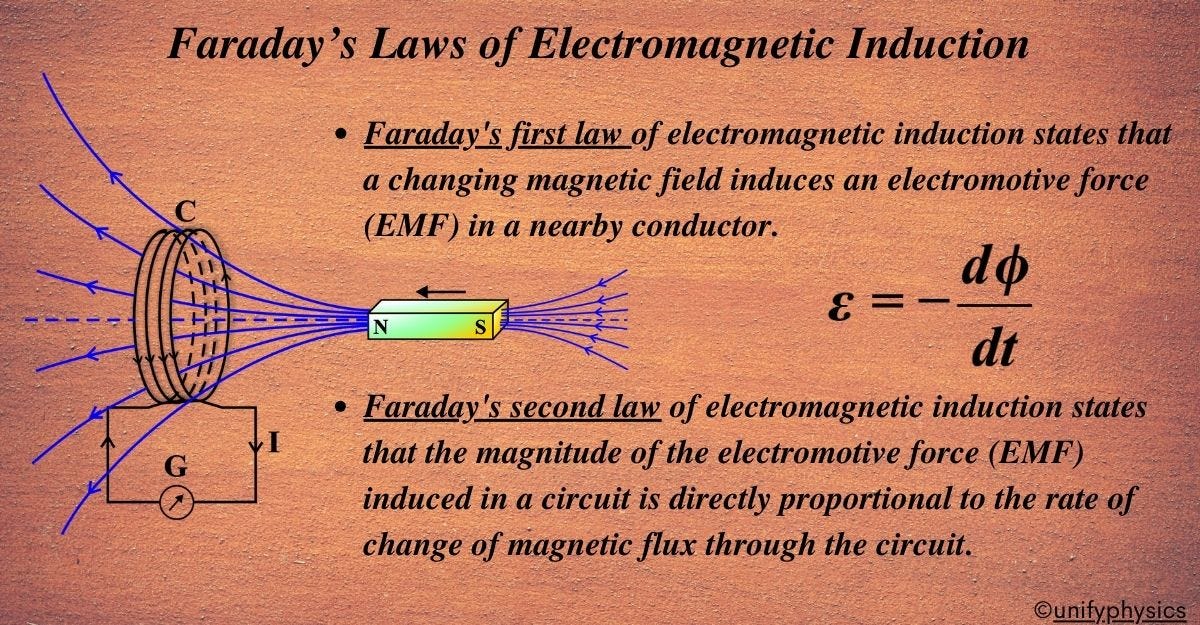
Electromagnetic Induction is a fundamental concept in electromagnetism where a changing magnetic field induces an electric current or electromotive force (EMF) in a conductor. This principle is the basis for many electrical devices, such as transformers, electric generators, and motors.
Faraday’s Law of Induction
The core principle of electromagnetic induction is described by Faraday’s Law. It states that a time-varying magnetic field creates an electric field, which induces an electric current in a conductor.
Mathematically, Faraday’s Law is expressed as:
E=−dΦB/dt
Where E is the induced electromotive force (EMF) (in volts, V).
- ΦB is the magnetic flux through a loop or coil (in webers, Wb).
- dΦB/dt is the rate of change of magnetic flux.
- The negative sign indicates that the induced EMF opposes the change in magnetic flux (this is called Lenz’s Law, which we’ll explain below).
Magnetic Flux
Magnetic flux (ΦB) is a measure of the quantity of magnetic field passing through a given surface. It depends on:
- The strength of the magnetic field (B).
- The area (A) through which the magnetic field lines pass.
- The angle θ is the angle between the magnetic field direction and the normal to the surface.
Mathematically, magnetic flux is given by:
ΦB=BAcosθ
Where:
- B is the magnetic field strength (in teslas, T).
- A is the area through which the field passes (in square meters, m²).
- θ is the angle between the magnetic field and the normal to the surface.
Lenz’s Law
Lenz’s Law states that the direction of the induced EMF (and current) will always oppose the change in magnetic flux that caused it. In other words, if the magnetic flux through a loop is increasing, the induced current will flow in a direction that creates a magnetic field opposing that increase; if the magnetic flux is decreasing, the induced current will flow in a direction that tries to maintain the magnetic flux.
This law is a consequence of the conservation of energy.
Faraday’s Law and Induced EMF
The induced EMF depends on how rapidly the magnetic flux through a loop changes:
- If the magnetic field changes, the flux changes, inducing an EMF.
- The faster the magnetic flux changes, the greater the induced EMF.
- If the area of the loop changes (such as when a coil is expanded or contracted), the magnetic flux through the coil changes, inducing EMF.
Induced Current in a Conducting Loop
When the induced EMF is applied across a conductor (such as a coil of wire), an electric current will flow if the circuit is closed. The magnitude of the induced current is determined by Ohm’s Law, which relates the current to the induced EMF and the resistance RRR of the circuit:
I=E/R
Where:
- I is the induced current (in amperes, A).
- E is the induced EMF (in volts, V).
- R is the resistance of the conductor (in ohms, Ω\OmegaΩ)
EM WAVES
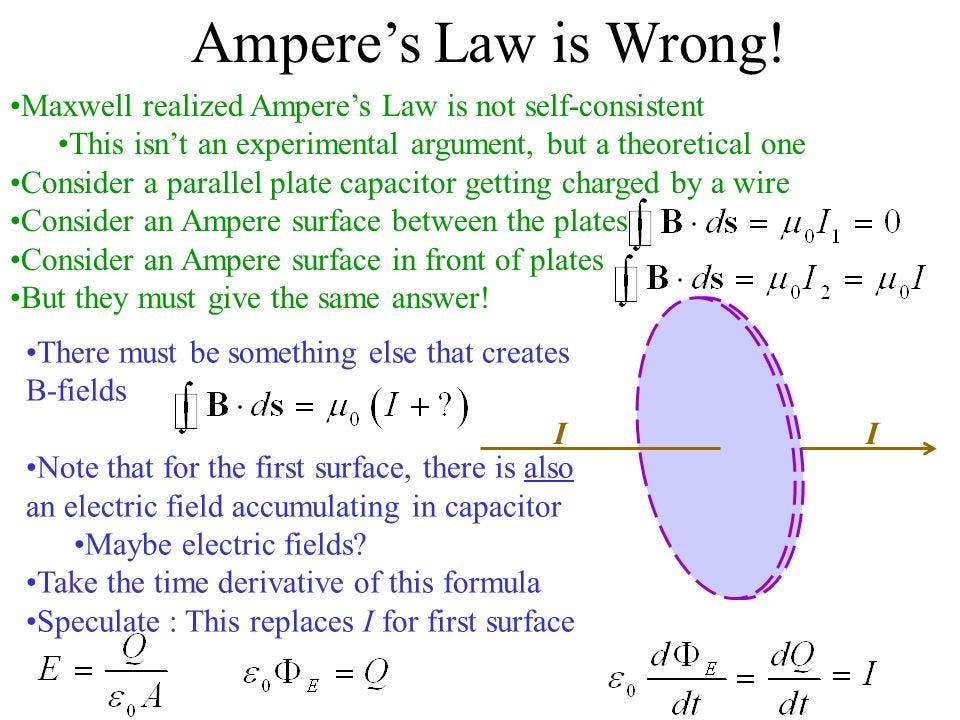
Ampere’s law is wrong.Here’s why?
Let us look at Ampere’s law:
∮C B⋅dl=μ0Ienc
Where:
- ∮C represents the line integral around a closed path C.
- B is the magnetic field at a point on the loop (in teslas, T).
- dl is an infinitesimal vector element of the path, pointing in the direction of the line integral.
- Ienc is the total enclosed current passing through the loop (in amperes, A).
- μ0 is the permeability of free space, a constant that quantifies the ability of a vacuum to support a magnetic field
Now let us look at an example:
- In a capacitor the energy is stored in the form of an electric field so according to this law there is no magnetic field but experimentally there is a magnetic field.
Ampere Maxwell Law
Ampère-Maxwell Law is a generalization of Ampère’s Law that accounts for both steady and time-varying electric currents. This law is a crucial part of Maxwell’s Equations, which are the foundation of classical electromagnetism.
While Ampère’s Law relates magnetic fields to steady electric currents, Ampère-Maxwell Law extends this relationship to include changing electric fields. It incorporates the concept of displacement current, which was introduced by James Clerk Maxwell to explain how changing electric fields can also produce magnetic fields.
Ampère-Maxwell Law (Integral Form)
The integral form of the Ampère-Maxwell Law states that the magnetic field circulating around a closed loop is related to the total current passing through the loop, including both the conduction current (the actual flow of charge) and the displacement current (which accounts for changing electric fields).
Mathematically, it is expressed as:
∮CB⋅dl=μ0(Ienc+ϵ0dΦE/dt)
Where:
- ∮CB⋅dl is the line integral of the magnetic field around a closed loop C.
- Ienc is the total electric current enclosed by the loop.
- dΦE/dt is the rate of change of the electric flux ΦE through the loop.
- ϵ0 is the permittivity of free space
- μ0 is the permeability of free space
Key Components of the Equation
- Conduction Current Ienc
- This represents the actual electric current (the flow of charge) that is passing through the surface bounded by the loop.
2. Displacement Current ϵ0dΦE/dt
- This term accounts for the contribution of a time-varying electric field to the magnetic field. A changing electric field E induces a magnetic field, and this is the basis of electromagnetic wave propagation.
- The displacement current is mathematically equivalent to the current that would be required to produce the same changing electric flux in a capacitor.
1. Introduction to Electromagnetic Waves
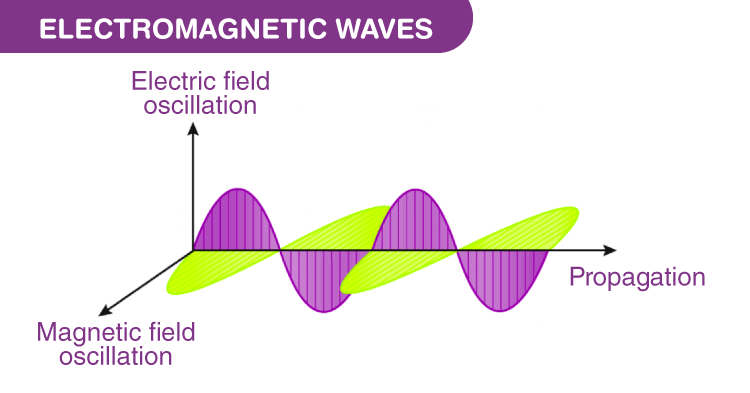
- Electromagnetic waves are waves that are created by the oscillation of electric and magnetic fields perpendicular to each other and to the direction of wave propagation.
- These waves do not require a medium for propagation, meaning they can travel through a vacuum (space).
- They travel at the speed of light (c=3×10⁸ m/s).
2. Nature of Electromagnetic Waves
- An electromagnetic wave consists of oscillating electric and magnetic fields. These fields are perpendicular to each other and to the direction of propagation of the wave.
- The electric field oscillates in one plane (e.g., y-axis) and the magnetic field oscillates in a perpendicular plane (e.g., z-axis), while the wave travels along the x-axis.
3. Characteristics of Electromagnetic Waves
The key characteristics of electromagnetic waves are:
- Transverse Nature: The oscillations of both the electric and magnetic fields are perpendicular to the direction of wave propagation.
- Speed of Light: In a vacuum, all electromagnetic waves travel at the same speed, c=3×10⁸m/s.
- Energy Transfer: Electromagnetic waves carry energy through space. This energy is divided between the electric and magnetic fields.
- Wavelength and Frequency: The wavelength (λ) and frequency (f) of an electromagnetic wave are related by the equation: c=λf Where:
- c is the speed of light,
- λ is the wavelength,
- f is the frequency.
4. Electromagnetic Spectrum
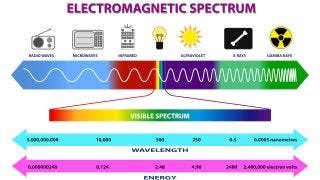
The electromagnetic spectrum is the range of all electromagnetic waves arranged according to their frequency or wavelength. The various types of electromagnetic waves include:
- Radio Waves: Used in communication (e.g., radio, television).
- Wavelength: 103 m10³ \, \text{m} 103m to 10−1 m10^{-1} \, \text{m}10−1m
- Frequency: 3×10⁴ Hz3 \times 10⁴ \, \text{Hz}3×10⁴Hz to 3×10⁹ Hz3 \times 10⁹ \, \text{Hz}3×10⁹Hz
- Microwaves: Used for cooking and satellite communication.
- Wavelength: 10−1 m10^{-1} \, \text{m}10−1m to 10−3 m10^{-3} \, \text{m}10−3m
- Frequency: 3×10⁹ Hz3 \times 10⁹ \, \text{Hz}3×10⁹Hz to 3×10¹² Hz3 \times 10^{12} \, \text{Hz}3×10¹²Hz
- Infrared Radiation: Used in thermal imaging and remote sensing.
- Wavelength: 10−3 m10^{-3} \, \text{m}10−3m to 7×10⁻⁷ m7 \times 10^{-7} \, \text{m}7×10⁻⁷m
- Frequency: 3×10¹² Hz3 \times 10^{12} \, \text{Hz}3×10¹²Hz to 4.3×10¹⁴ Hz4.3 \times 10^{14} \, \text{Hz}4.3×10¹⁴Hz
- Visible Light: The light visible to the human eye.
- Wavelength: 7×10⁻⁷ m7 \times 10^{-7} \, \text{m}7×10⁻⁷m to 4×10⁻⁷ m4 \times 10^{-7} \, \text{m}4×10⁻⁷m
- Frequency: 4.3×10¹⁴ Hz4.3 \times 10^{14} \, \text{Hz}4.3×10¹⁴Hz to 7.5×10¹⁴ Hz7.5 \times 10^{14} \, \text{Hz}7.5×10¹⁴Hz
- Ultraviolet Radiation: Used for sterilization and in black lights.
- Wavelength: 10−8 m10^{-8} \, \text{m}10−8m to 4×10⁻⁷ m4 \times 10^{-7} \, \text{m}4×10⁻⁷m
- Frequency: 7.5×10¹⁴ Hz7.5 \times 10^{14} \, \text{Hz}7.5×10¹⁴Hz to 3×10¹⁶ Hz3 \times 10^{16} \, \text{Hz}3×10¹⁶Hz
- X-rays: Used in medical imaging and security scanning.
- Wavelength: 10−12 m10^{-12} \, \text{m}10−12m to 10−8 m10^{-8} \, \text{m}10−8m
- Frequency: 3×10¹⁶ Hz3 \times 10^{16} \, \text{Hz}3×10¹⁶Hz to 3×10¹⁹ Hz3 \times 10^{19} \, \text{Hz}3×10¹⁹Hz
- Gamma Rays: Used in cancer treatment and nuclear reactions.
- Wavelength: Less than 10−12 m10^{-12} \, \text{m}10−12m
- Frequency: Greater than 3×10¹⁹ Hz3 \times 10^{19} \, \text{Hz}3×10¹⁹Hz
5. Production of Electromagnetic Waves
Electromagnetic waves are produced by the acceleration of charged particles. For example:
- A charge oscillating in an antenna generates electromagnetic waves (radio waves).
- Changing electric fields generate magnetic fields (and vice versa) as described by Maxwell’s equations.
6. Propagation of Electromagnetic Waves
Electromagnetic waves propagate through space by oscillating electric and magnetic fields that regenerate each other. A changing electric field creates a magnetic field, and a changing magnetic field induces an electric field, resulting in the continuous propagation of the wave.
7. Energy in Electromagnetic Waves
Electromagnetic waves carry energy, which is related to the amplitude of the fields. The energy density in an electromagnetic wave is given by:
u=ϵ0E^2/2+B^2/2μ0
Where:
- u is the energy density,
- E is the electric field intensity,
- B is the magnetic field intensity,
- ϵ0is the permittivity of free space,
- μ0 is the permeability of free space.
8. Poynting Vector
The Poynting vector (S) describes the energy flow per unit area of the electromagnetic wave:
S=E×B
This vector represents the direction of energy flow and its magnitude gives the energy flux.
9. Reflection, Refraction, and Diffraction of EM Waves
- Reflection: When an electromagnetic wave hits a surface, part of the wave reflects off the surface.
- Refraction: When electromagnetic waves pass from one medium to another, their speed and direction change.
- Diffraction: The bending of waves around obstacles or the spreading of waves when they pass through small openings.
10. Applications of Electromagnetic Waves
Electromagnetic waves have a wide range of applications, including:
- Radio waves: Broadcasting, wireless communication.
- Microwaves: Satellite communication, radar, and cooking.
- Infrared: Thermal imaging, remote controls, and night-vision devices.
- Visible light: Vision, photography, and illumination.
- Ultraviolet radiation: Sterilization, black lights, and medical imaging.
- X-rays: Medical diagnostics, security scans.
- Gamma rays: Cancer treatment, nuclear reactions.
Let us study X ray machines as we know the EM waves.
The working principle of X-rays involves the interaction of high-energy electromagnetic radiation with matter, primarily through the process of electron acceleration and deceleration. Here’s a detailed explanation of how X-rays are generated and how they work:
Generation of X-rays
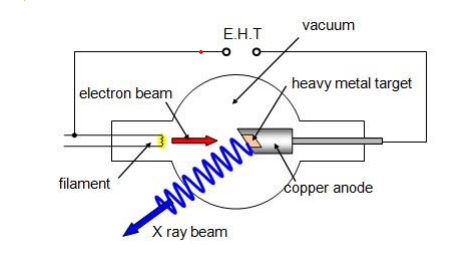
X-rays are produced by X-ray tubes (a type of electron tube), which consist of a cathode (a heated filament) and an anode (a target made of high atomic number material, such as tungsten). The process of generating X-rays can be broken down into the following steps:
- Electron Emission from Cathode:
- A high voltage is applied between the cathode (negatively charged) and the anode (positively charged) in the X-ray tube.
- The cathode is heated, causing it to emit electrons through thermionic emission (i.e., electrons are ejected due to the heat).
- Acceleration of Electrons:
- The emitted electrons are accelerated toward the anode by the high voltage between the cathode and anode. These electrons can reach speeds close to the speed of light (a significant fraction of the energy applied to the tube).
3. Interaction at the Anode (Target):
- The high-energy electrons strike the target material (usually tungsten, because of its high melting point and high atomic number).
- There are two main types of interactions that occur when the electrons collide with the anode material:
4.Characteristic X-ray Production:
- When a high-energy electron collides with an inner orbital electron of the tungsten atom, it may knock the electron out of its orbit. This creates a vacancy in the electron’s orbit.
- To fill this vacancy, an electron from a higher energy level of the atom falls down to the lower energy level, emitting X-ray radiation in the process. This emitted radiation has a characteristic energy that corresponds to the energy difference between the two energy levels involved.
- Bremsstrahlung (Braking Radiation):
- When the high-energy electron passes close to the nucleus of the tungsten atom, it is decelerated or “braked” due to the strong electrostatic force exerted by the positively charged nucleus.
- This sudden deceleration causes the electron to lose energy, which is emitted in the form of X-ray radiation. The energy of this X-ray radiation is continuous and depends on the amount of energy lost by the electron.
5. X-rays Emission:
- The resulting X-rays, both characteristic and bremsstrahlung (continuous spectrum), are emitted from the target material and can pass through the X-ray tube window. These X-rays are directed toward the object or patient being examined.
X-ray Spectrum
- The X-ray spectrum consists of two types of radiation:
- Characteristic X-rays: These have discrete energies and are produced by the transitions of electrons between specific energy levels in the atom. These are often represented as a sharp peak in the X-ray spectrum.
- Bremsstrahlung X-rays: These are continuous and form a broad spectrum because the energy of the emitted X-rays depends on how much the incident electron is decelerated. This forms a broad, smooth curve in the X-ray spectrum.
메타데이터
- post_id
- 5823917e7e36
- slug
- electromagnetism-and-em-waves-5823917e7e36
- url
- https://medium.com/@prav.202412/electromagnetism-and-em-waves-5823917e7e36
- canonical_url
- https://medium.com/@prav.202412/electromagnetism-and-em-waves-5823917e7e36
- author_url
- https://medium.com/@prav.202412
- status
- ok
- fetched_at
- 2026-07-24 13:32:38