What the Heck is a Yama?
How to protect yourself: Yama #1: Ahimsa (non-violence)
Yoga Journey | 8 Limbs of Yoga | Yamas | #1 Ahimsa
What the Heck is a Yama?
How to protect yourself: Yama #1: Ahimsa (non-violence)
Photo by Aleksandr Ledogorov on Unsplash
To document my yoga journey, I’m writing about what I’ve learned along the way. In this story, I introduced the Eight Limbs of Yoga. Now, I’m turning my focus to the first limb — the Yamas. Writing about them helps me slow down, break the concepts apart, and understand them in a way that makes sense.
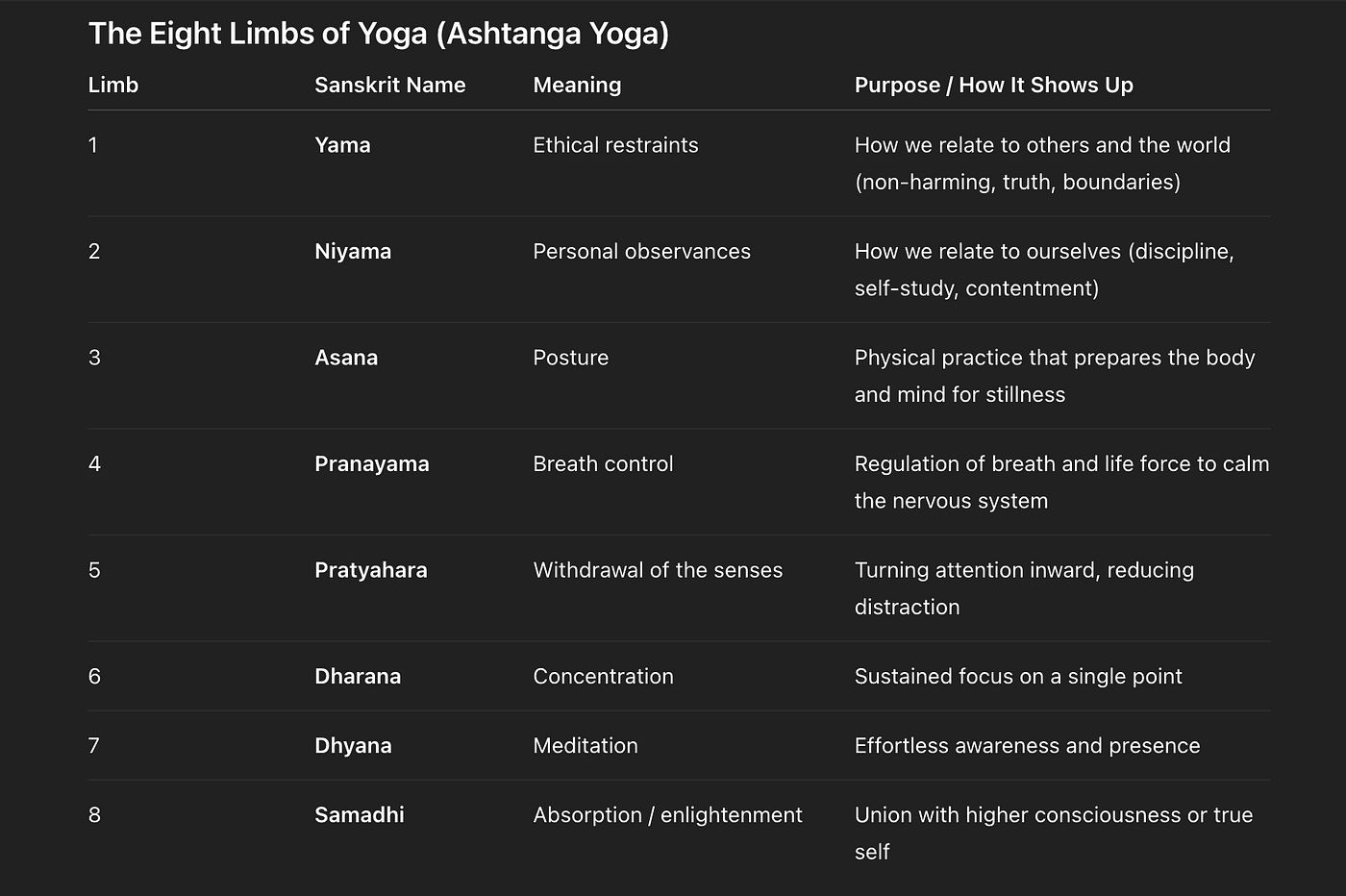
The 8 Limbs of Yoga. Screenshot by author.
Near the start of my 200-hour yoga teacher training, my yoga teacher, Lucy, taught us about the yamas. Now, what the heck is a yama? I didn’t know then, but it had nothing to do with biting into a yummy sweet potato yam, as I’d hoped.
The word yama (when referring to the first limb of yoga) means “reining in” or “control” in Sanskrit. Yamas are ethical restraints or moral principles that direct us in how to relate to people and the world.
I think of them as the foundations that help me to find grounding when I interact with nature, my relationships, myself, and society. The yamas can guide me to act purposefully and make decisions from a self-aware and centered place, which enables me to embrace authenticity within myself and others.
There are 5 yamas.
-
Ahimsa (non-violence)
-
Satya (truthfulness)
-
Asteya (non-stealing)
-
Brahmacharya (moderation of the senses/right use of energy)
-
Aparigraha (non-greed)
Ahimsa (non-violence)
Let’s chat about the first yama, Ahimsa (non-violence). (‘Himsa’ = ‘hurt’ and ‘a’ = ‘not’). I’ll provide a personal scenario and how my story relates to ahimsa, and share ways to practice ahimsa in daily life.
The way I understand ahimsa is not causing harm to ourselves, others, or nature, either in a physical, mental, or neglectful manner. It’s trying to ensure whatever I do, and how I do it, is done harmoniously, without causing pain or harm.
The Scenario
Whenever I visited a particular family member, our conversations would eventually spiral into an argument. He would begin belittling me — calling me an idiot, telling me I was stupid and knew nothing. I tried to defend myself, but it only angered and drained me. His tone would escalate, and at times, he’d erupt into what played out as an adult temper tantrum.
I’d leave feeling exhausted and frustrated, and I’d often sink into a low mood that lasted for days — sometimes weeks. Although I knew, logically, that I wasn’t an idiot, a small part of me began to wonder if there was some truth in what he said. I blamed him for making me cry, and for making me feel small and worthless.
Then one day, something shifted.
I realized that during those days when I sat on the couch alone, feeling sorry for myself, he wasn’t shouting or putting me in physical danger. I was the one endangering myself — by choosing to absorb his words, by second-guessing who I was, and by turning his cruelty inward.
His behavior hurt me, but my reaction was what kept the pain alive. Every time I replayed the scenario, it was like a self-inflicted punch. The moment I saw that, I understood where my real power was — and where my healing needed to begin.
How this relates to ahimsa
This experience taught me a deeper meaning of ahimsa. Before I studied yoga, I related to non-violence as only about not harming others: by speaking kindly, acting gently, and avoiding conflict. I was pretty good at practicing those things. But I began to see how often I was violating ahimsa toward myself.
Each time I replayed his words in my mind, questioned my worth, or punished myself emotionally for days afterward, I was committing an act of inner violence. His behavior was harmful, yeah, for sure — but the greater hurt came from how I allowed those words to live inside me long after the conversation ended.
Practicing ahimsa meant recognizing that I did not deserve that treatment — from him or from myself. It meant choosing to stop attacking my own character, to stop second-guessing who I am, and to protect my inner peace. Sometimes ahimsa isn’t about staying quiet or being “nice.” Sometimes it’s about setting boundaries, walking away, and refusing to participate in situations that cause harm.
True non-violence began when I chose compassion over self-blame and learned to respond rather than react. Ahimsa became an act of self-respect — one breath, one choice, one boundary at a time. It also became a quiet, mindful way to let go of that relationship.
Simple ways to practice ahimsa
Here are some other ways I try to practice ahimsa:
- Speaking kindly to myself by encouraging myself when things get hard. I practice my self-mantra “Try, Mary, Try!” This helps me move forward whenever I want to give up.
- When I make a mistake or mess up, I give myself space for grace. It’s okay to mess up! I forgive myself and try to figure out what I’ve learned, rather than replaying the error in my head and then becoming down, negative, or angry. Then I let it go and move on.
- I pause and reflect before reacting to situations that may involve discomfort or conflict. It could be waiting a day or so before replying to an email, text, or phone call, instead of replying immediately, where my words could have the potential to react with anger or bitterness rather than compassion.
- I try not to push my body to its physical limits when cycling, running, or swimming. It’s okay to challenge myself, but when I feel unstable or experience extreme fatigue, I slow down and return to my breath. I remind myself that moving in rhythm with my breath matters more than chasing a fast and furious personal challenge, with the risk of injuring myself.
- Gratitude. Being thankful for my breath, my mind, and the ability to move my body without pain. Three true blessings that provide contentment and enable me to experience an abundance of joy.
Ahimsa isn’t a passive concept or a time slot reserved for the yoga mat. It’s a daily, lived practice that asks me to notice where harm is occurring — especially the harm I inflict on myself through self-criticism, overexertion, and staying in relationships that rattle my peace.
Practicing ahimsa means choosing compassion over punishment, boundaries over endurance, and breath over force. It reminds me that healing begins not when others change, but when I do — when I soften my inner dialogue, honor my limits, and act from self-respect. In this way, ahimsa becomes both a protector and a guide, gently steering me back to wholeness by becoming self-aware and making mindful choices that empower me.
What are some other ways you can practice ahimsa? Let me know in the comments!
References and yoga training.
Temple Bar Yoga, Soul Sanctuary, Whole Body Paradigm
About the writer
Mary Chang is a writer, parent, yoga teacher & fitness enthusiast exploring adventures to document her life journey. Finding shine through yoga, nature & stories. Fueled by sweat, solitude, and grit.
This story is a follow-up to my journey — and struggles— toward becoming a yoga teacher, as well as some of the lessons I’ve learned along the way. It is part of a collection of yoga stories meant to document my experiences and serve as a reminder to myself that yoga extends far beyond the asanas (poses).
My yoga stories to date.
References and yoga training.
Temple Bar Yoga, Soul Sanctuary, Whole Body Paradigm
About the writer
Mary Chang is a writer, parent, yoga teacher & fitness enthusiast exploring adventures to document her life journey. Finding shine through yoga, nature & stories. Fueled by sweat, solitude, and grit.
메타데이터
- post_id
- 583d985e520f
- slug
- what-the-heck-is-a-yama-583d985e520f
- url
- https://medium.com/mary-chang-story-writer/what-the-heck-is-a-yama-583d985e520f
- canonical_url
- https://medium.com/mary-chang-story-writer/what-the-heck-is-a-yama-583d985e520f
- author_url
- https://medium.com/@marychang-10894
- status
- ok
- fetched_at
- 2026-06-09 15:37:30