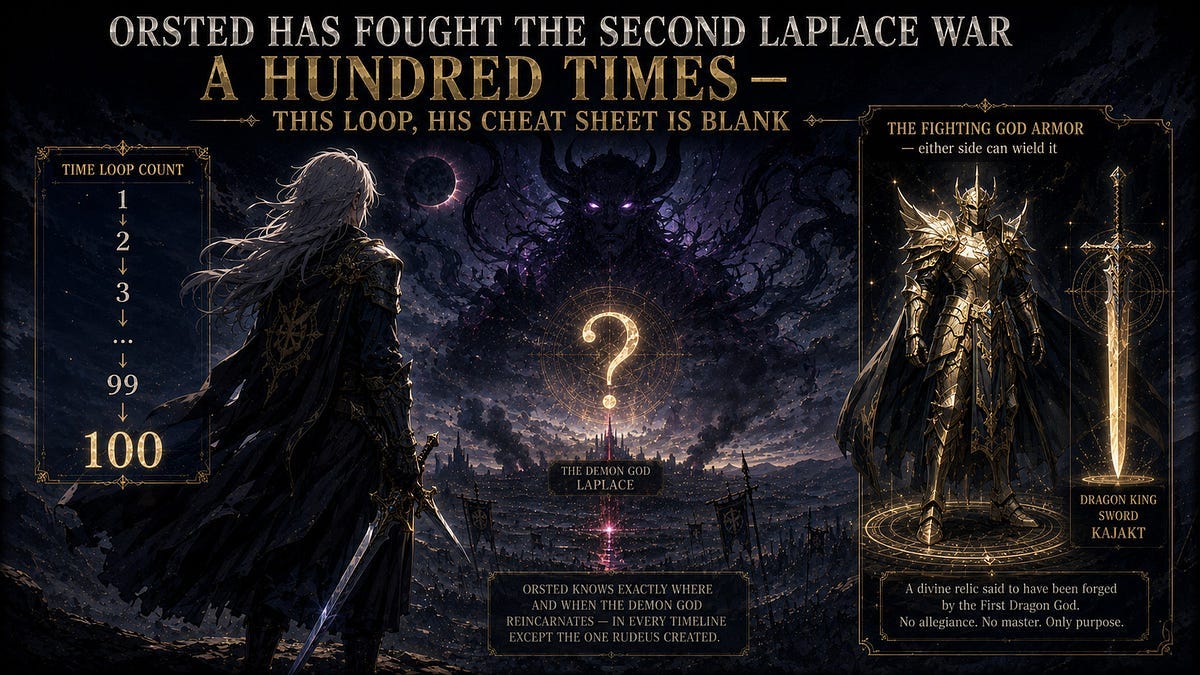
Orsted Has Fought the Second Laplace War a Hundred Times. This Loop, His Cheat Sheet Is Blank
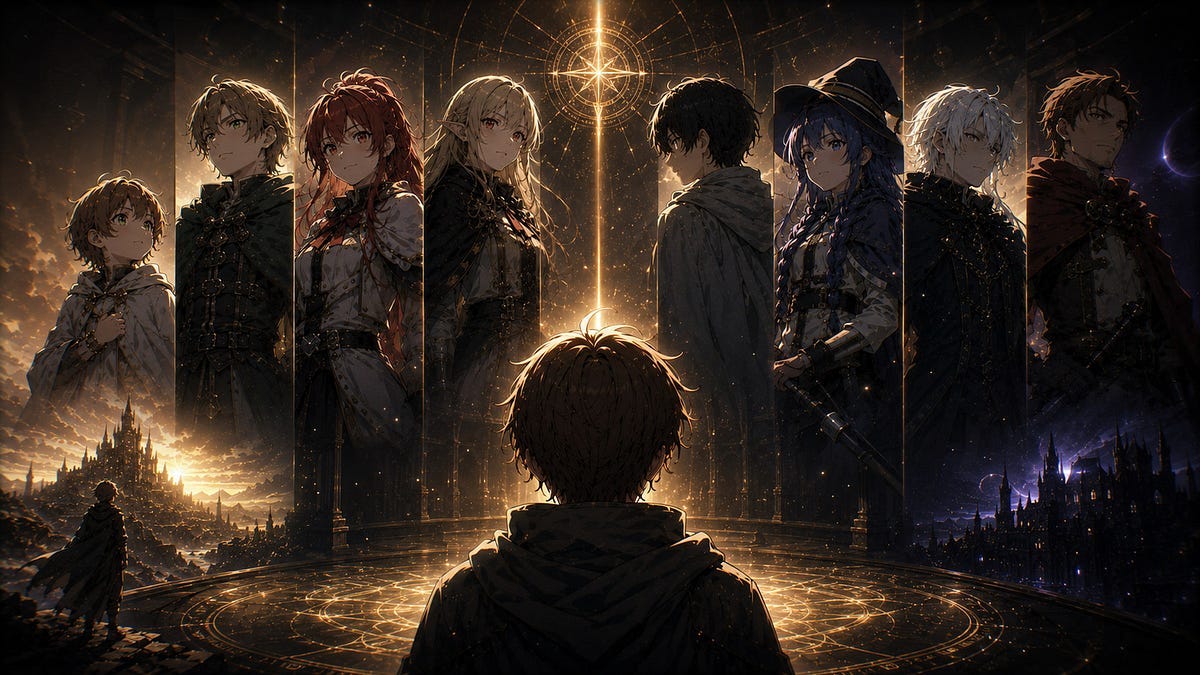
The Dragon God knows exactly where and when the Demon God reincarnates — in every timeline except the one Rudeus created. On the…
Orsted Has Fought the Second Laplace War a Hundred Times. This Loop, His Cheat Sheet Is Blank
The Dragon God knows exactly where and when the Demon God reincarnates — in every timeline except the one Rudeus created. On the spawn-point problem, a sealed Badigadi, and the golden armor both sides can use.
⚠️ Maximum spoiler warning: This piece covers the ending of the complete Mushoku Tensei novels — including late-game Orsted lore and Badigadi’s fate — plus untranslated Japanese web-only material and fan speculation about the sequel. Anime viewers: Season 3 is airing right now (summer 2026), and this is all far beyond it. Final books or bust.
The scariest thing about Orsted was never his mana pool or his curse. It’s that he fights every war with the answer key.
A hundred-plus loops through the same century have taught the Dragon God where every landmine sits — including the big one: the reincarnation of the Demon God Laplace, and the continent-wide war he ignites. In loop after loop, Orsted has learned to defuse that war before it starts, in the coldest way imaginable.
But the loop we just read — the one with Rudeus Greyrat in it — broke the pattern. And that, more than any battle, is what the long-teased sequel inherits. This is Part 7 of our series on Mushoku Tensei’s sequel lore, the layer built from untranslated Japanese material (Parts 5 and 6 covered the Greyrat bloodlines and the K500 map). Today: the war itself.
The first war, briefly
Canon refresher, fully available in English. Around a century before the Armored Dragon calendar begins, the Demon God Laplace launched the war humans remember as the Laplace War. Of the seven heroes who led humanity, four died. The surviving three — Dragon God Urupen, Perugius Dola the Armored Dragon King, and the first North God Kalman — couldn’t kill Laplace even with Ruijerd Superdia fighting beside them, so in year 1 of the new calendar they settled for sealing him.
Sealed is not dead. Laplace had already seeded his “factor” into future bloodlines — an Ancient Dragon technique ensuring a compatible body would exist somewhere downstream. In the timelines Orsted knows, Laplace reincarnates around K510 and starts the Second Laplace War (our rendering of the Japanese term; no official English exists).
How Orsted cheats
Late in the main story, Orsted lays out his method with the detachment of a man describing lab procedure. He thinks in terms of a baseline — the history that unfolds when he touches nothing — versus divergences, the ripples his own actions cause (he spells out this framework in the web-side material, but it’s implicit throughout the translated books). Over a hundred loops, he’s compiled what amounts to an actuarial table of the world.
On Laplace specifically (web ch. 217, near the end of the translated story), his table says: the revival window is essentially fixed, close to each loop’s end — he’s tried to provoke an earlier revival and failed. After reincarnating, Laplace lies low, gathers followers, then makes war. Putting him down at full strength costs enormous effort and mana — mana Orsted desperately needs for the fight that comes immediately after, against Hitogami, the Man-God who is his true enemy.
Hence the cheat. In one recurring timeline (web ch. 211), Pax Shirone survives to found a republic, a slave merchant named Bolt Makedonias (rendering ours) rises through it, and from that lineage, generations later, Laplace is reborn. Once Orsted mapped that, his optimal play became horrifyingly simple: steer history down the known track, wait by the known cradle, and end the Demon God as an infant. When Rudeus, appalled, suggests they could just recreate the republic in this loop and re-fix the spawn point, Orsted’s answer is flat: he’s tried. It doesn’t take. And he adds the sentence that reframes the entire series: a loop that has to pass through the war can’t reach Hitogami — which is why, by his own accounting, this loop is already a failure.
Orsted’s greatest weapon was never power. It was the map. Rudeus’s whole life just burned the map.
Because in this timeline, Pax died. The republic never formed. The Makedonias lineage never rises. Somewhere out there, the Laplace Factor is still counting down — and for the first time in a hundred lifetimes, Orsted doesn’t know where.
The blank space on the map
Where does Laplace come back, then? The untranslated material circles one unsettling candidate, which we unpacked fully in Part 5: a future son of Sieghart Saladin Greyrat. Both of Sieg’s parents carry the Laplace Factor; the timing lands in the revival window; and the web-side material — Sylphiette’s nightmare, Perugius’s wary honor-name, the spinoff manga’s whole arc — keeps painting targets on that branch of the family. It is, we stress, one Japanese fan theory. But it’s the theory that makes the sequel a tragedy engine: the Demon God reborn inside the family that was supposed to prevent him.
Rudeus, to his credit, saw the war coming even without knowing the cradle. In web ch. 213 he sketches his recruitment list for a fight he knows he won’t live to see: the Ogre God and the Ore God (renderings vary), figures with no stake in the current era but destined to oppose Laplace; the next generations of the Water God and Sword God styles, since today’s masters won’t live to fight; and the long-lived anchors — North God Kalman III, and Randolph Marianne the Death God. The essayist adds the sobering update from the author’s comment-replies: by the spinoff’s end, Randolph is dead, his title passed to Sieghart. Rudeus’s alliance is already short one Great Power — and its replacement is the father of the theory’s Laplace.
The faction math, if the theory holds
Now the essayist games it out, and this is speculation stacked on speculation, so hold it loosely.
If Sieg’s son is Laplace, who stands with them? Sieg himself, protecting his child as his father vowed he would. Atofe — Atoferatofe Rybak, the immortal Demon King who fought for Laplace in the first war — plus her guard, almost by reflex. Possibly Kishirika Kishirisu, the Demon Empress. And Kishirika is where the math gets scary, because of who her fiancé is.
Badigadi — the immortal, many-armed Demon King, former Fighting God — ends the main story sealed (we’ll stay vague on the how). The books establish a lovely lock on that seal: thanks to a demon-eye-nullifying drug, Badigadi can’t be found by any magic eye, not even Kishirika’s all-seeing one. The list of living beings who know where he sleeps is tiny: Orsted, Ruijerd, Alexander, Perugius… and Hitogami, whose sight works by different rules. The seal’s warden is Ruijerd — and unsealing would take someone stronger than the warden. Badigadi declared he’d side with no one. The essayist’s needle-through-the-heart observation: “no one” has never included Kishirika. If she calls, everything about his character says he answers. And if Hitogami wants a Fighting God on the board, he knows exactly whom to whisper to — leaving Ruijerd, the most incorruptibly just man in the series, standing between an unstoppable force and a door. (Whether Lara’s star-reading sends him help in time is the kind of scene we’d pay to read.)
The wildcards both sides can hold
Two artifacts float free of the faction math, because they’re objects, not allies.
The Fighting God Armor — golden, sentient, mana-devouring — was created by the second-generation Dragon God Laplace himself, who sealed it away when it tried to consume him; Badigadi later wore it to become the Fighting God, and in that armor split Laplace into the Demon God and the Technique God. The books (part 23) are explicit that the armor makes even an amateur into something that can kill the strongest beings alive. It has no rightful owner. Either side could field it — and Part 8 of this series covers a genuinely wild Japanese fan theory about who ends up inside it.
The other is the Dragon King Sword Kajakt (romanization varies), the blade tied to Badigadi’s seal. A late-book anecdote (part 26) about the sword being stolen — and its formidable keeper struggling to retrieve it from a mere Sword Saint — reads, in hindsight, like the author flagging just how much latent power that object holds. A seal is only as safe as its key.
That’s the shape of the Second Laplace War as Japan-side readers see it: a war Orsted has won a hundred times by cheating, now stripped of the cheat; an alliance built by a dead man; a seal whose lock has one divine-shaped hole in it; and two artifacts waiting to be picked up by whoever gets there first. The old Laplace War made heroes. This one, we suspect, will be about whether anyone can stay one.
This is Part 7 of our Mushoku Tensei sequel-lore series, drawn from Japan-side material with no official English release. Part 5 mapped Rudeus’s six bloodlines, Part 6 the K500 continent; Part 8 asks the big one — who is the sequel’s protagonist? Follow Manga Deep Dive for it — and tell us in the responses: does Badigadi stay neutral, or does Kishirika’s call outweigh a promise?
A note on sourcing: The following are canon or public record — the Laplace War and its sealing by Urupen, Perugius, and Kalman I with Ruijerd’s aid; the Laplace Factor; Orsted’s loop methodology, the fixed revival window, the Bolt Makedonias timeline and Orsted’s infanticide strategy, and his “this loop is a failure” verdict (web chs. 211/217, late translated volumes); Rudeus’s anti-Laplace recruitment plans (web ch. 213); the Fighting God Armor’s origin and Badigadi’s history with it; Badigadi’s sealing, the eye-nullifying drug, Ruijerd as warden, and the Kajakt theft anecdote (late book volumes). Randolph’s death and Sieghart inheriting the Death God title come from untranslated material and author comment-replies. The spawn-point theory (Sieg’s son), the faction assignments, Kishirika/Badigadi’s defection scenario, and the artifact predictions are one Japanese fan’s speculation (our source essayist), relayed with its caveats intact. Names follow official English releases where they exist; “Second Laplace War,” “Kajakt,” “Bolt Makedonias,” and “Ore God” are renderings of untranslated terms and may differ from future official translations.
Originally published at https://mangadeepdivejp.substack.com on July 26, 2026.
메타데이터
- post_id
- 58413a680ff6
- slug
- orsted-has-fought-the-second-laplace-war-a-hundred-times-this-loop-his-cheat-sheet-is-blank-58413a680ff6
- url
- https://medium.com/@mangadeepdivejp/orsted-has-fought-the-second-laplace-war-a-hundred-times-this-loop-his-cheat-sheet-is-blank-58413a680ff6
- canonical_url
- https://medium.com/@mangadeepdivejp/orsted-has-fought-the-second-laplace-war-a-hundred-times-this-loop-his-cheat-sheet-is-blank-58413a680ff6
- author_url
- https://medium.com/@mangadeepdivejp
- status
- ok
- fetched_at
- 2026-08-12 23:53:48