The Best and Worst Things You Can Do for Your Knees After 50
The biggest mistakes people make with aging knees
The Best and Worst Things You Can Do for Your Knees After 50
The biggest mistakes people make with aging knees

Photo from Canva
I was doing lunges at the gym when I heard a pop and felt a searing pain in my right knee.
I dropped the dumbbells I’d been holding and hobbled around on the other leg as I grasped my painful knee.
“What happened?” asked a nearby friend as he heard me utter a slew of colorful words.
“I don’t know, but it’s bad,” I said, sitting down on a bench.
I tried walking on it, but it was impossible. I limped out of the gym — it was the only time in the 45 years of my gym workouts that I ever abandoned a workout because of an injury.
Convinced I’d done some serious damage, I scheduled an appointment with an orthopedic surgeon. He ordered an MRI, saying the symptoms were those of a torn ligament.
At the follow-up appointment a week or so later, he asked how I felt.
“It’s actually not as painful,” I told him.
Surprisingly, the MRI didn’t show any damage. The fact that the pain was already improving confirmed it.
“I expected to see a torn ACL,” he said. “But I see nothing other than some arthritis. It’s intact.” He said the sudden pain I felt was my unstable patella (kneecap) popping in and out of place.
This was a huge relief. I was sure I’d be scheduling surgery that day.
That was over a decade ago. Follow-up visits showed a progression of arthritis, but nothing as dramatic as that first incident. The doctor warned me I’d “probably need a knee replacement” by my mid-60s.
At 67 and nowhere near needing a knee replacement, I’m happy to have proved him wrong… for now. Knee pain is second only to back pain as the biggest complaint I heard from personal training clients over the years.
A vulnerable joint
We ask a lot of our knees, so it’s no surprise this joint gives us so much grief.
According to the World Health Organization, about 73% of people living with osteoarthritis are over 55. And the knee is the most commonly affected joint worldwide. The average age for total knee replacements is around 65 to 70 years old.
Part of the reason is biomechanical: knees are caught between the powerful forces generated by the hips above and the ground forces below.
Unlike the hip, which is a deep ball-and-socket joint, the knee functions like a hinge. But it still has to absorb forces from walking, stairs, turning, uneven ground, and carrying loads — constantly caught between mobility and stability.
To give you an idea of the forces your knees endure, consider that:
- During walking: roughly 2–3 times body weight
- During stair climbing: roughly 3–4 times body weight
- During running: around 6–8 times body weight
- During deep squatting: forces can exceed 7–8 times body weight
A 170-pound person may place over 500 pounds of force on their knees while walking up stairs.
Knees also have a poor blood supply compared to muscle, as cartilage and menisci don’t heal quickly. The healing process slows even more with age.
Overall, our knees endure enough stress performing daily activities — without even adding sports or workouts into the mix. And in the search for answers on how to protect and strengthen them, you’ll find a lot of misinformation.
Here are the best and worst practices, according to science.
Best: Move consistently
Worst: Avoid movement
When something hurts, it makes sense to stop doing things that make it hurt.
However, avoiding all movement only makes things worse. If you have knee pain that kicks up after long periods of sitting, you know this holds. Muscles protect joints, and stiffness worsens with inactivity.
The evidence says exercise is the single most consistently supported intervention for knee osteoarthritis across the entire literature. Avoiding challenging your knees teaches your body that fragility is its new normal.
Good exercises include:
- Gentle hiking on uneven terrain
- Stationary cycling
- Pool walking
Best: Strengthen the muscles around the knee
Worst: Believe that walking is enough
Walking is a healthy cardiovascular exercise, but it doesn’t fully preserve muscle, power, and balance, and it doesn’t strengthen the muscles that support the knee. Hip strengthening is an often overlooked way to improve knee functioning.
Because here’s the thing: weak hips lead to faulty walking mechanics. Strengthening your hips prevents rotation of the femur and lessens stress on the knee, studies show. Fixing the hip changes what happens at the knee without touching the knee.
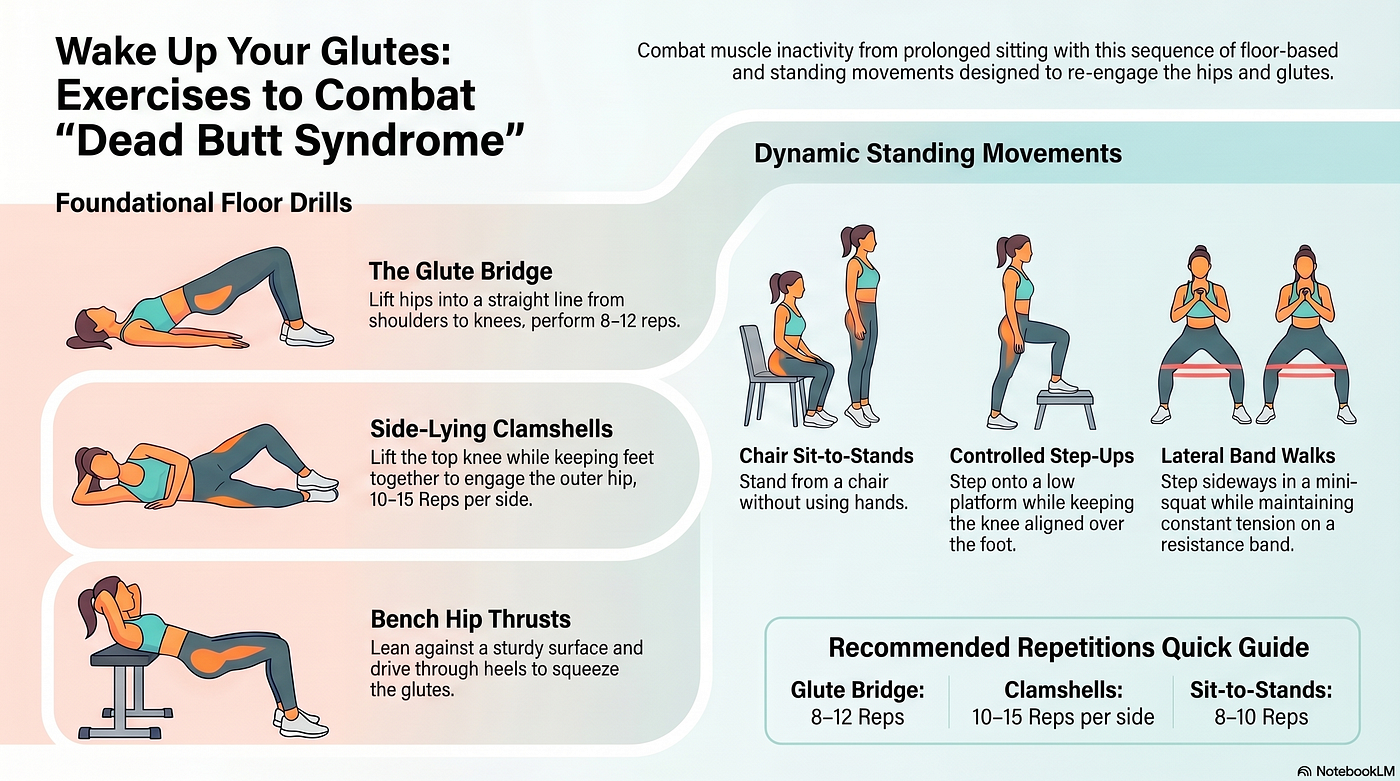
Image created using NotebookLM
Good exercises include (see above):
- Lateral band walks
- Single-leg balance work
- Glute bridges
Best: Progress gradually
Worst: Surprise your knees
Starting a new exercise routine after months or even years of inactivity is a recipe for knee pain. Knees tolerate load much more easily when they’ve been prepared for it gradually. Sudden spikes in activity — especially after 50 — don’t allow for tissues to adapt slowly.
Good practices include:
- Gradual increases in activity
- Alternating harder and easier days
- Regular walking or exercise routines versus “weekend warrior” bouts
Best: Improve ankle and hip mobility
Worst: Assume your knee is the problem
Knee pain doesn’t always originate in the joint. The hips and ankles may be the actual problems. Weak hips, for example, not only contribute to poor walking mechanics, but they can also cause the knees to collapse inward during walking and stair climbing. Stiff ankles can shift forces upward into the knee joint. Even poor foot mechanics can change how the knee tracks.
Good exercises for ankle and hip mobility include:
- Calf stretches — face a wall and stand about 6-inches out from it, lean your upper body into the wall while keeping your heels on the ground
- Ankle/foot alphabet “writing” — while seated, extend one leg and practice tracing the alphabet using your extended foot
- Clamshells — lie on your side, knees together and bent at a 45-degree angle, and raise and lower your top leg while keeping your feet together
Best: Keep running
Worst: Sit on the couch
I’m not a runner, but I’ve worked with many runners who enjoy it well into their later years. Although running’s impact seems like it would contribute to knee problems, a meta-analysis of studies shows recreational running is associated with less osteoarthritis than being sedentary or high-volume running.
Running — like other exercise — stimulates cartilage remodeling. Not exercising is what actually makes achy joints inevitable. The sedentary population has worse outcomes than the running population.
Good practices include:
- Gradually increasing mileage
- Strength training alongside running
- Running on varied terrain
Long-term & mindset solutions
Since my initial painful episode, I’ve had a couple of cortisone shots, which have helped decrease the pain and improve movement. But my doctor cautioned me against getting them more than twice a year. The relief is temporary, lasting a few months at best, and could increase cartilage volume loss.
Another danger of this ‘quick fix’ is that people often overload the joint or return too quickly to activities once the pain fades. Cortisone doesn’t rebuild muscle, correct mechanics, or otherwise help heal the knee joint — it’s not a standalone solution. The knee may feel better while the underlying joint remains weak or unstable.
The biggest problem with knee pain is that people stop doing things out of fear — they stop hiking, avoid stairs, and become afraid to move normally. In reality, knees often become more fragile from under-use than careful use.
Keep moving, gently and slowly build up your strength, and work all your leg and glute muscles, and you’ll be able to stay active for many more years.
메타데이터
- post_id
- 58999a4e5930
- slug
- the-best-and-worst-things-you-can-do-for-your-knees-after-50-58999a4e5930
- url
- https://medium.com/crows-feet/the-best-and-worst-things-you-can-do-for-your-knees-after-50-58999a4e5930
- canonical_url
- https://medium.com/crows-feet/the-best-and-worst-things-you-can-do-for-your-knees-after-50-58999a4e5930
- author_url
- https://medium.com/@linda_86854
- status
- ok
- fetched_at
- 2026-06-09 15:37:30