Payment Data Standardization and Enrichment
This post is part of a series exploring how data and payments are converging and why this shift matters for anyone building the future of…
Payment Data Standardization and Enrichment
This post is part of a series exploring how data and payments are converging and why this shift matters for anyone building the future of commerce, banking or reporting.
Originally published at https://divsrani.substack.com.
After the foundational step of Data Control, orchestrators have a few more steps before they can start monetizing or deploying AI agents on this data. It starts with Data Standardization and Enrichment. Data Standardization involves transforming raw data into uniform format and structure to ensure consistency and conformity. Enrichment involves adding missing information to the data to increase its usefulness.
But why is Data Standardization so critical? The answer lies in how payment initiation has evolved over the last 30 years to give way to a wide range of interactions in terms of who, how or where the payment is taken. Each shift has increased convenience, security and access. At the same time, it has given rise to new data formats, schemas, and integration challenges.
Let’s see four different ways payment initiation has evolved.
Who initiates a payment?
Person —> Profile —> Voice —> Agent
There was a time when you had to buy a book, you visited a book shop, made the payment at the counter. The cashier saw you and knew the person behind the payment. May even talk to you a bit and know that you were buying this book for your friend. From that world, we moved to a digital world where your order is placed on an online site that sees you as a digital profile with sparse user IDs and session tokens. More recently, we moved to a world of voice and agents. With voice we may still have some connection to the person, but in agentic commerce, smart agents act on your behalf making the purchaser’s identity obscure and the data formats vastly varied.
What are the payment methods?
Cash —> Card —> Wallets
The days of cash gave way to the convenience and security of cards (at least in markets like the US). From there, we moved to a world of digital wallets where cards have become a layer behind the wallets. Each payment method brings its own API standards, data structures, and transaction metadata. For example — Visa’s schemas differ from Mastercard’s, which differ from Apple Pay’s.
Where is the payment initiated?
Store —> Omni-channel —> Embedded
From a time of in-store purchases, we have moved to omnichannel (websites, social channels, mobile apps, IoT devices). With embedded payments, we see the payments layer becoming invisible to the person initiating the payment. It is becoming one of the steps behind the scenes to complete a larger task like ordering a meal or booking a hotel.
How is the payment recorded?
Cash books —> Off-chain —> On-chain (DeFi)
From simple ledger entries, we moved to complex database transactions across multiple systems. Now we’re seeing the emergence of on-chain payments where transaction data lives on public blockchains with entirely different data structures and immutability characteristics.
To get a sense of how data evolved, see the visual below (from left to right) showing how data modes got more and more complex and varied.
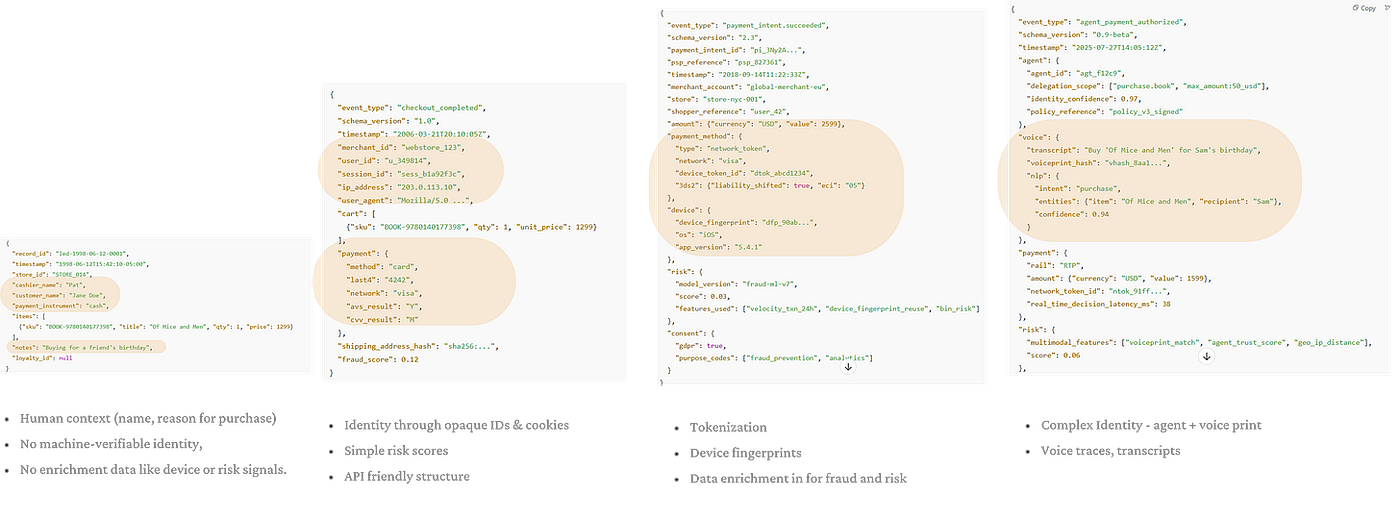
Modes and enrichment of data as interactions in payment initiation evolved from In-store Cash → Online/ Card → Tokenized Wallets → Agentic/ Voice based
Each shift has created distinct data silos with incompatible formats. An orchestrator has to figure out multi-modal handling and enrichment of data at scale. For example-
- 50+ different payment methods, each with unique API responses
- Regional payment processors with localized data schemas
- Differences in how intent is captured by click-based systems and voice commerce
- Depth of context in embedded payment flows varies from e-commerce flow
- Nature of traces and cryptographic proofs for On-chain vs Off-chain
So how are leading PSPs/ orchestrators tackling this data chaos? The approaches vary dramatically based on their market positioning and customer needs, and these choices determine what AI capabilities they can ultimately deploy.

Adyen
Adyen, which serves enterprises with global use cases, has invested heavily in standardizing their API fields and options across all payment interactions. Their approach is elegant in its comprehensiveness: their checkout API can pull every type of payment — cards, ACH, local payments — using the same pspReferenceID (their universal transaction identifier). Whether the sale happens in-store or online, you can pull transaction details using the same shopReference. Payment and settlement details follow a consistent schema, making cross-channel analysis and comparison seamless.
This standardization enables powerful AI capabilities. Adyen can run fraud detection algorithms that spot patterns across payment methods and channels, which would have been impossible with fragmented data. Their AI can optimize payment routing in real-time by analyzing success rates across different processors and methods using consistent data points. When a voice-initiated payment fails, their system can immediately suggest the optimal alternative payment method based on unified historical data.
Square
This enterprise-focused approach may not work for Square and Stripe, who have large SMB merchant bases with different needs. They’ve focused on standardizing payments and sales within their closed ecosystems. Square’s Order Migration and Convergence was a multi-year effort that unified data from Square Point of Sale, Online Store, Invoices, and Appointments into a single order schema. Previously, a customer who bought in-store and online appeared as different entities with incompatible data formats, making personalization and customer lifetime value calculations nearly impossible.
Post-standardization, Square can now deploy AI that recognizes the same customer across all touchpoints, enabling features like intelligent inventory suggestions and personalized payment preferences. However, this closed-loop approach, while optimizing for their ecosystem, limits their ability to integrate third-party AI services or provide standardized data to merchant partners.
What happens if we don’t standardize?
Orchestrators who haven’t tackled standardization are increasingly locked out of AI opportunities. They can’t deploy effective fraud detection across payment methods, can’t optimize routing algorithms, and can’t offer merchants unified analytics. As AI becomes table stakes in payments, these players risk becoming pure commodity processors, competing only on price while missing the high-margin opportunities that come with intelligent payment optimization.
Advantage of doing it real time
Although standardization can be done in downstream reporting systems, there are huge benefits when this step is moved upstream and executed in real-time at the point of checkout. This real-time standardized data becomes high-leverage infrastructure. Your unified data layer doesn’t just help optimize financial performance; it enables instant decision-making that can increase approval rates, reduce fraud, and personalize the payment experience.
A batch-processed standardization system might identify a fraud pattern hours after transactions complete, but a real-time standardized system can block suspicious transactions instantly while offering alternative payment methods that have higher success rates for that specific customer profile.
This real-time capability also accelerates partnership opportunities and global scaling. When your data is standardized in real-time, integrating with new regional processors or emerging payment methods becomes plug-and-play rather than a months-long data mapping exercise.
메타데이터
- post_id
- 589d1dbda5db
- slug
- payment-data-standardization-and-enrichment-589d1dbda5db
- url
- https://medium.com/operations-research-bit/payment-data-standardization-and-enrichment-589d1dbda5db
- canonical_url
- https://medium.com/operations-research-bit/payment-data-standardization-and-enrichment-589d1dbda5db
- author_url
- https://medium.com/@divsrani
- status
- ok
- fetched_at
- 2026-06-24 13:29:15