Understanding Python’s Inner Workings: Bytecode, PVM, and Compilation
Python is renowned for its simplicity and readability, but its execution model is quite sophisticated. This article provides a detailed yet…
Understanding Python’s Inner Workings: Bytecode, PVM, and Compilation
Python is renowned for its simplicity and readability, but its execution model is quite sophisticated. This article provides a detailed yet concise overview of Python’s inner workings, focusing on bytecode, the Python Virtual Machine (PVM), the compilation process, and comparisons with other languages.
Bytecode
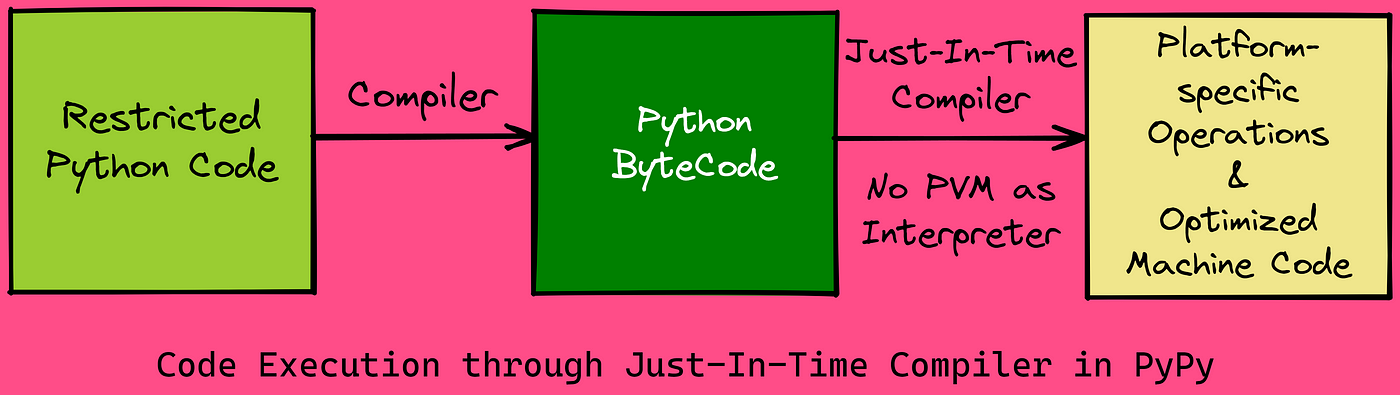
When you run Python code, it first gets translated into an intermediate form known as bytecode. This bytecode is a low-level, platform-independent representation of your source code, which the Python Virtual Machine (PVM) can execute.
Steps in Bytecode Generation:
- Lexical Analysis: The source code is tokenized into keywords, operators, and identifiers.
- Syntax Analysis: The tokens are parsed into a syntax tree.
- Bytecode Compilation: The syntax tree is transformed into bytecode.
Bytecode files have a .pyc extension and are typically stored in the __pycache__ directory.
Python Virtual Machine (PVM)
The PVM is the runtime engine of Python. It reads and executes the bytecode instructions, acting as an abstraction layer between the bytecode and the hardware.
PVM Execution Steps:
- Loading Bytecode: The PVM loads the compiled bytecode into memory.
- Execution: The PVM interprets and executes each bytecode instruction.
Compilation Process
Python uses a two-step process: compilation to bytecode and interpretation by the PVM. Here’s how it works:
- Compilation to Bytecode: Python’s compiler translates the source code (.py files) into bytecode (.pyc files).
- Bytecode Interpretation: The PVM reads and executes the bytecode.

Differences from Other Languages
Python’s execution model differs from both compiled and interpreted languages:
- Interpreted Languages (e.g., JavaScript): These languages often execute code directly without an intermediate bytecode step, leading to slower performance.
- Compiled Languages (e.g., C++): These languages translate source code directly into machine code for the target platform, offering faster execution but less portability.
- Hybrid Languages (e.g., Java): Like Python, Java compiles to bytecode, but the Java Virtual Machine (JVM) has a different structure and performance characteristics.
Conclusion
Python’s use of bytecode and the PVM provides a balance between performance and portability, distinguishing it from other languages. Understanding these inner workings highlights the efficiency and flexibility that contribute to Python’s widespread popularity.
메타데이터
- post_id
- 589fce9bca48
- slug
- understanding-pythons-inner-workings-bytecode-pvm-and-compilation-589fce9bca48
- url
- https://medium.com/@algoaryan/understanding-pythons-inner-workings-bytecode-pvm-and-compilation-589fce9bca48
- canonical_url
- https://medium.com/@algoaryan/understanding-pythons-inner-workings-bytecode-pvm-and-compilation-589fce9bca48
- author_url
- https://medium.com/@algoaryan
- status
- ok
- fetched_at
- 2026-08-10 00:35:34