Outrage Roulette: How Clickbait Learned to Follow Me Home
Inside the attention economy that turns local fear, personal data, and civic collapse into outrage currency.
Outrage Roulette: How Clickbait Learned to Follow Me Home
Inside the attention economy that turns local fear, personal data, and civic collapse into outrage currency.
Introduction
Maybe the honest way to begin an essay about clickbait is to admit that this title is doing some fishing.
That feels disconcerting. I am writing about manipulative online bait while using a title designed to attract curious readers. Sad? A little. Revealing? Absolutely.
But there is a difference between a lure and a trap. A title can invite attention honestly. A headline can create a curiosity gap without abusing the reader’s fear, grief, trust, location, or sense of civic responsibility. The problem begins when the lure becomes predatory: when curiosity gets converted into anxiety, anxiety into engagement, and engagement into a measurable commodity.
That commodity is what I am calling Outrage Currency.
My clearest example arrived through NewsBreak, a service I originally signed up for because I wanted broader reporting on subjects that mattered to me. I remember selecting interests. I remember providing a location. At the time, that exchange seemed reasonable. Local news is local for a reason. A person in Indianapolis needs different community information than a person in Fredericksburg, Portland, or any other place where weather, policy, schools, traffic, public safety, and civic weirdness follow their own regional logic.
But over time, the bargain changed.
What began as a promise of relevance curdled into a traveling sludge machine. The headlines became more intense, the personalization felt creepier, and the line between local information, sponsored bait, tabloid framing, and emotional manipulation became harder to distinguish. The nascent internet wanted us to click because we were curious. The modern feed wants us to click because not clicking might feel unsafe, irresponsible, or socially negligent.
Clickbait has evolved from an annoying curiosity trap into situational outrage bait: a system that uses location, personal context, civic uncertainty, and emotional vulnerability to turn fear into engagement. That exchange is Outrage Currency, and its real danger is not merely that readers click headlines with deliberately outrageous, albeit strangely plausible, hooks. It is that platforms, scammers, and feed-driven media ecosystems increasingly disguise predation as relevance, trust, and protection.
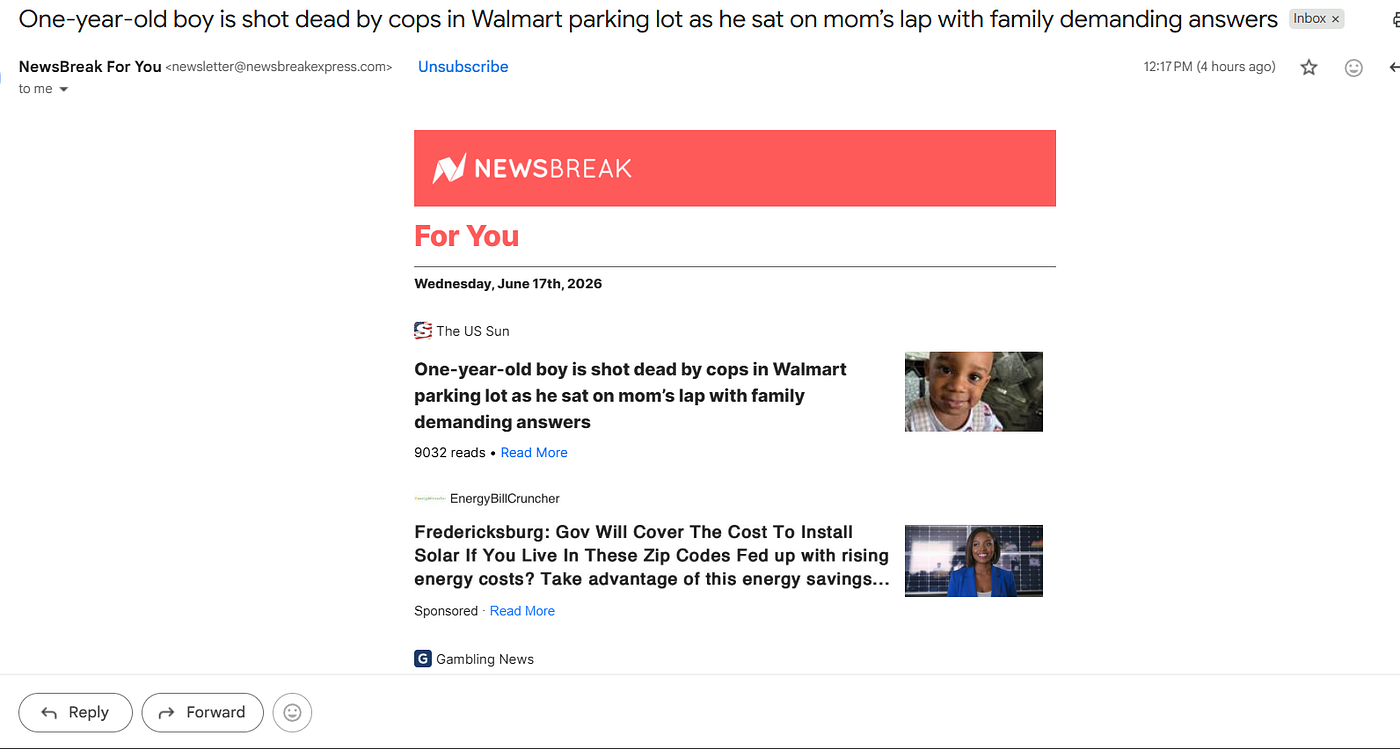
Exhibit A: The Inbox Sludge
The clearest example arrived in my inbox.
A NewsBreak email presented itself as a personalized “For You” update. The featured headline involved a one-year-old child, a police shooting, a Walmart parking lot, a mother’s lap, and a grieving family demanding answers. Immediately underneath it sat a sponsored solar ad aimed at Fredericksburg residents. Beneath that, gambling content started to appear.
That is not an information hierarchy. It is a moral junk drawer.
The tragedy itself deserves seriousness. The delivery system deserves scrutiny. A child’s death, a sponsored lead-generation pitch, and gambling-adjacent content should not feel like neighboring tiles on the same civic dashboard. But that is the logic of the modern feed: flatten everything into clickable objects, then let proximity, shock, and personalization do the rest.
NewsBreak is not some obscure digital alleyway. Reuters reported in 2024 that the service had become one of the most-downloaded news apps in the United States and that its ecosystem included licensed material, web-scraped local information, press releases, and AI-assisted rewriting.
That matters because this is not merely a stylistic complaint about ugly headlines. It is an infrastructure problem.
The inbox did not say, “Here is a tabloid-grade tragedy stack with sponsored bait attached.” It said, “For You.”
That phrase is doing a lot of work. “For You” suggests relevance, personalization, even care. It implies that the machine has selected something meaningful based on who I am, where I am, or what I have previously signaled. But the result felt less like a public-service function and more like emotional roulette: spin the wheel and see whether today’s prize is tragedy, panic, civic decay, a suspicious ad, or some new anxiety disguised as your sleep-deprived neighbor.
The tragedy was real. The delivery system was sludge.
Exhibit B: The Feed Is Everywhere
NewsBreak is not an isolated offender. A quick scroll through MSN reveals the same architecture at scale: sponsored financial bait, sensational politics, celebrity residue, tragic human-interest stories, sports widgets, mystery headlines, and recommended videos arranged as if they belong to the same moral category.
They do not.
A local tragedy is not synonymous with a celebrity update. A debt-relief ad is not equivalent to public-interest reporting. A sports score does not belong in the same moral category as a murder headline. But the feed does not care what something is. It cares whether the object can keep the wheel spinning.
This is the feedification of everything. News, ads, entertainment, scams, civic updates, tabloid panic, weather warnings, health scares, political rage, and algorithmic recommendations all get poured into the same trough. The user is expected to sort the moral categories in real time while the interface keeps refreshing.
That is one reason the modern feed feels so corrosive. It does not merely contain clickbait. It erodes the boundaries that help people interpret information responsibly. Context collapses. Urgency becomes ambient. Everything looks equally immediate, equally clickable, and equally available for monetization.
The result is not information overload in the old sense. It is interpretive overload. The reader must constantly ask: Is this news, or could it be sponsored bait? Is this local, or could it be proximity theater? Is this relevant, or could it be emotional targeting? Is this designed to inform me, or could it be designed to extract something from me?
The feed rarely answers. It just deals another card.
From AOL Curiosity Bait to Digital Conditioning
My earliest recollection of clickbait goes back to the 1990s, during the AOL dial-up era. That internet now feels ancient, but the early ingredients were already there: mystery links, pop-ups, chatrooms inundated with bots, fake intimacy, strange screen names, chain messages, and that tiny jolt of anticipation when the machine announced, “You’ve got mail.”
The old bait was primitive, but effective. It relied on curiosity, novelty, and uncertainty. Who sent the message? Who was in the chatroom? What happens if I click? What is hiding behind that flashing banner? The technology was clunky, the graphics were crude, and the manipulation often wore clown shoes, but the emotional mechanics were recognizable.
Chatbots were part of that early conditioning. They were not modern clickbait, but they helped establish its emotional operating system: simulated familiarity, curiosity without context, and the illusion that the machine had something personally relevant to say.
That matters because clickbait did not begin as a headline style. It began as a relationship scam between human curiosity and machine-mediated attention.
In hindsight, the early web trained users to respond to prompts that now sound suspiciously close to phishing. Click here. Read this. Open now. Someone is waiting. Something is hidden. Something has been sent to you. That training did not disappear. It evolved.
At first, the bait was mostly curiosity-driven. It asked a simple question: What happened next?
That version was annoying, but often relatively shallow. “You will not believe what happened next” may be insulting to the reader’s intelligence, but it usually does not pretend to be a civic warning, a public safety alert, or a local emergency. It wants a click. It does not necessarily want to colonize the reader’s nervous system.
The current version is different.
From Curiosity Bait to Situational Outrage Bait
Clickbait has moved from curiosity bait to situational outrage bait.
Curiosity bait says: “You will not believe what happened next.”
Situational outrage bait says: “Something horrifying, unfair, dangerous, or suspicious may be happening near you, to people like you, because of forces you already distrust.”
That is a major escalation. Curiosity bait exploits the gap between knowing and not knowing. Situational outrage bait exploits the gap between safety and threat.
This is why a headline can feel ridiculous and plausible at the same time. The hook is deliberately outrageous, but not implausible. It has enough proximity, specificity, or emotional charge to bypass the reader’s first line of skepticism. The reader may not fully believe it, but belief is not always required. The platform only needs enough uncertainty to produce the click.
That uncertainty is the casino floor.
Every headline becomes a spin. It could be useful, exaggerated, hyperlocal, misleading, scam-adjacent, or genuinely important. The feed collapses those possibilities into the same emotional wager: click now or risk missing something you should have known.
This is where outrage becomes currency.
The first generation of clickbait wanted our attention. The current generation is targeting our nervous systems. It wants proximity, suspicion, fear, grief, and civic instability because those emotional states keep people activated. Activated readers click. Activated readers return. Activated readers feed the system with behavioral data, ad impressions, and emotional residue.
The old internet asked, “Are you curious?”
The new feed asks, “Are you safe?”
Then it charges admission for the answer.
Outrage Currency
This is where clickbait becomes something larger than a bad headline economy.
Outrage Currency is the emotional exchange rate of the attention economy. Platforms convert fear, proximity, grief, suspicion, urgency, and civic instability into clicks, ad impressions, behavioral data, and revenue. The reader pays with attention, anxiety, uncertainty, and time. The platform collects engagement.
That exchange depends on emotional activation. Calm readers skim. Activated readers click. Fearful readers return. Suspicious readers keep searching for confirmation. Angry readers share. In the modern feed, outrage is not merely a reaction. It is a monetizable state.
Those who develop modern clickbait articles may not be historians in the formal sense, but the machinery behaves as though it has studied Information Age history. It understands that the internet trained users through prompts, alerts, mystery links, chatbots, pop-ups, email notifications, social feeds, and personalized recommendations. It understands psychology. It understands human curiosity. More importantly, it understands emotion.
The first generation of clickbait wanted our attention. The current generation is targeting our nervous systems.
That distinction matters. Attention lives in cognition. The nervous system carries the body’s threat response: stress, vigilance, dread, and the exhausting calculation of whether something can be safely ignored. Situational outrage bait does not simply invite readers to wonder. It pressures them to worry.
That is why the modern feed so often uses hooks that are deliberately outrageous, albeit strangely plausible. The headline does not need to be fully believed. It only needs to create enough emotional uncertainty for the reader to click. Perhaps the story is exaggerated. Perhaps it is misleading. But buy-in becomes more likely when the headline appears to affect your neighborhood, your safety, your family, your health, or your local community. The emotional triggers are deceptive because they make disengagement feel irresponsible.
The fear of being uninformed is the wager.
Outrage Roulette works because it keeps the reader suspended between skepticism and obligation. The platform does not have to earn trust in the traditional sense. It only has to create a condition in which not clicking feels risky.
In that economy, context is a speed bump. Proportion is bad for business. Outrage is liquid.
Vulnerability as the Business Model
The most troubling part is not that clickbait exists. The most troubling part is that the same emotional tactics used by the feed overlap with the tactics used by cybercriminals.
That concern is not theoretical for me. The final course in my master’s program was Elder Abuse. During a compressed five-week summer session, we spent roughly two weeks examining emotional manipulation of seniors who were victimized by cybercriminals. What stayed with me was not only the fraud itself. It was the method: urgency, familiarity, fear, authority, isolation, and trust.
Those tactics are everywhere now.
A deceptive email no longer has to look like the old punchline version of spam. It can appear to come from an established contact. It can mimic a company, a government agency, a bank, a health provider, a delivery service, or a local alert. It can use the language of protection while attempting extraction. It can create the emotional pressure of danger while pretending to offer safety.
Federal data supports the concern. The FTC reported that people lost $3.5 billion to imposter scams in 2025, with reported losses nearly tripling since 2020. The FBI’s 2024 Internet Crime Report identified phishing and spoofing among the top reported internet crime categories, and people over 60 submitted the majority of complaints and suffered nearly $5 billion in losses as a group.
The danger is not that vulnerable readers are foolish. The danger is that the wolves have learned to wear sheep’s clothing: the name of a trusted contact, the tone of a local alert, the urgency of a government notice, or the intimacy of a story selected “for you.”
That is why seniors matter in this conversation. Older adults are not uniquely gullible. They are disproportionately targeted because manipulators understand trust, routine, social familiarity, grief, isolation, financial anxiety, health concerns, and respect for authority.
The scam is designed to exploit people’s vulnerabilities, then use them as leverage.
This is also why the line between clickbait and fraud feels thinner than it used to. A NewsBreak headline, an MSN recommendation, a sponsored financial ad, a fake government notice, and a deceptive email are not identical. But each can rely on the same emotional architecture: urgency, borrowed trust, implied proximity, uncertainty, and pressure to act before reflection catches up.
In other words, Outrage Currency is not only monetized irritation. It is monetized vulnerability.
The feed does not need every reader to be deceived. It only needs enough people to be activated, frightened, curious, lonely, confused, or overwhelmed at the wrong moment. That is the predatory genius of the system. It does not attack everyone the same way. It waits for the emotional opening.
Then it calls the opening relevance.
News Deserts and the Civic Vacuum
Local news deserts make it easier to manipulate curious eyeballs.
That sentence sounds blunt because the problem is blunt. When reliable local reporting disappears, people do not stop needing information about their communities. They still need to understand crime, schools, weather, transportation, health alerts, local government, business closures, public safety, taxes, housing, and the strange civic mysteries that make a place feel more personal.
The information need remains. The trustworthy infrastructure weakens. Into that vacuum comes the feed.
This is where platforms like NewsBreak become difficult to evaluate. On the surface, they appear to answer a legitimate need: local relevance. A person wants to know what is happening nearby, especially if local newspapers have shrunk, disappeared, or become harder to access. The app promises convenience. The feed promises personalization. The headline promises urgency.
But a news desert is not neutral space. It is a vulnerable environment.
When trusted local reporting is absent or scarce, the reader has fewer anchors. There are fewer familiar bylines, fewer institutional memories, fewer reporters who understand local context, and fewer publicly accessible editorial standards. That makes it easier for aggregators, sponsored content, rewritten stories, tabloid framing, and algorithmic recommendations to cosplay as authentic civic information.
The outrage machine did not replace a healthy information ecosystem. It moved into the abandoned building after the newsroom lights went out.
That matters because local journalism is not merely a content category. At its best, it is a public-service function built around reliability, context, and accountability. It helps residents distinguish between rumor and record, crisis and inconvenience, corruption and incompetence, public danger and private tragedy. When that plumbing breaks, people still search for water. The feed is waiting with a hose attached to a swamp.
This is where Outrage Currency becomes exceptionally profitable. The platform does not need to invent curiosity. Local uncertainty already creates it. People want to know what happened, whether it happened nearby, whether it affects their family, and whether ignoring the story would leave them uninformed or exposed. In a news desert, that uncertainty becomes easier to monetize.
The result is not simply bad information. It is civic disorientation.
That is the danger of news deserts in the age of outrage roulette. The absence of reliable local news does not create silence. It creates space for louder, cheaper, more manipulative systems to move in and cosplay as dependable sources.
Personalization Creep: The Sludge Followed Me
The creepier part is that I did not sign up for sludge.
When I first used NewsBreak, I was looking for broader reporting on subjects that mattered to me. I remember selecting interests. I remember providing a location. That exchange seemed reasonable at the time. Local news is local for a reason. A person in Indianapolis needs different community information than a person in Fredericksburg, Portland, or any other place where weather, policy, schools, traffic, public safety, and civic weirdness follow their own regional logic.
But over time, the service began to feel less like a news app and more like a portable sludge refinery.
The curated machine followed me from Indianapolis to Fredericksburg to Portland and back to Fredericksburg. I do not know which exact mechanism created that experience. Saved locations, IP-based geolocation, app permissions, email engagement, advertising identifiers, inferred behavior, or some combination of those systems could all be part of the machinery. The point is not to accuse one specific setting of doing one specific thing without proof. The point is that the user experience felt unmistakable: the feed kept finding me.
That changes the emotional texture of clickbait.
An outrageous, location-tailored headline feels more intimate. It suggests proximity. It borrows the shape of relevance. It implies that the story might matter because it is near me, because it was selected for me, because the machine knows enough about my movements, interests, or civic shadow to place it in my inbox.
That is where personalization becomes leverage.
The word “local” should imply context. In a functioning information ecosystem, local reporting helps people understand where they live. It connects residents to decisions, risks, debates, resources, and shared realities. But in the outrage economy, local can become an emotional targeting mechanism. The feed does not need to prove that a story is important. It only needs to make the story feel close enough to deserve concern.
That closeness is powerful because place is personal. A headline involving a distant county may register as background noise. A headline framed around my area asks for a different kind of attention. It taps into safety, belonging, memory, routine, family logistics, and the daily mental map that helps a person move through the world.
This is why the phrase “For You” feels so loaded.
“For You” sounds helpful. It sounds curated. It sounds as if the platform is filtering chaos into relevance. But when the result is tragedy beside sponsored bait, the promise curdles. The feed is no longer simply saying, “Here is information.” It is saying, “Here is information shaped around you.”
That is a much more invasive proposition.
The creepiest thing was not that the feed seemed to know where I was. It was that local relevance had curdled into a traveling fear-delivery system.
Personalization makes outrage more efficient. It narrows the distance between the headline and the reader’s nervous system. It reframes “something happened” into “something happened near you.” It turns “someone should care” into “perhaps you should care.” It distorts curiosity as an obligation.
That is how Outrage Currency gains value. The platform does not merely sell attention. It sells the feeling that disengagement might leave the reader uninformed, unsafe, or irresponsible. When that feeling follows a person across cities, the feed stops looking like a service.
It starts looking like a shadow.
The Monster, the Trap, and the Lure
This is where the monster metaphor becomes more than decoration.
In Stranger Things, Henry represents trauma. Vecna is trauma given form, agency, and predatory method. The Mind Flayer uses Henry’s lived experience to trap him inside a distorted worldview, then convinces him that the monster is not a monster at all.
That framework is useful because situational outrage bait operates through a similar emotional sequence. It does not need to invent vulnerability from nothing. It only needs to locate it, amplify it, and sell advertising beside it.
A person already worries about safety, family, money, health, aging parents, local instability, scams, public trust, or being caught unaware. The outrage machine studies those openings. Then it presents itself as protection. It does not say, “I am exploiting your fear.” It says, “I am keeping you informed.”
That is the Mind Flayer move.
The manipulation becomes more powerful when the platform borrows the language of care. “For You” sounds personal. “Local” sounds useful. “Recommended” sounds helpful. “Alert” sounds urgent. “Sponsored” sounds almost respectable, at least until the reader realizes that tragedy, fear, ads, gambling, celebrity residue, and financial bait have been stacked into the same behavioral funnel.
The system does not require the reader to trust it unconditionally. Full trust would be convenient, but uncertainty is enough. The machine only needs to create a state where not clicking feels negligent.
That brings me back to the title of this essay.
There is something uncomfortable about criticizing clickbait while using a title designed to attract curiosity. I am not pretending otherwise. A title is a lure. It is supposed to create enough interest for a reader to step closer.
But a lure is not automatically a trap.
A responsible title invites attention without manufacturing danger. It tells the reader, “There is something worth reading here.” It does not suggest that ignoring the piece will leave them unsafe, ignorant, morally negligent, or personally exposed. The ethical difference is not whether curiosity is involved. Curiosity is part of reading. The difference is whether curiosity is respected or weaponized.
Clickbait weaponizes the gap between what a reader knows and their fear about missing important news. Situational outrage bait goes further. It makes the missing information feel personal, local, urgent, and possibly dangerous.
That is why Outrage Roulette is such a useful metaphor. The spin feels voluntary. The click feels like a choice. But the emotional odds have already been engineered. The wheel has been weighted with fear, proximity, urgency, and the suspicion that looking away might cost something.
A good title asks for attention.
A trap demands emotional payment before the reader even knows what is being sold.
Refusing the Spin
I signed up for local news because I wanted broader reporting on subjects that mattered to me. That was the original bargain. I would provide interests and location, and the platform would help me understand what was happening around me.
Somewhere along the way, that bargain curdled.
Relevance became surveillance-adjacent. Curiosity became provocation. Local news became a feed-shaped container for tragedy, sponsored bait, gambling content, tabloid framing, and algorithmic residue. My inbox became an outrage roulette wheel, and every spin carried the same implied question: What if this matters to you?
That question has power because people do not want to be uninformed. We do not want to miss a warning, overlook a threat, ignore a scam, misunderstand a public danger, or fail someone we love. The outrage economy understands that. It knows how to turn concern into compulsion. It knows how to make disengagement feel negligent.
That is the price of Outrage Currency.
We pay with attention first. Then with anxiety. Then with trust. Then with the quiet exhaustion of having to evaluate whether every headline, alert, recommendation, and sponsored message is useful, manipulative, deceptive, or dangerous.
The solution is not as simple as blaming readers for clicking. The modern feed is engineered to create the emotional conditions that make clicking feel rational. Nor is the solution merely technological, though unsubscribing, checking app permissions, limiting personalization, and supporting real local reporting are reasonable acts of resistance.
The deeper resistance is psychological and civic.
We can reject proximity as a substitute for importance. We can resist urgency masquerading as truth. We can disavow manufactured urgency when it tries to replace evidence. We can stop treating every personalized headline as a public-service announcement. We can decline the premise that being constantly activated is the same thing as being informed.
The wheel keeps spinning because outrage has value. It has value to platforms, advertisers, scammers, and every system that benefits when fear outruns reflection.
But our nervous systems are not currency.
And not every headline deserves the cost of admission.
메타데이터
- post_id
- 58cf825728fa
- slug
- outrage-roulette-how-clickbait-learned-to-follow-me-home-58cf825728fa
- url
- https://medium.com/@beyondabsurdity/outrage-roulette-how-clickbait-learned-to-follow-me-home-58cf825728fa
- canonical_url
- https://medium.com/@beyondabsurdity/outrage-roulette-how-clickbait-learned-to-follow-me-home-58cf825728fa
- author_url
- https://medium.com/@beyondabsurdity
- status
- ok
- fetched_at
- 2026-06-20 20:29:01