Why Every Great User Experience Feels Familiar: The Hidden Power of Design Systems
Have you ever noticed how your favorite digital apps just… make sense?
Why Every Great User Experience Feels Familiar: The Hidden Power of Design Systems
Have you ever noticed how your favorite digital apps just… make sense?
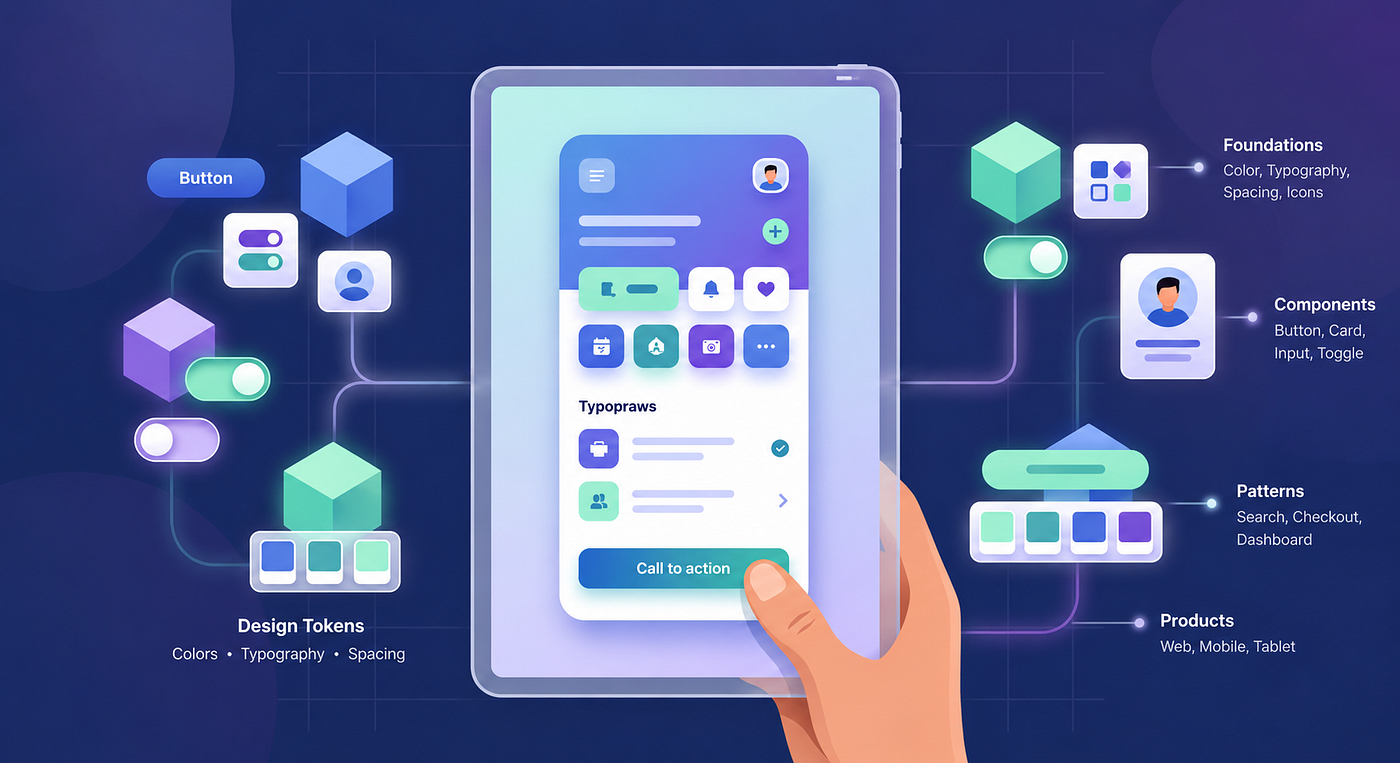
Whether you’re booking a weekend getaway on Airbnb, running a store on Shopify, tracking a project in Jira, or navigating via Google Maps, there’s a comforting sense of familiarity. The buttons do exactly what you expect them to do. Forms don’t confuse you. Getting from point A to point B feels like second nature.
None of this happens by accident. Behind almost every digital product you love is a Design System — an invisible framework working behind the scenes to create consistency, efficiency, and most importantly, trust.
The Coffee Shop Rule
Think about what it’s like to walk into a Starbucks. It doesn’t matter if you’re in Mumbai, London, or New York; the experience is universally understood. You instantly know:
- Where the line starts to place your order.
- How the menu above the counter works.
- What “Tall,” “Grande,” and “Venti” mean.
- The overall vibe and service you’re going to get.

This familiarity is brilliant because it drastically reduces your mental effort. You don’t have to relearn how to buy coffee every time you visit a new city. Design systems do the exact same thing for the digital world. You shouldn’t have to figure out what a “Submit” button looks like every time you open a new screen. Consistency creates confidence.
What Happens When We Wing It?
To understand the value of a design system, imagine a city without one. What if every neighborhood decided to use different colors for their traffic lights? What if stop signs were triangles in one town and blue squares in the next? Driving would instantly become frustrating, exhausting, and downright dangerous.
When digital products lack a design system, they create the same kind of chaos:
- One designer makes a button blue and rounded; another makes it green and square.
- Developers waste hours coding the exact same components from scratch over and over.
- Users get frustrated because the app acts differently from page to page.
In the tech world, we call this UX debt. It’s messy, and it slows everyone down.
How the Heavyweights Do It
Look at some of the biggest names in tech, and you’ll see design systems doing the heavy lifting:
- Airbnb: As they expanded globally, hundreds of designers and engineers were working on the platform at the same time. Without their Design Language System, it would have been a disjointed mess. Today, whether you’re a guest searching for a room or a host updating your calendar, it feels like the exact same app. They proved that a design system isn’t just a library of buttons — it’s how you build trust.
- Shopify (Polaris): Shopify powers millions of businesses. If their interface constantly changed, store owners would spend all their time learning the software instead of selling their products. Their design system, Polaris, keeps everything standard. The result? Merchants spend their energy growing their businesses, not fighting the UI.
- IBM (Carbon): Enterprise software is notoriously complex. IBM uses their Carbon Design System to tame that complexity. By standardizing grids, layouts, and data tables, they prove a crucial point: the complexity should live in the business logic, never in the user interface.
Why Our Brains Love It
At the end of the day, humans are wired to seek out patterns. When we open an app and see familiar elements, a few great things happen:
- Our cognitive load drops: We don’t have to think as hard.
- We move faster: Decision-making becomes a breeze.
- We make fewer mistakes: The predictable layout guides us safely.
People don’t actually fall in love with apps because they are highly unique or radically different. We love them because they are effortless to understand.
The Secret Business Perks
Most companies start building a design system to make things look pretty and consistent. But the biggest payoffs usually happen behind the curtain:
- Lightning-Fast Delivery: Because teams can reuse components like Lego blocks, they stop reinventing the wheel and ship features much faster.
- Ending the Turf Wars: Designers, developers, and product managers finally share a single, unified language. There’s less confusion and virtually no handoff drama.
- Squashing UX Debt: Instead of fixing the same annoying typo or clunky button on 50 different pages, the team fixes it once in the design system, and it automatically updates everywhere.
The AI Elephant in the Room
With the rise of AI, design systems are actually becoming more critical, not less. Yes, AI tools can generate entire screens in seconds. But without a rulebook, AI can just as easily generate a chaotic, inconsistent mess. Design systems are evolving into the “guardrails” that ensure AI-generated designs stay on-brand, accessible, and user-friendly. The companies that win the future will be the ones that mix the raw speed of AI with the strict discipline of a great design system.
Final Thoughts
The ultimate irony of a brilliant design system is that users rarely notice it.
And that is exactly the point. When people can focus entirely on booking their trip, selling their products, or navigating a new city without fighting the interface, the design system has done its job.
The best design systems aren’t something you look at. They are something you feel. You feel it in every smooth swipe, every predictable layout, and every moment of quiet confidence. That is the hidden power of great design.
메타데이터
- post_id
- 58df7badb48c
- slug
- why-every-great-user-experience-feels-familiar-the-hidden-power-of-design-systems-58df7badb48c
- url
- https://www.designsystemscollective.com/why-every-great-user-experience-feels-familiar-the-hidden-power-of-design-systems-58df7badb48c
- canonical_url
- https://www.designsystemscollective.com/why-every-great-user-experience-feels-familiar-the-hidden-power-of-design-systems-58df7badb48c
- author_url
- https://medium.com/@rakeshpatels
- status
- ok
- fetched_at
- 2026-06-24 18:57:25