Negroni Book Club | Spring Reads
Scandinavian Literature for Spring Reads
Negroni Book Club | Spring Reads
Scandinavian Literature for Spring Reads
For our latest book club, I decided to dive into Scandinavian Literature, and it turned out to be a very unexpected journey. Both books we chose deal with generational trauma, and both left us completely baffled.
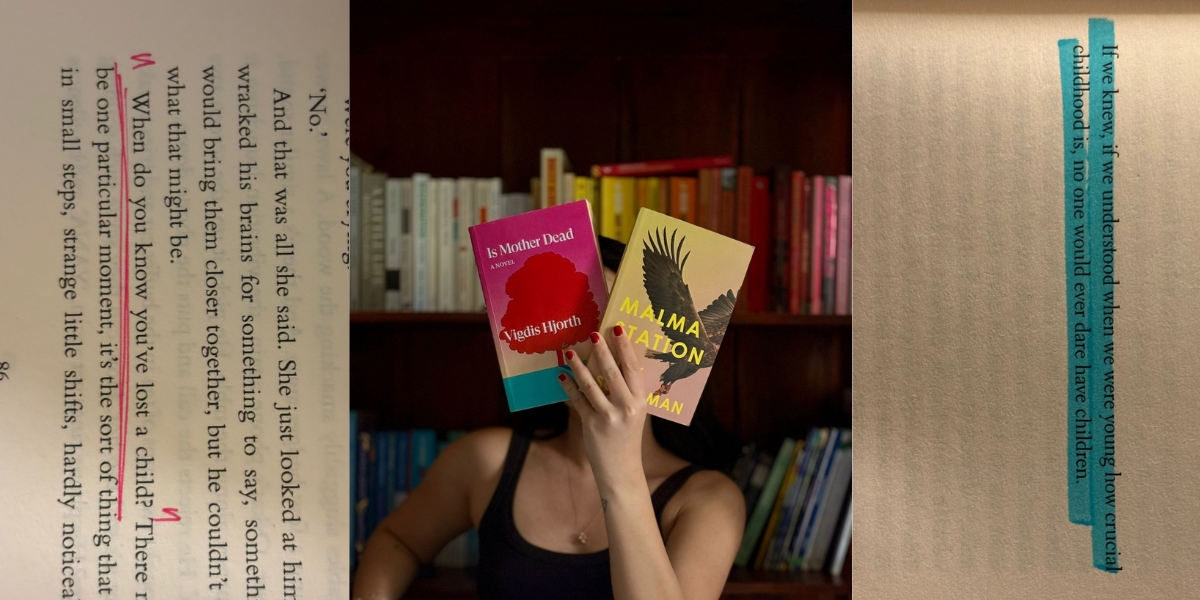
Photo Credit Meltem Birogul
Malma Station by Alex Schulman
Well, I’m at a loss for words. It is one of the most intricate yet strikingly straightforward stories I have read recently. As written above, I decided to immerse myself in Scandinavian literature with my book club. This was the first book I chose, and it was a delightful surprise. I started reading it on my way to Milan from Rome and, luckily, I was able to finish it thanks to the (all too common) delays of the Italian rail system.
The story revolves around three different people who pass through the same station: Malma Station. One is trying to salvage his marriage, another is navigating a strained relationship with her father, and a third is searching for her mother. But is it really that simple?
No. (Please be aware that there will be spoilers below.)
The entire narrative serves as a profound example of generational trauma. It illustrates how a dysfunctional upbringing impacts a child, who then carries that weight into their own parenting, likely perpetuating the cycle for the next generation. As I mentioned at the start, the narrative is incredibly intricate. While the first three chapters initially seem disconnected, as we delve deeper, we begin to see Harriet through several lenses: her relationship with her father, the perspective of her husband (Oskar), and that of her daughter (Yana). It is truly heartbreaking to realize that the root of this trauma lies with Harriet’s mother. I have read other reviews, and I find it hard to believe that no one else has held her accountable.
It was her mistakes — the failure to act responsibly toward a family and two children — that shaped and, more accurately, “damaged” Harriet’s personality. This, in turn, damaged Harriet’s own marriage and her relationship with her daughter. In the story, the mother abandons Harriet and her husband for another man. As the narrative unfolds through Oskar and Yana’s perspectives, we see the exact same pattern repeating itself, though this time with the added burden of being rejected by one’s own parents.
I think one of the most compelling aspects of this book is that the deeper you delve into the story, the more the boundaries between the chapters and their respective narrators dissolve. In the chapters told from Yana’s perspective, I had the distinct impression — especially toward the end — that I was reading about a young Harriet. Similarly, when the story shifted to Oskar’s point of view, I felt a profound sense of empathy for Harriet’s father. I believe this fluidity is a testament to the author’s remarkable talent.
“When do you realise you’ve lost a child?”
Is Mother Dead? by Vigdis Hjorth
I don’t even know where to start with this author. This is the second book I’ve read by her, and I’m honestly speechless because the first one — Will and Testament — was also incredibly heavy. Reading that book felt like an intense therapy session.
This one was just as heavy; I actually struggled to get through it during April. It seems like a simple estranged mother-daughter relationship at first, but you eventually come to understand the generational trauma that shaped how the mother raised her child. Now, that child hasn’t spoken to her family for 30 years while building a life of her own.
It’s very deep, but what I love most about this author is the structure. On one page, you’re reading a chapter that’s two or three paragraphs long, and on the next, you’re plunged into the protagonist’s inner thoughts — sometimes just one or two sentences that make you stop and say, “Wow.” I don’t know if there is a special name for this technique, but it is incredibly captivating. You aren’t just being told a story; you are literally standing in the protagonist’s shoes. It isn’t just storytelling — it’s total immersion.
As I mentioned at the very beginning, it was incredibly difficult for me to get through this book. In my own life, my mother is the most important person to me, and I can’t even fathom a situation where I wouldn’t be on speaking terms with her. Because of that, I was very judgmental of the protagonist at first — this “incredible artist” — but as the story progresses, you start to see that her behavior was really a result of how she was raised.
Actually, the mother suffered from something much deeper. I found myself feeling more empathetic toward her; I truly understand why she wouldn’t want to see her daughter after all these years. The family she created — raised with all its flaws and virtues — was the only thing she had that felt “acceptable” by society’s standards. While I don’t fully understand why the daughter ran away, I definitely understand why the mother was so offended by the art she produced after leaving her hometown, her marriage, and her family. To the world, that art seemed like a public way of saying she was a “shitty mother.”
I really feel for the mother, especially since she was already dealing with her own demons — she was even suicidal. For the daughter to realize her mother’s problems only after 30 years and then try to force some kind of communication? I don’t think she has the right to do that. They kept in touch sporadically through letters, and then there was the father’s funeral. Even if you hated your father, your mother was still there, and you could have supported her — even if she was troubled or struggled to show love. Now, she’s in her eighties, likely in the last decade of her life, and the daughter is suddenly demanding answers about a 30-year gap she chose to create. It feels incredibly selfish. I believe in following your gut and your dreams, but you can’t just burn all your bridges and then expect to walk back over them.
I’ll close by saying that, much like my first experience with this author, this was a deeply unsettling — even traumatizing — read for me. As someone who loves her mother dearly, I cannot imagine any scenario where I wouldn’t see her for over three decades; it feels impossible.
It is incredibly sad, but I do eventually come to understand the protagonist’s mother. I don’t want to place all the blame on her, because she grew up without her own mother and father figures. She was raised by relatives and likely never felt like she truly belonged. When she finally had the chance to have her own family — marrying into a world that seemed “out of her league” — she felt an immense pressure to be perfect. She didn’t know how to manage a relationship with her children because she had no blueprint for parental love. On top of that, the father figure was authoritative and demanding, leaving the mother unable to truly express herself.
She couldn’t raise her daughter well because she was struggling just to survive. They even shared the same talent — drawing — but they couldn’t connect through it. When the daughter left, the one thing the mother had successfully built collapsed. To then be portrayed globally as a “bad mother” through her daughter’s art was the final blow. I’m no expert, but this is the definition of generational trauma. It is tragic because every child deserves a loving mother, and every mother deserves a loving child. It really should be a two-way street.
메타데이터
- post_id
- 58effaaf0628
- slug
- negroni-book-club-spring-reads-58effaaf0628
- url
- https://medium.com/@meltembirogul/negroni-book-club-spring-reads-58effaaf0628
- canonical_url
- https://medium.com/@meltembirogul/negroni-book-club-spring-reads-58effaaf0628
- author_url
- https://medium.com/@meltembirogul
- status
- ok
- fetched_at
- 2026-06-09 15:37:30