A Beginner’s Guide to Apache Kafka: The Powerhouse of Event Streaming
Apache Kafka is a powerful, open-source distributed event streaming platform designed to handle real-time data streams.
A Beginner’s Guide to Apache Kafka: The Powerhouse of Event Streaming
Apache Kafka is a powerful, open-source distributed event streaming platform designed to handle real-time data streams. Originally developed by LinkedIn, it is now an Apache Software Foundation project and is widely used by companies like Netflix, Uber, and LinkedIn for building scalable and fault-tolerant data pipelines.
Photo by Jametlene Reskp on Unsplash
What is Apache Kafka?
Kafka enables applications to publish, subscribe to, store, and process streams of records in a distributed and fault-tolerant manner. It is primarily used for capturing and processing events, making it a critical component for real-time analytics, monitoring, and event-driven architectures.
This is the first article from the Apache Kafka series. Follow my account to make sure that you won’t miss another ones.
Roadmap
- ➡️ Apache Kafka Introduction (you are here)
- *Kafka topics*
- *Kafka producers*
- *Kafka consumers*
- *Kafka broker*
Key Features of Kafka
- Distributed and Scalable: Kafka is built around a distributed system of servers (brokers) and clients (producers and consumers), allowing it to scale horizontally.
- High Throughput: It can process millions of messages per second.
- Fault-Tolerant: Kafka ensures data durability and replication, preventing data loss.
- Publish-Subscribe Model: Multiple producers can publish data to topics, while multiple consumers can subscribe and process data independently.
Kafka Architecture: Key Concepts
Kafka revolves around three fundamental concepts: topics, producers, and consumers.
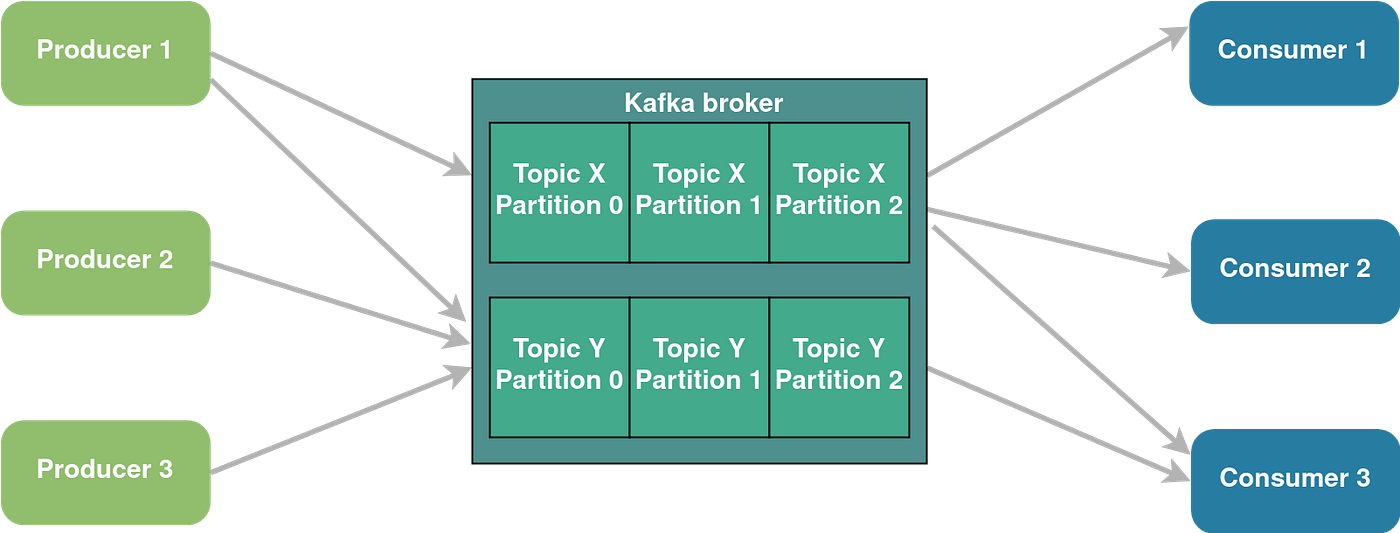
Kafka architecture
1. Topics
A topic is a durable log of events and acts as a directory that stores records. Topics allow multiple consumers to access the same data stream.
2. Producers
Producers are applications that publish records to Kafka topics. They push data into the system for further processing.
3. Consumers
Consumers subscribe to topics and process records. They pull data from Kafka and act upon it in real time.
Streaming Data: The Heart of Kafka
Kafka is built to handle streaming data — information continuously generated by thousands of sources. Examples include:
- Sensor data from IoT devices
- Customer activity on a website for real-time analytics
What is an Event in Kafka?
An event is a record of something that happened. It consists of three main components:
- Key: An identifier for the event
- Value: The actual event data
- Timestamp: When the event occurred
Kafka’s Publish-Subscribe Model
Kafka follows the publish-subscribe model, allowing multiple producers to publish records to a topic and multiple consumers to subscribe to and process them. This enables efficient data distribution without tight coupling between services.
Why Use Kafka? Key Benefits
Kafka is widely adopted due to its robust capabilities:
- Durability: Stores data persistently, preventing data loss.
- Scalability: Easily handles increased workloads by scaling horizontally.
- High Performance: Processes large amounts of data with low latency.
Common Use Cases
- Real-time Analytics: Process customer behavior in real time.
- Monitoring & Log Aggregation: Centralize logs for analysis.
- Event Sourcing: Build event-driven applications.
- Stream Processing: Transform and analyze data on the fly.
Decoupling Systems with Kafka
One of Kafka’s biggest advantages is decoupling producers and consumers. This means:
- Producers don’t need to know who is consuming the data.
- Any consumer can access all available data in Kafka.
Kafka Delivery Semantics
Kafka provides different delivery guarantees to handle network unreliability:
- At least once: Ensures records are never lost but may be duplicated.
- At most once: Guarantees no duplicate records but may lose some.
- Exactly once: Ensures records are never lost and are processed exactly once (achieved using transactions).
Kafka APIs: How to Interact with Kafka
Kafka provides several APIs for different use cases:
- Producer API: Publishes streams of records.
- Consumer API: Subscribes to topics and processes records.
- Streams API: Enables applications to process data streams in real time.
- Connector API: Integrates Kafka with external systems.
Kafka vs. RabbitMQ: Key Differences
Kafka is often compared to RabbitMQ, another messaging system, but they serve different purposes:
- Kafka supports multiple consumers, while RabbitMQ messages are consumed by only one consumer.
- Kafka stores messages durably, allowing replay, whereas RabbitMQ messages are ephemeral.
- Kafka is designed for event streaming, whereas RabbitMQ is a message broker optimized for request-response communication.
The difference between Kafka and RabbitMQ mainly result from the fact that they follow different messaging architectures compared in my other article: Messaging Models in System Design: Point-to-Point vs. Publish-Subscribe. Kafka follows the Publish-Subscribe architecture, while RabbitMQ follows Point-to-Point messaging pattern.
Conclusion
Apache Kafka is a game-changer for real-time data processing. Its distributed, fault-tolerant nature makes it ideal for building scalable event-driven systems. Whether you’re working on analytics, monitoring, or large-scale messaging, Kafka provides the reliability and performance needed to handle massive data streams efficiently.
Further Reading
Have you worked with Kafka before? Share your experiences and use cases in the comments below!
메타데이터
- post_id
- 5908859e16bf
- slug
- a-beginners-guide-to-apache-kafka-the-powerhouse-of-event-streaming-5908859e16bf
- url
- https://medium.com/@software.engineer.notes/a-beginners-guide-to-apache-kafka-the-powerhouse-of-event-streaming-5908859e16bf
- canonical_url
- https://medium.com/@software.engineer.notes/a-beginners-guide-to-apache-kafka-the-powerhouse-of-event-streaming-5908859e16bf
- author_url
- https://medium.com/@software.engineer.notes
- status
- ok
- fetched_at
- 2026-07-31 21:25:58