From Hilbert’s Sixth Problem to Physics AI: Why Learning the Boltzmann Equation Matters
Most scientific AI learns macroscopic fields. A Nature Communications study takes a different route: learning the mesoscopic distribution…
From Hilbert’s Sixth Problem to Physics AI: Why Learning the Boltzmann Equation Matters
Most scientific AI learns macroscopic fields. A Nature Communications study takes a different route: learning the mesoscopic distribution functions that
The current excitement around Hilbert’s sixth problem has brought the microscopic-to-macroscopic bridge back into public view. This work asks a computationally complementary question: can a physics-informed neural operator learn the evolution of the Boltzmann description itself and fast-forward a simulation without resolving every intermediate collision step?
A fluid looks continuous. Water bends around an obstacle, air forms vortices behind a wing, and blood moves through branching vessels as if each point in space had a well-defined velocity and pressure.
But matter is not continuous. It is made of enormous numbers of particles moving, colliding and exchanging momentum. The familiar equations of fluid mechanics are therefore macroscopic summaries of a much richer microscopic world.
Between these two descriptions lies kinetic theory, and at its centre is the Boltzmann equation. Rather than tracking every molecule, the Boltzmann equation evolves a probability distribution: how many particles are likely to be found at a position, moving with a given velocity, at a given time. It is the statistical bridge between particle dynamics and continuum flow.
That bridge is also why recent interest in Hilbert’s sixth problem matters for artificial intelligence. One strand of Hilbert’s programme concerns placing the passage from microscopic laws to macroscopic equations on a rigorous mathematical foundation. Our study addresses a different level of the same multiscale hierarchy: how to make the mesoscopic Boltzmann description computationally faster without discarding the kinetic information it contains.connect particle motion to fluid dynamics.
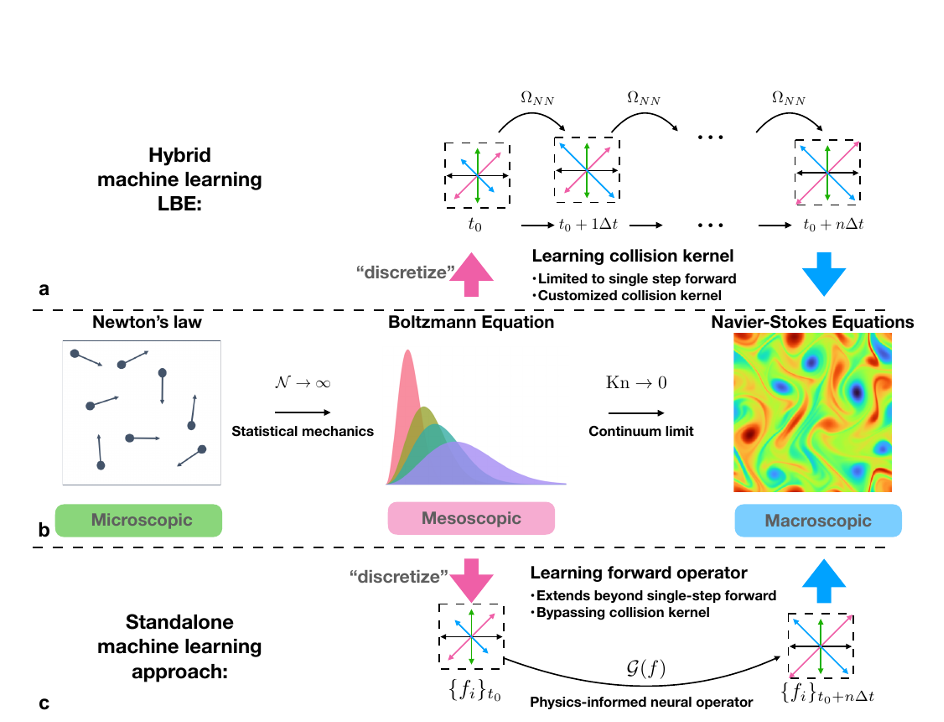
The microscopic–mesoscopic–macroscopic hierarchy. The neural operator acts at the mesoscopic lattice-Boltzmann level, learning a large-time forward map rather than a single collision update. Source: Xue et al., Nature Communications (2026), CC BY 4.0.
The missing middle in scientific machine learning
Most machine-learning models for fluid dynamics begin at the macroscopic end of this hierarchy. They learn velocity, pressure, density, temperature or vorticity fields. This is natural: those are the quantities engineers and scientists usually want to observe.
Yet macroscopic fields are compressed summaries. In kinetic theory, quantities such as density and momentum are obtained by taking moments of the particle distribution. Once only those low-order moments are retained, much of the non-equilibrium information in the full distribution is lost.
An everyday analogy is traffic. Knowing the average speed on a road is useful, but it does not tell you how cars are distributed among lanes, directions and local clusters. Two traffic states can have the same average speed while evolving very differently. In the same way, two kinetic states can share similar macroscopic variables while containing different internal distributions that matter for future evolution.
This is why learning the Boltzmann-level state is important. Physics AI should not only learn the endpoint of a multiscale hierarchy; it should also learn the bridge that connects the scales.
“Physics AI should not only learn the endpoint of a multiscale hierarchy; it should also learn the bridge.”
Why the lattice Boltzmann equation is a useful bridge
The full Boltzmann equation is defined over both physical space and velocity space, which makes it expensive to solve directly. The lattice Boltzmann method simplifies the velocity space into a small set of discrete directions on a lattice.
At each lattice site, the method stores several distribution functions. Each one represents the amount of particle population travelling in a particular discrete direction. A conventional lattice Boltzmann solver then repeats two operations:
1. Streaming: particle populations move to neighbouring lattice sites.
2. Collision: populations at each site are redistributed among the available velocity directions.
This stream–collide cycle is simple, local and highly parallel, which is why lattice Boltzmann methods are widely used for complex flows, multiphase systems and biomedical haemodynamics. But explicit time stepping also means that a solver must execute every small intermediate step, even when the quantity of interest lies much further in the future.
A fast-forward button for kinetic dynamics
Our central idea is to replace repeated small-step advancement with a learned large-step forward operator. Instead of asking a neural network to approximate only the collision kernel for the next time step, we train a physics-informed neural operator to map the complete set of distribution-function fields at the current time directly to their state many lattice-Boltzmann steps later.
The distinction is important. A collision-kernel model still has to be inserted into a conventional time-stepping loop. Our model learns the combined effect of transport and collision over an extended interval. In the tested problems, one forward pass can jump tens or hundreds of lattice-Boltzmann time steps, avoiding explicit evaluation of the collision operator at every intermediate step.
This is the source of the speed-up. The model is not making each collision slightly cheaper; it is skipping most of the intermediate collision calculations altogether.

The learned operator advances the full kinetic state and recovers macroscopic observables through moment maps. The framework also enforces global lattice equivariance by combining spatial transformations with velocity-channel permutations.
Making the neural operator respect physics
A neural network can fit data while still violating the physical structure of the system. We therefore built two lattice-Boltzmann-specific constraints into training.
Moment matching. The predicted distribution functions must reproduce key macroscopic quantities, including mass and momentum. This preserves consistency between the mesoscopic state and the macroscopic fields derived from it.
Global equivariance. The lattice has discrete rotational and reflection symmetries. If the entire physical system is rotated or reflected — and the velocity channels are permuted accordingly — the model’s prediction should transform in exactly the same way. Enforcing this property prevents the network from learning orientation-dependent artefacts that are not present in the underlying formulation.
These constraints are not generic decorative penalties. They encode how the lattice-Boltzmann variables relate across scales and how the discrete lattice behaves under symmetry transformations. Across the experiments, they reduced prediction error, lowered variability between independent training runs and improved the stability of long rollouts.
Learning at one resolution, predicting at another
Another important result is resolution transfer. For the vortex-street problem, the neural operator was trained using distribution functions on an 80 × 80 grid and then evaluated directly on a 160 × 160 grid without retraining. The collision relaxation time also differed at the finer resolution.
The model nevertheless retained accurate predictions. This suggests that it had learned aspects of the underlying kinetic evolution rather than simply memorising a fixed array of grid values. Such discretisation-aware generalisation is one of the main attractions of neural operators compared with ordinary image-to-image networks.
Why not simply predict velocity or phase?
For some tasks, directly predicting a macroscopic field is entirely reasonable. In the two-dimensional phase-field example, a model trained only on the phase variable achieved very low error for that scalar quantity.
But a scalar phase prediction is not a complete lattice-Boltzmann state. It cannot uniquely reconstruct all distribution functions needed for later collision, streaming, forcing or boundary-condition operations. A model that predicts the full kinetic state can recover velocity, density, phase and other moment-based observables, while also remaining compatible with a downstream lattice-Boltzmann solver.
This is the trade-off. Kinetic learning requires more memory — there are more variables per grid cell — but it preserves information that macroscopic-only models cannot generally recover.
A broader lesson for AI for science
AI for science is often framed as a contest between data and equations. The more productive view is to ask at which level of physical description a model should learn, and which structures must be preserved at that level.
For fluid dynamics, the answer does not always have to be the Navier–Stokes equations or their macroscopic solution fields. The mesoscopic level offers a different opportunity: it is coarse enough to avoid tracking individual molecules, yet rich enough to retain non-equilibrium information that macroscopic summaries lose.
Our work shows that a neural operator can act as a fast-forward map at this intermediate scale. It can advance particle distribution functions over large time intervals, preserve key moments and lattice symmetries, transfer across grid resolutions, and deliver speed-ups reaching hundreds of times in the tested cases.
The larger message is simple: as scientific AI develops, we should not only teach machines to reproduce what we observe at the macroscopic scale. We should also teach them the statistical bridges through which the macroscopic world emerges.
paper: **https://rdcu.be/fxtBQ Authors: **Xiao Xue, Marco F. P. ten Eikelder, Mingyang Gao, Xiaoyuan Cheng, Yiming Yang, Yi He, Shuo Wang, Sibo Cheng, Yukun Hu and Peter V. Coveney.
메타데이터
- post_id
- 591f42e12e92
- slug
- from-hilberts-sixth-problem-to-physics-ai-why-learning-the-boltzmann-equation-matters-591f42e12e92
- url
- https://medium.com/@xuexiao_96/from-hilberts-sixth-problem-to-physics-ai-why-learning-the-boltzmann-equation-matters-591f42e12e92
- canonical_url
- https://medium.com/@xuexiao_96/from-hilberts-sixth-problem-to-physics-ai-why-learning-the-boltzmann-equation-matters-591f42e12e92
- author_url
- https://medium.com/@xuexiao_96
- status
- ok
- fetched_at
- 2026-08-04 13:21:16




