Twisted Nuclear Fusion Design: The Stellarator
Nuclear fusion power is perpetually fifty years away, but will this design remover the word ‘perpetually’?
Nuclear Fusion Power
Twisted Nuclear Fusion Design: The Stellarator
Nuclear fusion power is perpetually fifty years away, but will this design remover the word ‘perpetually’?
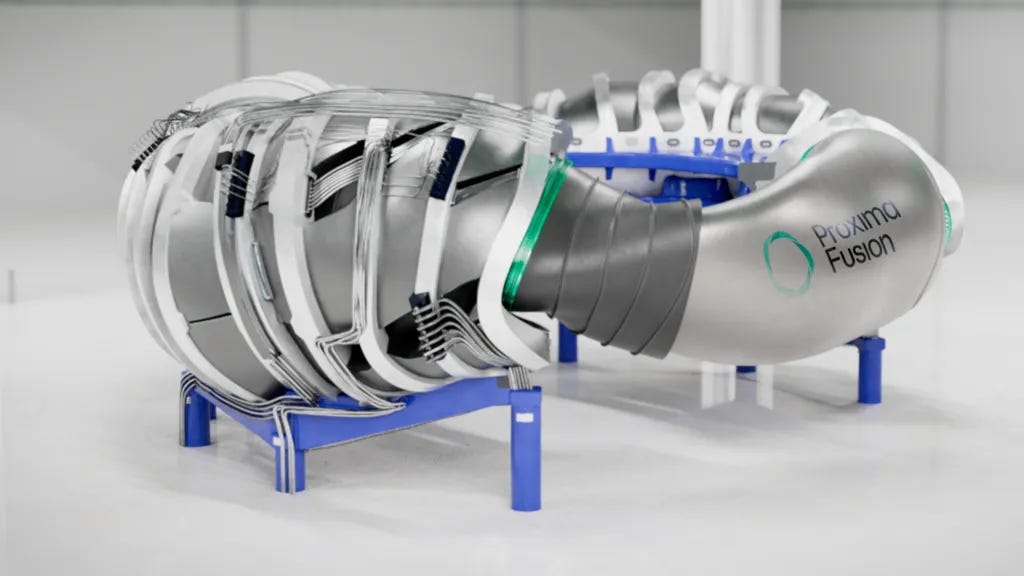
Picture: Proxima Fusion Stellarator
Over the past three or four years I’ve written maybe a dozen articles about nuclear fusion power. I’m convinced that its successful development will be transformative for mankind.
The significant success of wind and solar power generation in many countries is proving that replacing hydrocarbons for power generation may well be achievable, but those sources are unlikely to be able to provide for the growth in power demand that is foreseen. The demand growth is not only driven by AI power hunger, but also by increased demand for air conditioning and refrigeration as the climate warms.
As the Age of Electricity moves apace, demand is on a solid upward trajectory in our five-year forecast period from 2026 to 2030. Amid robust growth, the next five years will add on average 50% more electricity demand per year than over the past decade. The brisk pace will be supported by growing industries, electric vehicles, space cooling, and data centres, among many other end uses. Electricity consumption is now projected to grow at least 2.5 times faster than overall energy demand, hastening the world’s transition to an electricity-based economy. — iea.org
The concept of the stellarator
Nuclear fusion is the process that powers the sun and other stars. Replicating this process on Earth is the biggest technology challenge that science currently faces.
We can create the plasma, but confining plasma that is as hot as the core of the sun in a stable state is at the heart of the problem, so to speak.
The current world record for plasma duration in a tokamak design was achieved by the WEST (W-Tungsten Environment in Steady-State Tokamak) facility in France. In February 2025, the WEST machine successfully maintained a stable plasma for 1,337 seconds — approximately 22 minutes. Tokamak is the name used to describe a doughnut-like design for plasma containment.
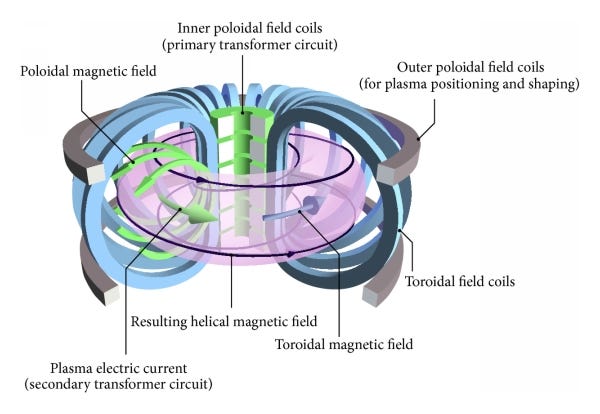
Tokamak schematic. Credit: By R.A. Pitts, R.J. Buttery, S.D. Pinches — R.A. Pitts, R.J. Buttery, S.D. Pinches, Fusion: the way ahead, Physics World 19 (2006) 20, CC BY 4.0
The stellarator realises a different design concept, although it looks something like a distorted tokamak.
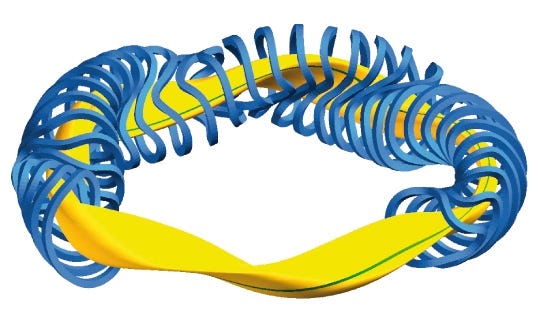
Stellartor design. Credit: By Max-Planck Institut für Plasmaphysik CC BY 3.0,
Unlike the tokamak design, which relies on a large current induced within the plasma to create the necessary magnetic field, the stellarator generates its confinement field almost entirely through complex, externally placed magnetic coils.
This fundamental difference enables the stellarator to operate in a steady state, as it does not require the continuous, large-scale current induction that characterises the tokamak. By maintaining this magnetic cage from the outside, the stellarator avoids the reliance on internal currents which are inherently prone to sudden instabilities and terminations.
This approach is intended to produce a more robust and reliable confinement environment suitable for a power plant.
Some history
The stellarator concept originated in the nineteen fifties with Lyman Spitzer at Princeton University. Early versiosn encountered significant difficulties regarding plasma confinement efficiency.
Researchers observed that particles escaped the magnetic traps far more rapidly than theoretical models predicted. These findings led to a shift in focus towards the tokamak design, which appeared more promising during that period. Consequently, research into stellarators slowed for several decades.
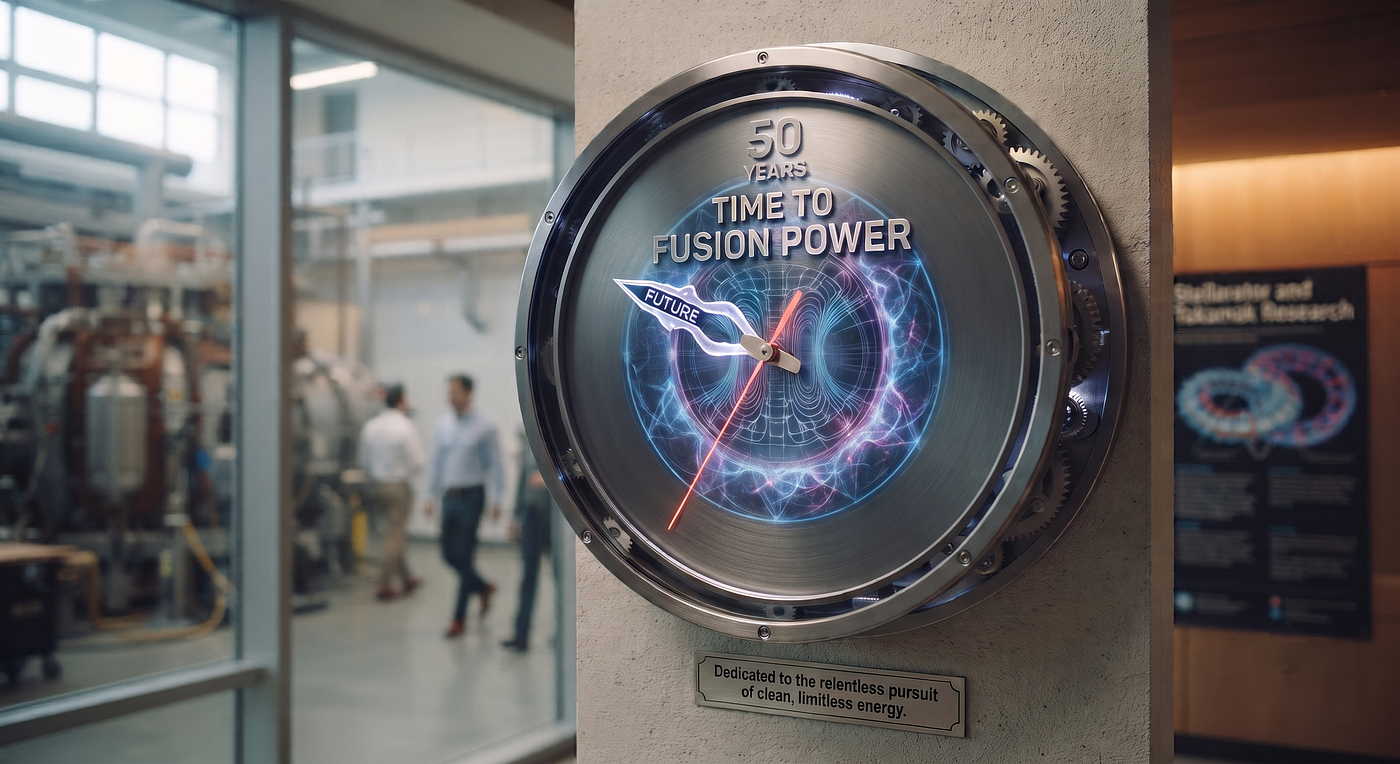
Generated by AI
During this time, the scientific community focused heavily on the tokamak, which achieved greater success in plasma temperature and density.
However, modern advances in supercomputing have changed this dynamic. Contemporary researchers use high-speed computing to calculate the intricate three-dimensional shapes of the magnetic coils required to optimise confinement, leading to a resurgence in interest.
These computational tools allow engineers to map out magnetic surfaces with immense accuracy, mitigating the particle loss issues that plagued the early experimental devices.
Magnetic field geometry
The magnetic configuration of a stellarator requires precise control. The plasma must be confined within a toroidal shape, which resembles a doughnut.
Because the magnetic field strength varies across the radius of this torus, particles tend to drift away from the central axis. To counteract this effect, the stellarator employs a twisted, non-axisymmetric magnetic field.
This twist, or rotational transform, ensures that individual particles remain within the magnetic surfaces as they travel around the torus. Creating this configuration demands high precision in the design and manufacture of the superconducting coils that surround the vacuum vessel.
These coils must be shaped into complex curves to create the specific three-dimensional field lines. The engineering complexity involved in these shapes presents a major manufacturing challenge, yet it is this precise twisting of the magnetic field lines that provides the stellarator with its unique confinement properties without needing a plasma current.
Advantages of steady state operation
One primary benefit of the stellarator is its capacity for steady state operation. Fusion power plants must operate continuously to provide a stable electricity supply.
Tokamaks often struggle with this requirement because they rely on pulsed operation to drive the plasma current. Interruptions in the plasma current can lead to instabilities or disruptions that potentially damage the reactor components.
Because the stellarator generates its confining field through external coils, it can maintain stable plasma conditions for extended durations without the risks associated with plasma-driven currents.
This stability simplifies the engineering requirements for the reactor vessel and heat exhaust systems, as it removes the need to restart the plasma discharge repeatedly. Furthermore, the absence of plasma current means the device does not suffer from disruptions, which are rapid and potentially destructive losses of confinement that pose a risk to the structural integrity of tokamaks.
Future prospects and the wendelstein 7-x
Current research centres on large-scale experiments such as the Wendelstein 7-x in Germany. This machine serves as a proof of principle for the optimised stellarator design. It looks as if the cat got into the knitting, but it works for short periods.
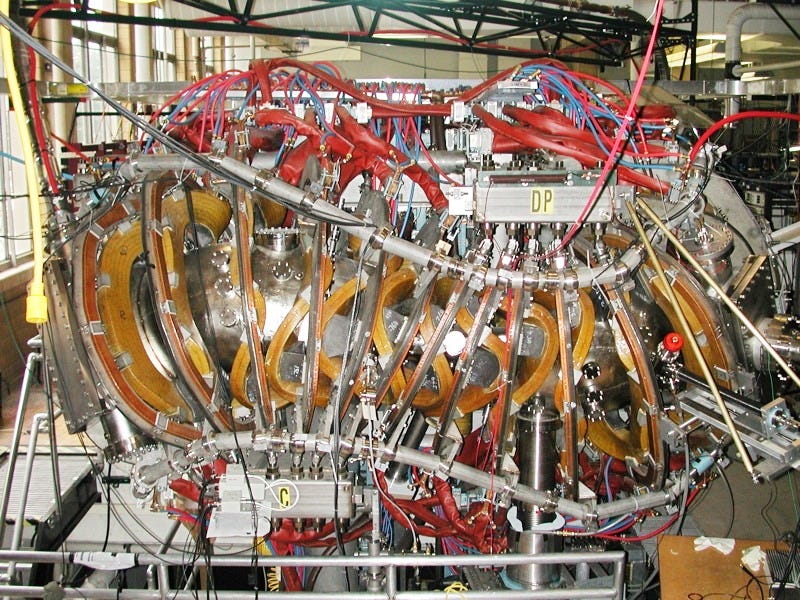
HSX Stellarator. Credit: By The HSX Team, Jerahmie — The HSX Team, Public Domain
It demonstrates that complex magnetic fields can indeed confine plasma with sufficient performance for fusion energy production. Researchers now focus on managing heat loads on the vessel walls and developing materials capable of withstanding the intense neutron flux produced during deuterium-tritium fusion reactions.
The data gathered from this facility is crucial for the design of a future demonstration power plant. While technical hurdles remain regarding the fabrication of such complex coil systems on a larger scale, the stellarator provides a credible alternative to the tokamak.
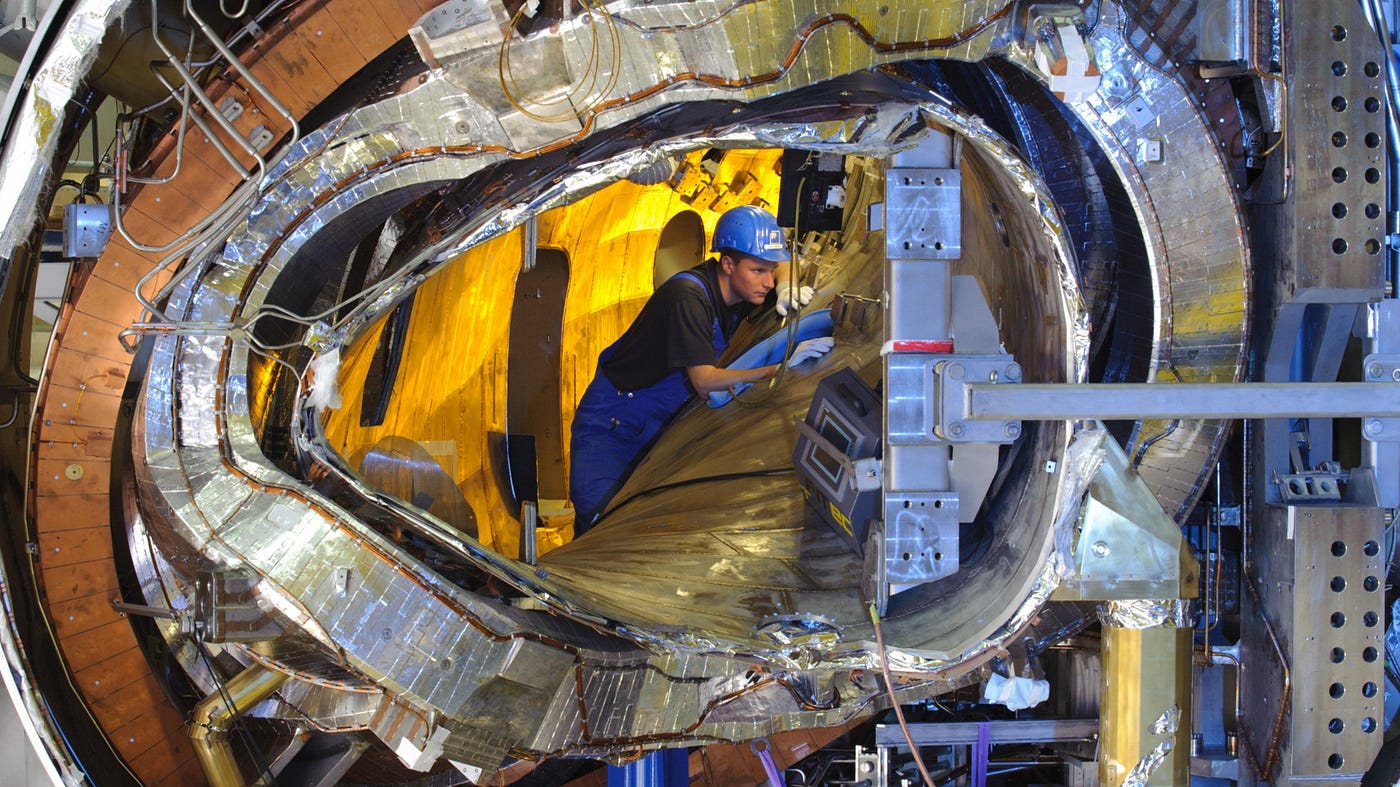
Inside the Wendelstein 7-X stellarator. Credit: MPI for Plasma Physics/Wolfgang Filser
48 minutes in Japan
The Large Helical Device (LHD) in Japan, which is one of the world’s most advanced stellarators, has demonstrated this steady-state capability extensively. It has successfully maintained a stable plasma for pulses lasting up to 48 minutes. This duration is not a hard physical limit of the magnetic configuration itself, but rather a reflection of the specific operational goals and technical capacity of the LHD facility during those experimental runs.
If progress continues, these machines may play a vital role in the future of commercial nuclear fusion energy, offering a pathway toward a sustainable and constant source of power that does not rely on the pulsed cycles required by other magnetic confinement configurations.
The primary engineering challenges to increasing this duration further involve:
- Heat extraction: The divertor systems must manage the continuous heat exhaust from the plasma without eroding or overheating. It is currently engineered to handle a maximum total heat exhaust of 64.3 MW.
- Fueling and impurity control: Most fusion technologies rely on the deuterium-tritium (DT) fusion process, which occurs when a deuterium nucleus (a proton bound to a neutron) and a tritium nucleus (one proton and two neutrons) fuse to produce helium-4, a free neutron and large amounts of energy. After the deuterium-tritium fusion process, helium nucleii, known as helium ash, remain within the magnetic field. Maintaining the plasma requires constant refueling and the removal of helium ash, which would otherwise extinguish the fusion reaction. These nucleii are diverted out of the plasma stream.
- Superconducting coil cooling: The cryogenics system must reliably remove the heat generated by the intense magnetic fields and any stray radiation over long periods. 5.65 kW of cooling capacity is designed in for this.
As noted, these are primarily engineering — as opposed to scientific — challenges. The ongoing refinement of this technology remains a priority for international fusion research programmes seeking reliable, long-term energy generation solutions.
The 50 year clock may be running a little faster now, but I doubt that I will still be around to finally see commercial scale nuclear fusion power.
메타데이터
- post_id
- 5931e2efaea7
- slug
- twisted-nuclear-fusion-design-the-stellarator-5931e2efaea7
- url
- https://medium.com/the-dock-on-the-bay/twisted-nuclear-fusion-design-the-stellarator-5931e2efaea7
- canonical_url
- https://medium.com/the-dock-on-the-bay/twisted-nuclear-fusion-design-the-stellarator-5931e2efaea7
- author_url
- https://medium.com/@james-marinero
- status
- ok
- fetched_at
- 2026-07-16 20:04:03