Players and Spectators: Entertainment and Disembodied Agency in Infinite Jest
David Foster Wallace’s Infinite Jest, a thousand-page postmodern satire of the American entertainment apparatus, draws on many of the…
Players and Spectators: Entertainment and Disembodied Agency in Infinite Jest
David Foster Wallace’s Infinite Jest, a thousand-page postmodern satire of the American entertainment apparatus, draws on many of the author’s recurring philosophical concerns regarding sincerity and agency in a late capitalist epoch. This essay examines how entertainment functions therein as a conduct in which embodied agency is gradually supplanted by passive, instantaneous gratification. It first considers the world of television and entertainment, which Wallace presents as a model of instant, detached pleasure. It then turns to the Enfield Tennis Academy, the novel’s primary narrative site, a place where pleasure is deferred and agency is orientated around discipline.
Section (1) explores television and entertainment through three interrelated strands: the eponymous film Infinite Jest, American advertising, and the desire for televisual fame. Together, these strands illustrate how modern entertainment culture reshapes agency and gratification. Section (2), ‘The Enfield Tennis Academy’, returns to the experience of embodied agency, dividing the analysis between the figure of the disciplined prodigy and the logic of deferred gratification. The essay concludes by reflecting on what Infinite Jest ultimately suggests about the ‘hollowness of contemporary American pleasure’ (Wood).
- Television and Entertainment
(1a) Infinite Jest
Infinite Jest is constructed around an eponymous experiential film that functions as the novel’s most immediate and overt vehicle for critiquing entertainment culture. Shot and directed by the avant-garde filmmaker James O. Incandenza shortly before his suicide, the film is depicted as ‘lethal’ in its irresistible capacity for pleasure.The danger of the film is explored explicitly in the interview between Hugh Steeply, a U.S. government operative tasked with investigating the cartridge, and Rémy Marathe, a Québécois separatist. Steeply repeatedly emphasises the film’s unique threat: ‘the cartridge is so entertaining that the viewer loses all desire to do anything else.’ (110) Viewers are described as being wholly subsumed by the experience, ‘dying happy’ and ‘without complaint’ (112) What renders Infinite Jest so lethal is the specific form of pleasure it produces: a disembodied experience in which the viewer willingly surrenders agency and interest in the external world.
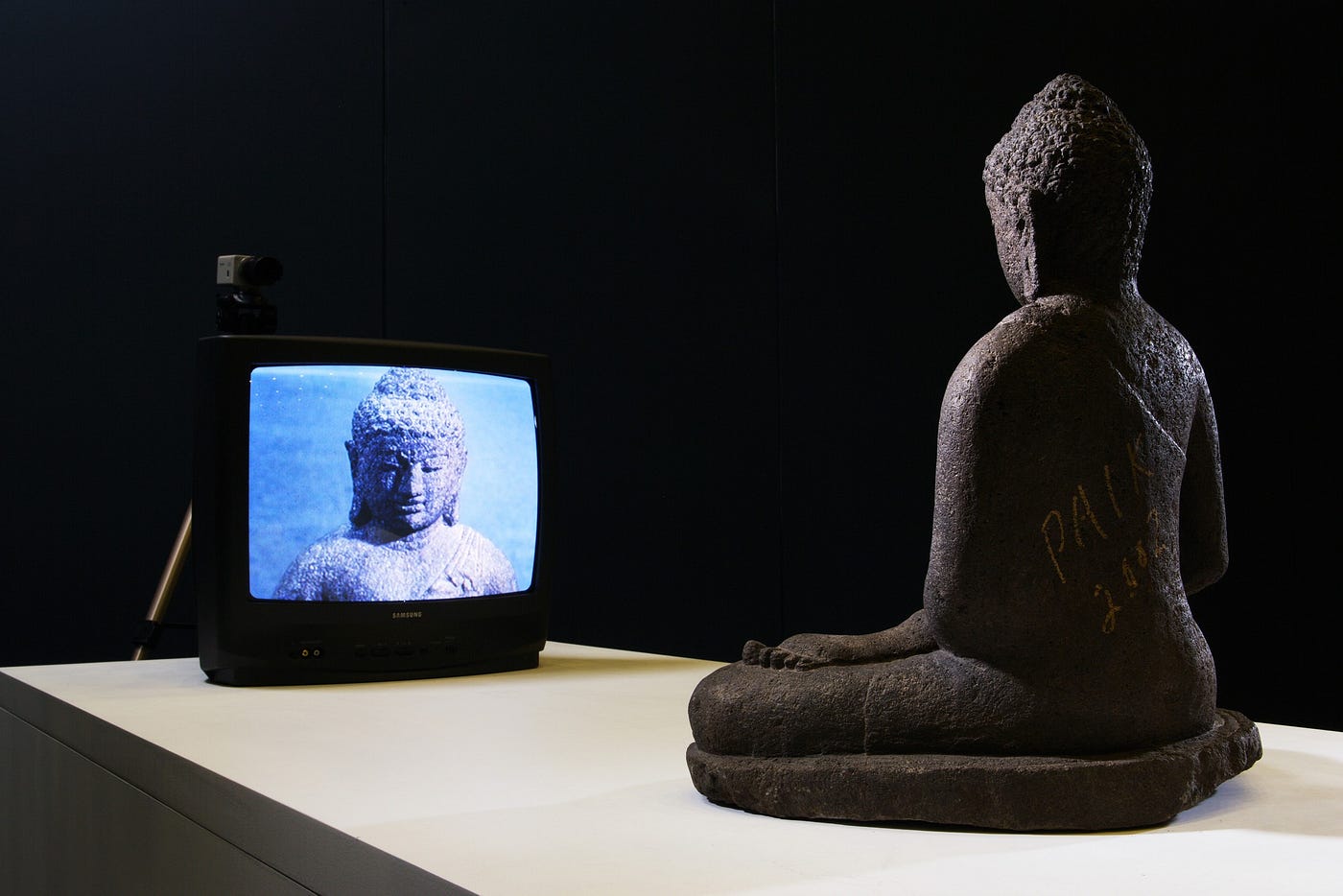
This model of mediated pleasure reflects Wallace’s broader critique of television. In his essay ‘E Unibus Pluram: Television and U.S. Fiction,’ Wallace argues that television operates through what he calls a ‘syncretic handle,’ reflecting back to viewers what they already want to see. He describes the television screen as ‘a mirror like the overlit bathroom mirror before which the teenager monitors his biceps and determines his better profile,’ a ‘window on nervous American self-perception’ (153). Television, here, acts as a distorting mirror that offers a more flattering and controllable image of the self than embodied reality can provide. Jacques Lacan’s account of the mirror stage helps frame this process. For Lacan, the specular image ‘seems to be the threshold of the visible world,’ producing a double with which the subject identifies more strongly than with their own fragmented bodily experience (Lacan 77). The mirror mediates between the Innenwelt and the Umwelt — the inner bodily world and the external field of images — offering a coherence the body itself cannot sustain.
Media entertainment in Infinite Jest operates under the same logic. It offers a coherent imago (images that are easier and more pleasurable to engage with than embodied life). The image becomes more compelling than the self that watches it, producing pleasure that is entirely disembodied. With ‘no restraint. No boredom. No risk. Nobody. Only pleasure,’ Incandenza’s film functions as a limit-case on entertainment’s capacity to remove agency and replace it with disembodied spectatorship. Those who view the film relinquish all bodily needs; they refuse food, movement, even survival, choosing instead to remain fixed before the screen. The body becomes negligible, while the image assumes total authority. In this sense, Wallace literalises Lacan’s account of the mirror stage: identification with the imago does not merely stabilise the self, but erases the embodied subject altogether.
(1b) American Advertising
Sat in a ‘stoned and distracted funk’ (410), Hal Incandenza, son of ‘Infinite Jest’s’ director and one of the book’s central characters, drifts into a slump of televisual pleasure. As he sits enveloped in the ‘steady hum of entertainment, his attention slips from bodily sensation’ (411) toward the screen. The scene echoes the passive spectatorship described in (1a) yet with the ‘extensive knowledge of American advertising’ acquired in his early teens, Hal is able to reflect on the structure of television’s pleasure even as he remains trapped within it. He recalls the advertising campaign’s central question: ‘What matters whether your choices are 4 or 104 or 504?’ (413). Channel surfing, he realises, is not restoring his agency; it’s merely keeping him sat and receptive, selecting among ‘504 visual spoon-feedings pumped into their entertainment ken’ (414). The promise of choice masks a deeper passivity.
The process of disembodiment Hal goes through as he becomes further enmeshed into the American Ad system echoes Lacan’s account of identification with the image. The advertising world Hal contemplates functions as the imago, offering relief from the unpredictability and effort of embodied experience. Ads offer Hal an image of himself as an autonomous consumer, a choosing subject whose preferences appear self-authored and coherent. By staging consumption as agentive decision-making, advertising supplies a ready-made identity that negates the stress and anxieties of an embodied life.
Hal’s disembodied absorption shows that the logic behind the lethal Entertainment is not exceptional to his father’s widely sought after film but already embedded in everyday American media culture. The same disembodied spectatorship that kills viewers in his father’s film is operating at the everyday-level, marketed as consumer choice and personal freedom.

- The Enfield Tennis Academy.
The tension between disembodied watching and embodied agency is central to Infinite Jest. Where entertainment offers passive pleasure and instant gratification, the Academy insists on sweat, repetition. Junior Tennis, in this sense, functions as a counterpoint to the novel’s culture of spectatorship, grounding agency in physical effort rather than passive consumption. Wallace suggests that elite athletes compel American audiences because they embody ‘the comparison-based achievement we Americans revere’ (‘Tracy Austin’, 142) existing on the opposite side of the television screen as figures who still practice the discipline and effort spectators no longer perform themselves. Athletic excellence becomes so compelling because of its rarity in a culture organised around viewing rather than doing.
(2a) How to handle being a feral prodigy.
In the instructional passages titled ‘How to Handle Being a Feral Prodigy,’ players are urged to respond to frustration not with resentment or shortcuts, but with patience. ‘Here is how to teach yourself, when an opponent maybe cheats on the line-calls, to remind yourself that what goes around comes around. Here’s how to play with personal integrity. How to be invulnerable to gamesmanship. To keep your attention aperture tight. Try to learn to let what is unfair teach you. That a poor sport’s punishment is always self-inflicted’ (174) Wallace describes the ‘complacent type’ as the player who improves rapidly until reaching a plateau and then constructs ‘a whole game around compensating for the weaknesses.’ (116). Such stagnation has the capacity to ‘cunningly masquerade as patience and humble frustration,’ disguising comfort as virtue. The danger mirrors entertainment culture’s logic: when sustained effort becomes uncomfortable, the temptation is to retreat into ease rather than continue striving.
Against this logic, tennis at Enfield demands repetition so extreme that it initially appears pointless. As Wallace explains, ‘the point of repetition is there is no point. Wait until it soaks into the hardware and then see the way this frees up your head’ (118). Through relentless drills, technique is absorbed into the body itself, a process Wallace likens to the ‘machine learning of the muscles’. Only once movement has sunk into bodily ‘hardware’ does genuine concentration become possible. Attention, in this model, is not achieved through motivation or insight but emerges from embodied mastery. This understanding of discipline stands in direct opposition to the logic of entertainment explored In Section (1). Where television pleasures the mind by disengaging with the body, tennis exhausts the body in order to quiet the mind. Entertainment promises ease and instant gratification, whereas tennis at the academy insists on boredom and delayed reward. In doing so, the Academy offers a model of agency grounded in sustained, embodied effort.
(2b) Desire and Deferred Gratification
At the Enfield Tennis Academy, all pleasure outside the court is framed as a potential threat to embodied discipline. Even natural teen romance is looked down upon as a ‘seductive detour’ (172), capable of pulling the player away from focus and deferred gratification. Wallace makes this logic explicit in the novel’s instructional passage, where players are given exaggerated advice on how to refuse extramural distractions:
Here is how to turn down an extramural date so you won’t be asked again. Say something like I’m terribly sorry I can’t come out to see 8½ revived on a wall-size Cambridge Celluloid Festival viewer on Friday, Kimberly or Daphne, but you see if I jump rope for two hours then jog backwards through Newton till I puke they’ll let me watch match-cartridges … so you can be sure that henceforth Daphne/Kimberly/Jennifer will take her adolescent-mating-dance-type-ritual-socialization business somewhere else (174).
The player is warned to ‘be constantly focused and on alert’, since feral talent is its own set of expectations and can abandon you at any one of the detours of so-called normal American life’. Even flippant leisure is a threat against true embodied agency which stands in direct contrast to the logic of entertainment culture explored in Section (1). Where television treats boredom as a problem to be eliminated through constant stimulation, tennis at Enfield treats boredom as necessary terrain through which agency is built. Pleasure is deferred rather than denied and only becomes meaningful through sustained effort. This emphasis on discipline is synonymous to Wallace’s wider reflections on tennis. In his essays, he describes junior tennis as ‘an early initiation into true adult sadness’, noting that by adolescence he had developed ‘a sort of Taoist hubris about my ability to control via non-control’ (9). What tennis offers, both in the essays and in Infinite Jest, is not escape from difficulty but a way of fully understanding it. Standing in opposition to entertainment culture’s promise of comfort without effort. Where television invites distraction and identification with images, Enfield demands presence, patience, and bodily commitment.

(2c) Tennis and Televisual Fame
Nevertheless, not even Enfield is immune to the logic of the corporate apparatus of televisual disembodiment. In his essay ‘E Unibus Pluram’, Wallace notes that television is ‘an absolute godsend for a human subspecies that loves to watch people but hates to be watched itself’, because ‘the television screen affords access only one way. We can relax unobserved’ (153). This cultural shift is embodied most clearly in LaMont Chu, a talented junior player at the Enfield Tennis Academy, who ‘confesses to an incredibly crippling obsession with tennis fame’ (388). LaMont wants to see his photographs in ‘shiny magazines’ and to have ‘guys in blue ESPN blazers describe his every move on the court,’ an ambition he wants ‘so bad it’s eating him alive’ (388).
In LaMont’s case, the spectacle of athleticism eclipses the experience of being an athlete: what he longs for is visibility rather than embodied achievement. His desire bypasses mastery of the sport itself and instead attaches to mediated, televised success. Tennis no longer functions primarily as a physical practice grounded in discipline, but as a means of producing images that circulate across screens.
LaMont’s obsession with future-tense fame makes all else pale and mirrors what Roman Ingarden describes as a ‘quasi-oblivion of the real world’ produced by intense aesthetic absorption (298). The imagined brilliance of his televised future subsumes his attention to the present demands of training and agency. As Susan Sontag argues, such aesthetic fixation ‘inhibits the perceiving subject’ (11); LaMont becomes unable to relate to tennis outside the image of himself as a successful on-screen figure. Though physically located within the Enfield Tennis Academy LaMont’s desires have been overtaken by the logics of modern entertainment. His fixation exposes the reach of televisual culture even into domains grounded in physical effort.
— —
Through Infinite Jest, David Foster Wallace attacks the modern American psyche and its descent toward passive spectatorship as a stand in for active human agency. Set against this landscape of emerging disembodiment, the Enfield Tennis Academy offers a counter-model grounded in repetition, and deferred reward. Tennis demands sustained attention to the body and insists that agency must be practiced rather than consumed.
Read together, these opposing polarities exacerbate Wallace’s most prominent concern with modern American culture, it’s not simply that entertainment serves to distract, but that it reshapes how agency is experienced overall. In a culture organised around pleasure without effort, Wallace asks whether such resistance is even possible and how difficult that may be to sustain.
메타데이터
- post_id
- 5933f663dd2b
- slug
- players-and-spectators-entertainment-and-disembodied-agency-in-infinite-jest-5933f663dd2b
- url
- https://medium.com/@franbeau/players-and-spectators-entertainment-and-disembodied-agency-in-infinite-jest-5933f663dd2b
- canonical_url
- https://medium.com/@franbeau/players-and-spectators-entertainment-and-disembodied-agency-in-infinite-jest-5933f663dd2b
- author_url
- https://medium.com/@franbeau
- status
- ok
- fetched_at
- 2026-07-10 17:18:11