Dangote Raised Fuel Prices at Dawn and Reversed Them Before Lunch. That’s Nigeria’s New Normal.
In a single morning, Nigeria’s fuel market told you everything you need to know about deregulation, global oil, and the road ahead.
Dangote Raised Fuel Prices at Dawn and Reversed Them Before Lunch. That’s Nigeria’s New Normal.
In a single morning, Nigeria’s fuel market told you everything you need to know about deregulation, global oil, and the road ahead.
By Fuel Price Watch | May 6, 2026 | 5 min read

It started before most Lagos residents had finished their morning commute.
Early on Wednesday, May 6, Dangote Petroleum Refinery announced an increase in its ex-depot price for Premium Motor Spirit — from N1,275 to N1,350 per litre. Downstream marketers reacted immediately. Depots began repositioning. Some loading schedules were adjusted. The market braced for the 14th price revision of the year.
By 11:55 a.m., it was over. The hike had been reversed. Ex-depot price: back to N1,275.
The cause? Brent crude had collapsed below $100 per barrel — a drop of over 10% in a single session — on reports that the United States and Iran may be nearing a preliminary peace framework. What Dangote raised in response to a global market, a global market took back within hours.
Welcome to deregulated Nigeria. Your pump price can move twice before lunch.
HOW WE GOT HERE — — — — — — — -
To understand this morning, you need to understand the past four months.
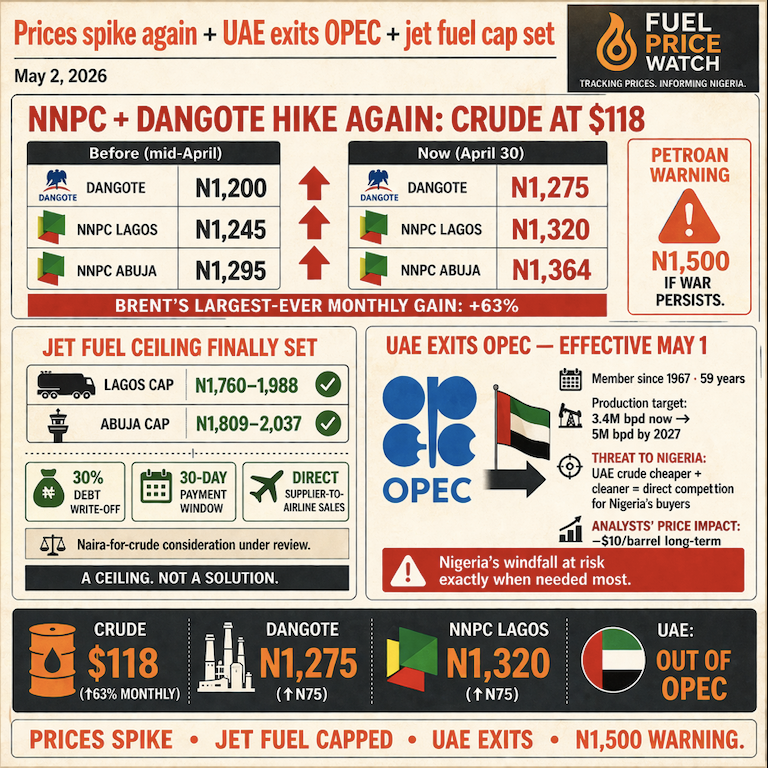
On January 1, 2026, Dangote’s ex-depot price was N699 per litre. Today it sits at N1,275 — an increase of over 82% in four months, across at least 13 separate revisions. Every single adjustment has been driven by the same force: the price of crude oil on international markets.
The chain is direct and unforgiving. Dangote imports crude from the United States, Brazil, and other international suppliers at Brent-indexed prices, paid in U.S. dollars. It refines in Lagos and sells in naira. When Brent goes up, input costs go up. When input costs go up, the gantry price goes up. When the gantry price goes up, NNPC follows, and retail prices across all 36 states adjust within days.
There is no buffer. There is no subsidy. There is no smoothing mechanism. This is what full downstream deregulation looks like in practice — speed and price transparency on one side, acute volatility on the other.
PETROAN’s national president, Billy Gillis-Harry, put it precisely last week: “Every single increase from any quarter is because we are not trading locally. All products in Nigeria are still internationally benchmarked.”
That is the most important energy policy sentence spoken in Nigeria this year.
THE STRAIT OF HORMUZ IS THE VARIABLE THAT CONTROLS EVERYTHING — — — — — — — — — — — — — — — — — — — — — — — — — — — — — — —
On February 28, 2026, the United States and Israel launched military operations against Iran. Within days, Iran effectively closed the Strait of Hormuz — a 34-kilometre chokepoint through which roughly 20% of global seaborne oil flows. Goldman Sachs estimates the strait is now operating at approximately 4% of normal transit volume. Around 23,000 seafarers from 87 countries remain stranded on some 2,000 vessels in the Persian Gulf.
Since that day, Brent crude has surged approximately 60%. It peaked at $126 per barrel last week. As of this morning — before the Iran deal reports — it was trading near $115.
Then Axios broke the story: U.S. officials believe a preliminary agreement could be reached soon. Trump paused Project Freedom, the naval escort operation launched Monday to guide civilian ships through the strait, saying talks were progressing. Markets moved immediately. Brent dropped to $99.86. WTI fell to $91.35. Dangote reversed its hike.
This is not coincidence. This is transmission. A diplomatic conversation in a back channel somewhere in the Middle East reached a filling station in Kano within the same trading session.
It is worth sitting with that for a moment.
WHAT A DEAL WOULD ACTUALLY MEAN — AND WHAT IT WOULDN’T — — — — — — — — — — — — — — — — — — — — — — — — — — — -
The diplomatic signals today are encouraging. But the relief will not be immediate.
Even if a ceasefire agreement is signed and the strait reopens, the physical restoration of normal shipping flows is expected to take several weeks. Tankers that have been rerouted around the Cape of Good Hope need time to return. Storage inventories drawn down during the crisis need to be replenished. Insurance premiums for Gulf shipping will not normalise overnight.
Analysts have estimated that a durable Hormuz reopening could bring Brent back toward the $80-$90 range. For Nigeria, that would translate into meaningful pump price relief — possibly several hundred naira per litre — as Dangote’s feedstock costs fall and the refinery passes through the reduction.
But Brent sits at roughly $100 today, even with the optimism. That is still approximately $35 above Nigeria’s 2026 budget benchmark of $64.85 per barrel. The budget has been overshot on the oil price assumption alone by more than 50%. Consumer pain is structural, not incidental.
And the situation remains fragile. No deal is signed. Iran has conditions. The U.S. blockade on ships traveling to and from Iranian ports remains in place. The ceasefire that was declared in early April has already shown cracks — UAE intercepts of Iranian munitions, attacks on commercial vessels, and a day last week when Brent surged 6% after a Fox News interview in which Trump warned Iranian forces would be “blown off the face of the earth” if they hit a ship in the strait.
The market is one headline away from reversing today’s reversal.
THE CHINA DEAL: A LONGER GAME WORTH WATCHING — — — — — — — — — — — — — — — — — — — — — — -
While the hike-and-reverse drama dominated Wednesday, the week’s more consequential development may have been signed six days ago in a city most Nigerians have never heard of.
On April 30, in Jiaxing City, China, NNPC Limited’s Group CEO Bayo Ojulari signed a Memorandum of Understanding with two Chinese firms — Sanjiang Chemical Company Limited and Xinganchen (Fuzhou) Industrial Park Operation and Management Co. Ltd. — for a Technical Equity Partnership aimed at completing, operating, and expanding the Port Harcourt and Warri refineries.
Combined capacity of both facilities: 335,000 barrels per day.
Nigeria has heard this story before. The Port Harcourt refinery briefly restarted in late 2024. It was shut down again by mid-2025. Ojulari himself acknowledged the earlier restart was “ill-informed and sub-commercial.” Between the Port Harcourt and Warri facilities, Nigeria has spent an estimated $18-$25 billion on rehabilitation over two decades with negligible sustained output.
So why might this time be different?
The answer, according to fuel marketers and industry analysts, is equity. Under previous rehabilitation contracts, foreign firms were paid to fix the refineries and hand them back. There was no performance alignment. Under the new framework, the Chinese partners are taking an ownership stake. Their financial returns depend entirely on whether the refineries actually produce. That structural change — from contractor to co-owner — is the argument for cautious optimism.
The Executive Secretary of the Major Energies Marketers Association of Nigeria, Clement Isong, framed it directly: “The key difference is that the third party they have brought is taking equity. He’s a part-owner of the refinery and so would want the refinery to work so he can get returns on his investment.”
If Port Harcourt (210,000 bpd) and Warri (125,000 bpd) ever reach meaningful capacity alongside Dangote’s existing 650,000 bpd, Nigeria would have over one million barrels per day of domestic refining — enough to meet all national demand and potentially position the country as a regional refined products exporter.
That is the prize on the other side of successful execution. The MOU is just the starting line. Watch for equipment mobilisation timelines, financing confirmation, and regulatory approvals before pricing this into any medium-term energy forecast.
WHAT YOU SHOULD DO WITH ALL OF THIS — — — — — — — — — — — — — — — — — —
The morning of May 6 compressed Nigeria’s entire fuel market reality into a few hours. A hike. A diplomatic signal. A crude price crash. A reversal. All before noon.
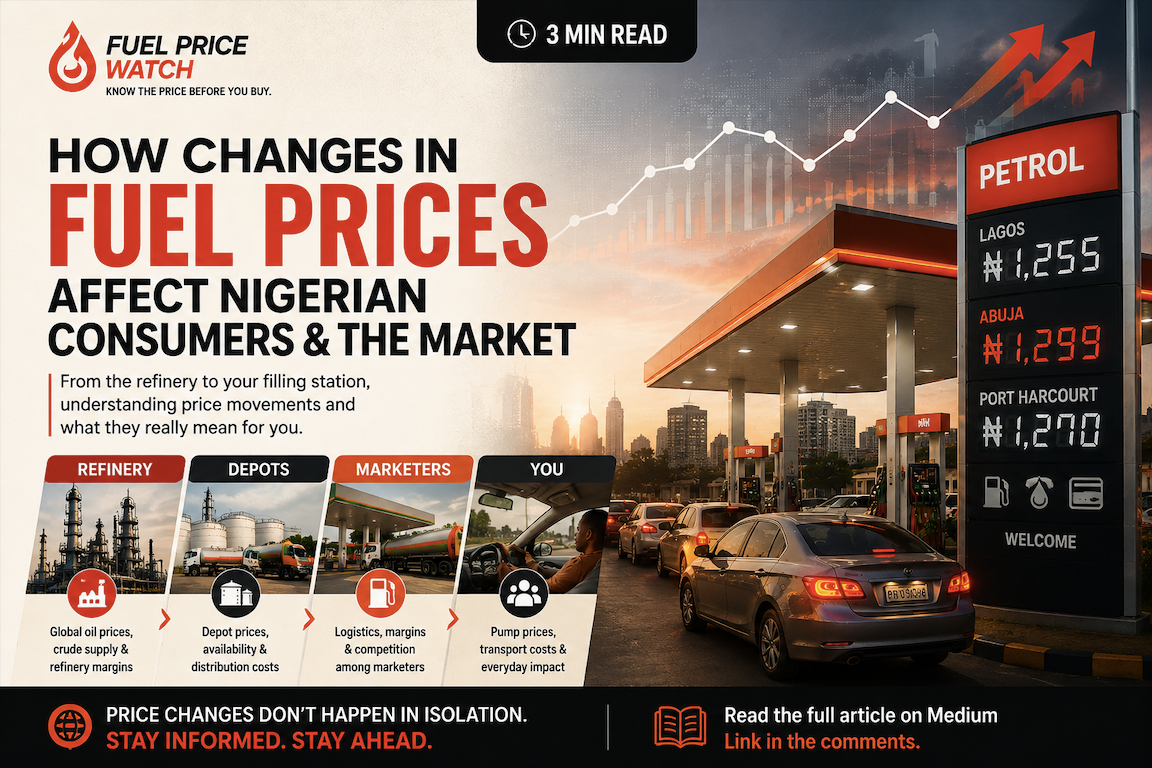
For individuals, the practical picture is this: pump prices hold at current levels for now. Lagos at N1,320, Abuja at N1,364, the far North at N1,380-N1,395 at NNPC outlets. Whether the next move is up or down depends almost entirely on a diplomatic negotiation happening in a language most Nigerians don’t speak, in a timezone six hours away.
For businesses, the volatility is the operating environment — not a temporary disruption. Three things matter above all others right now. First, the Iran diplomatic track is now your most important fuel budget variable. Check it weekly, not quarterly. Second, diesel at N1,950 per litre is approaching the psychologically significant N2,000 mark. Any breach of that threshold will send shockwaves through logistics, manufacturing, and agriculture — sectors already operating on stretched margins. Third, the NNPC China MOU is non-binding and subject to regulatory approvals. It is a signal of strategic direction, not a commissioning date. Do not build 2026 operational plans around it.
The broader truth that today illustrated is this: Nigeria has graduated from a subsidised, insulated fuel market into a live, internationally exposed one. Dangote’s refinery is world-class, domestically located, and responsive. But it is still fed by international crude, priced in dollars, against a naira under pressure.
Until Nigerian crude flows directly to Nigerian refineries at naira-denominated prices — which neither the China MOU nor any current policy commits to imminently — every barrel refined in Lekki will carry a Brent-indexed price tag.
The pump price is not a Nigerian decision. Not entirely. Not yet.
Track actual fuel prices in your state at app.fuelpricewatch.com
FuelPriceWatch #DangoteRefinery #NigeriaFuelPrices #StraitOfHormuz #NNPC #EnergyIntel
메타데이터
- post_id
- 5941a7bd5f0e
- slug
- dangote-raised-fuel-prices-at-dawn-and-reversed-them-before-lunch-thats-nigeria-s-new-normal-5941a7bd5f0e
- url
- https://medium.com/@fuelpricewatchteam/dangote-raised-fuel-prices-at-dawn-and-reversed-them-before-lunch-thats-nigeria-s-new-normal-5941a7bd5f0e
- canonical_url
- https://medium.com/@fuelpricewatchteam/dangote-raised-fuel-prices-at-dawn-and-reversed-them-before-lunch-thats-nigeria-s-new-normal-5941a7bd5f0e
- author_url
- https://medium.com/@fuelpricewatchteam
- status
- ok
- fetched_at
- 2026-08-18 21:58:10