M-Bus in Industrial Automation: How to Successfully Integrate Meters with PLC Controllers?
The M-Bus (Meter-Bus) standard is the undisputed leader in reading utility meters (heat, water, energy), yet integrating it with modern…
M-Bus in Industrial Automation: How to Successfully Integrate Meters with PLC Controllers?
The M-Bus (Meter-Bus) standard is the undisputed leader in reading utility meters (heat, water, energy), yet integrating it with modern PLC/SCADA systems often presents a challenge. Most industrial controllers natively operate on RS232 or RS485 standards, creating a barrier at the physical layer. How can this be overcome while maintaining transmission stability in harsh industrial environments?
The Challenge: Physical Layer Incompatibility
Directly connecting an M-Bus line to a PLC’s RS port is impossible due to fundamental electrical differences. M-Bus uses specific voltage and current modulation to power slave devices and transmit data, whereas RS232 and RS485 operate on entirely different voltage levels and logic.
To ensure communication, a hardware level converter is essential. This device must act as an M-Bus Master, not only translating signals but also providing power to the meter bus.
Key Parameters for Selecting a Converter
When selecting a device for a control cabinet, engineers must focus on three critical aspects derived from technical specifications:
- Current Load (Number of Slaves): The converter must be matched to the number of connected meters. Bus overload is the most common cause of voltage drops and transmission errors.
- Galvanic Isolation: In an industrial environment full of inverters and actuators, high isolation (e.g., 3 kV) is necessary to protect controller ports from surges and ground loops.
- Output Interface: The choice between RS232 (for short connections) and RS485 (for buses up to 1200 m).
Solution Overview: From Heating Substations to Large Facilities
1. Compact Installations (up to 10 meters) For smaller nodes and building automation, Redisage C01-C04 series DIN-rail modules (1M width) are the optimal choice.
- Models C01/C02: Dedicated for RS232 ports (available in passive and active versions).
- Model C04: A universal unit offering a choice between RS232 and RS485, ideal for integrators needing on-site flexibility.
- Reliability: These units provide support for up to 10 Slave devices while maintaining full 3 kV isolation and an operating temperature range of -40°C to +75°C.
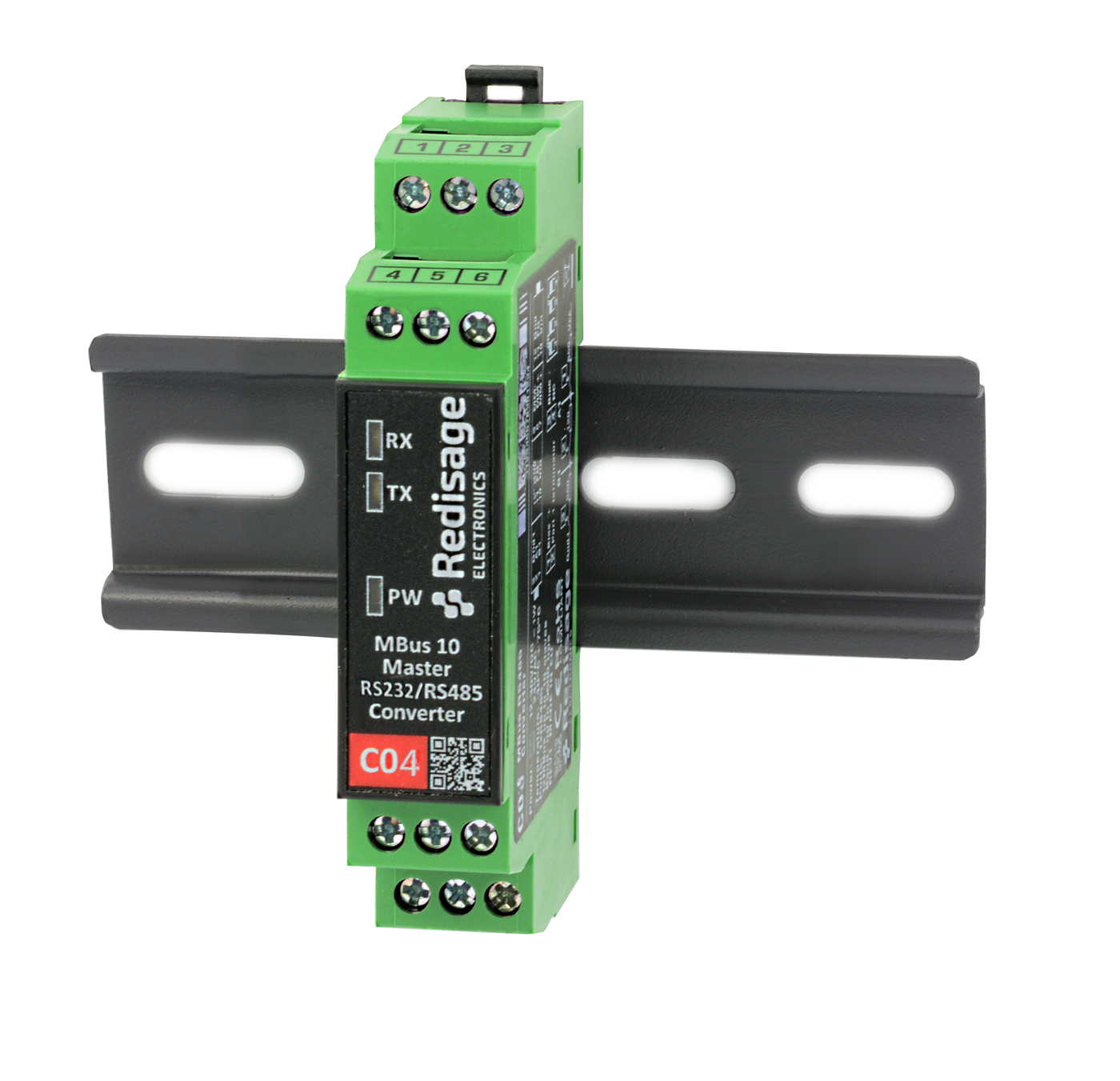
C04 — M-Bus 10 Master to RS232/RS485 Converter
2. Large-Scale Industrial Systems (up to 400 meters) For commercial facilities and heavy industry, high-current performance units are required, such as the Redisage C05-C08 series.
- Scalability: These models support from 60 (C05) up to 400 (C08) meters on a single bus.
- Repeater Function: They allow for signal regeneration, significantly extending the range of the M-Bus network.
- Immunity: Designed by Redisage Electronics in compliance with EN 61000–6–2 (Immunity standard for industrial environments), ensuring stability in electromagnetically noisy environments.
Summary
Professional M-Bus integration does not require complex software gateways. The key lies in a robust physical layer. Using dedicated, isolated industrial-grade converters from Redisage ensures data transparency and the safety of PLC controllers.
Looking for the right model for your project? Compare technical parameters and wiring diagrams for all models in the category: **industrial M-Bus to RS232/RS485 converters**.
메타데이터
- post_id
- 5955d4b71de2
- slug
- m-bus-in-industrial-automation-how-to-successfully-integrate-meters-with-plc-controllers-5955d4b71de2
- url
- https://medium.com/@redisageelectronics/m-bus-in-industrial-automation-how-to-successfully-integrate-meters-with-plc-controllers-5955d4b71de2
- canonical_url
- https://medium.com/@redisageelectronics/m-bus-in-industrial-automation-how-to-successfully-integrate-meters-with-plc-controllers-5955d4b71de2
- author_url
- https://medium.com/@redisageelectronics
- status
- ok
- fetched_at
- 2026-07-14 03:37:49