The Quiet One in the Corner
Over the years, I have had the privilege of visiting various museums in both Pakistan and England. Of the thousands of artefacts, statues…
The Quiet One in the Corner
Over the years, I have had the privilege of visiting various museums in both Pakistan and England. Of the thousands of artefacts, statues and painting I have seen, there has rarely been anything that has truly made me stop and stare.
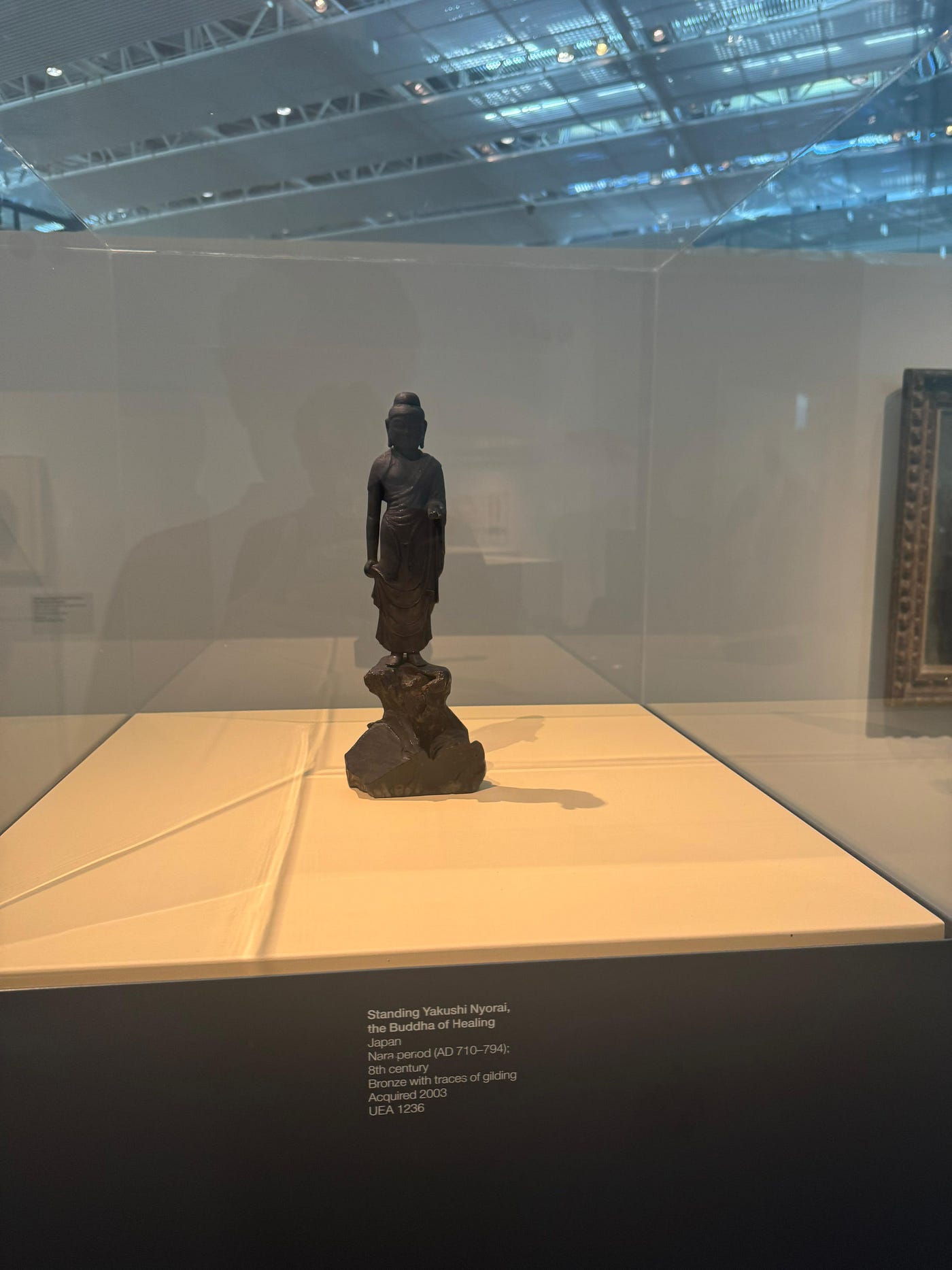
I was recently visiting the museum at the UEA when I came across this fantastic statue of Buddha. I don’t know what made me so fascinated that I stopped for a moment and kept looking at it, and then started thinking about its values and the time it has spent looking back at the eyes of its viewers, worshippers, and passersby.
I am a Muslim and do not follow the teachings of the Buddha. But something about the simple, yet intricate design stopped me in my tracks. Of course, there is nothing particularly eye-catching about the statue, no jewels, glitter, or shining stones, just a quiet presence that draws you in. It does not dominate the room. In fact, it’s easy to miss. I only saw it as I was looking for another artefact. But the more I looked at it, the more compelling it became.
Created in the Nara period (710–794 AD), this bronze statue has survived for over 1200 years, stands at 213mm tall, and is thought to originate from early eighth-century Japan (Rousmaniere, 1997). When you really take a moment to think about it, this small statue has survived longer than most historical periods you learn about at school. This statue has witnessed an unimaginable amount of time, cherished memories, good days, and bad days. Still, through all of that, it stood before me with a presence of stillness and almost reassurance that everything will be ok.
The figure shows Yakushi Nyorai, that’s known in English as “Buddha of Healing” or “Medicine Buddha”. For hundreds of years people prayed for protection and healing in times of hardship and sickness. Before sickness and disease was properly understood and correct sanitation and infection-control was practiced, people often turned to faith alone to cure them. It’s interesting to think about all those people who stood before this statue centuries ago, praying for cures to sickness and ease in times of hardship. Worried parents praying for sick children, doctors and monks alike asking for help during times of crisis, famine, and disease.
If you think the time it has spent on this world, the eras it has witnessed. There must have been a time when it was a symbol of hope, where people would have worshipped it, when it must have been the last hope of someone, it must have seen people crying in front of it, what immense value it must have had. And still time passes by, and now it’s standing tall on just a shelf. Keeping all the memories of the past, keeping a history of centuries within itself.
The first thing that initially drew me into the statue was the sense of calm and stillness is carried. Buddha stands upright, calm and still, on a jagged and rocky surface. This doesn’t seem to mean much at first. Honestly, I didn’t think it meant anything at the time. It wasn’t until I was home and looked back at the photo that I realised that it meant something.
In a world full of hate, it’s incredibly important to be able to stay at peace within yourself. In a world full of phone notifications, deadlines and internal noise, it’s important to drown it out and learn to live a quiet life. With everything quite literally crumbling apart underneath his feet, Buddha stays composed and solid.
Especially in today’s society, I think it’s incredibly important to learn something from this. Looking at this statue, I felt myself relax. Unclench my jaw, relax my shoulders and breathe.
The figure depicts Yakushi, the healing Buddha, who was revered in Japan from the second half of the seventh century onwards, as people believed such images could protect them from devastating illnesses like smallpox that periodically swept the country (Rousmaniere, 1997). For hundreds of years, people prayed for protection and healing in times of hardship and sickness. Before sickness and disease were properly understood and correct sanitation and infection-control were practiced, people often turned to faith alone to cure them.
The way the statue is physically made is incredible. It is made from bronze, but has signs of gilding-this means it was once coated in gold. It’s beautiful to think that this statue would have stood proudly in a person’s home or in a temple. I can’t imagine what it would have looked like brand new. Its shimmering gold surface would have glittered gracefully amongst the soft glow of candles and lanterns. Despite the fact it no longer has its gold shimmer, the bronze is still fantastic and the carving work itself is still magnificent.
The Nara Period saw the establishment of Buddhism in Japan. Nara was the capital of Japan at the time, modelled after Chang’an, the capital of the Chinese Tang Dynasty, and the era was defined by a blending of Japanese culture with wider continental influences (The Interdisciplinary Japanese Studies Blog, 2020). Temples were being built, and artistic work was being created that blended Japanese culture with international influences, as well as some original cultural traditions. This small bronze statue has seen Japan flourish into a country filled with its own ideas around culture, art, and history. It has seen a society of people who were eager to learn from the wider world, whilst still developing their own cultural identity.
What has affected me the most about this statue was not the age, nor the religious significance. No, it was about humanity. The Buddha’s calm expression and simple and plain robes he is wearing symbolises something which I think is so important. In today’s society, we face such high pressure to own the best shoes, have the best clothes, and live the so called “perfect life”. We live our lives facing constant pressure, chasing something that’s promised to make our lives better and “complete”. Having these things are great, but they won’t make you happy. The Buddha lived a simple life, wearing simple clothes and finding internal peace. He is the symbol of peace and inner tranquility, this shows me that physical objects can’t make you happy. An understanding of peace and an unbreakable faith are all that will make your life complete.
Yakushi Nyorai represents recovery from illness, relief from physical pain, emotional distress, anxiety, and loneliness. The Medicine Buddha offers a version of healing that embraces all these human emotions. In today’s society, suffering from mental illness can be seen as “taboo”. Something shameful that shouldn’t be talked about.
Though I’m not a Buddhist, after leaving the museum, I began reflecting on how important it was for me to accept and understand my emotions. Regardless of how you deal with your pain, whether it’s by praying, confiding in friends and family members, journaling about it, or just remaining silent, everyone has their method of coping and handling difficult times, and I think it is truly beautiful.
Remain standing quietly behind the glass pane, Yakushi Nyorai still holds the same truth as he did a millennium ago — that everybody experiences a personal challenge, hardship, or suffering at some point during his or her lifetime. But nevertheless, recovery, peace, and clarity are achievable. Sometimes, we all need a reminder of this truth, and maybe that reminder is hiding in the corner of some museum somewhere.
Bibliography
Rousmaniere, N. (1997) Standing Healing Buddha [Bronze sculpture, Accession №1236, Nara Period, 8th century]. Robert and Lisa Sainsbury Collection. Sainsbury Centre for Visual Arts, University of East Anglia, Norwich. Available at: https://sainsburycentre.ac.uk/art-and-objects/1236-standing-healing-buddha/ (Accessed: 31 May 2026).
The Interdisciplinary Japanese Studies Blog (2020) Visual analysis of the Standing Yakushi Nyorai, the Buddha of Healing. Available at: https://theinterdisciplinaryjapanesestudiesblog.wordpress.com/2020/10/09/visual-analysis-of-the-standing-yakushi-nyorai-the-buddha-of-healing/ (Accessed: 31 May 2026).
메타데이터
- post_id
- 5963970ddc0f
- slug
- the-quiet-one-in-the-corner-5963970ddc0f
- url
- https://medium.com/@najamsheraz3210/the-quiet-one-in-the-corner-5963970ddc0f
- canonical_url
- https://medium.com/@najamsheraz3210/the-quiet-one-in-the-corner-5963970ddc0f
- author_url
- https://medium.com/@najamsheraz3210
- status
- ok
- fetched_at
- 2026-06-23 03:48:11