Guilty Before the Crime: A Review of Dostoevsky’s Crime and Punishment
On the true power of consciousness, and the crimes it cannot forgive.
Guilty Before the Crime: A Review of Dostoevsky’s Crime and Punishment
On the true power of consciousness, and the crimes it cannot forgive.
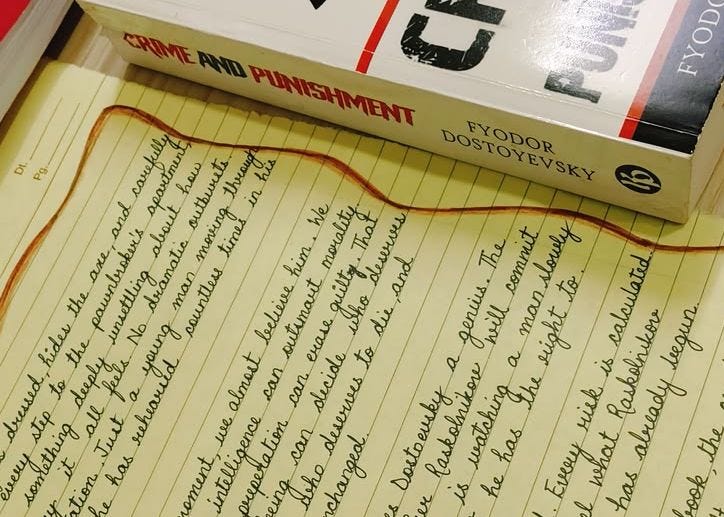
A snapshot of my thoughts while reading Crime and Punishment.
A particular kind of foreboding sets in about ten-twelve pages into Crime and Punishment, not the dread of not knowing what will happen, but the dread of knowing of what exactly is coming and watch a man walk toward it anyway. Dostoevsky doesn’t build suspense around whether Raskolnikov will kill the old pawnbroker but he builds it around something far more unsettling: what it costs a mind to convince itself that murder can be an idea rather than an act.
The Premise
Raskolnikov is a former law student living in St. Petersburg in a very awful condition: poor, half-starved in a coffin-sized room. He has a theory, one of those theories young men construct when they’ve read too much and slept too little, that certain “extraordinary” people are permitted to transgress ordinary morality if it serves a higher purpose. Napoleon didn’t ask permission to reshape Europe. Why should Raskolnikov ask permission to rid the world of a “useless” old moneylender and use her money to do good?
So he kills her, and almost as an after-thought of panic he kills her innocent sister too who happened to walk in at the wrong moment. Don’t worry that is not a spoiler because the murder happens right away. What follows, the other five hundred pages, is the actual novel — not who did it, why did he do it but can he live with it?
What the Book is Really About?
What differentiates Crime and Punishment from other crime fiction is how the detective — Detective Porfiry plays a cat-and-mouse game with Raskolnilov — a truly riveting, full of psychological chess moves, half-confessions, and threats disguised as pleasantries. But he is not trying to catch Raskolnikov with the evidence, instead he is waiting for Raskolnikov to catch himself. Because the real punishment in this novel is not the courtroom or the prison of Siberia. Its consciousness. It’s the fever, the isolation, the way Raskolnikov’s own mind becomes a locked room he can’t escape. Dostoevsky seems to be arguing that guilt isn’t a legal category but a physiological one. It shows up as illness, as paranoia, as the inability to sit still in your own skin.
Sonya, and the Book’s Moral Center
Sonya is a young woman forced into prostitution not by someone, but because of her family conditions, and by any Raskolnikov-style calculus she would be “useless”, degraded, yet she is the moral centre of the entire novel. The scenes between her and Raskolnikov, particularly the reading of the Lazarus story, are probably some of the most quietly devastating passages in Russian literature. She doesn’t lecture him. She simply refuses to look away from him, which turns out to be far more unbearable than judgment.
The Idea That Won’t Die
The lasting power of Crime and Punishment lies not in its crime, but in the moral question at its heart, one that remains unresolved. It shows up every time someone justifies cruelty in the name of a greater good, an efficient system, or a superior perspective. Dostoevsky wrote the definitive rebuttal to that idea a century and a half ago, and it still lands like a gut punch.
The Verdict
Crime and Punishment is not like any other thriller book that you can simply enjoy, it is a book that you survive and then can’t stop thinking about it. It asks whether redemption is still possible after you have convinced yourself that you are above the rules that binds everyone else, and it refuses to let you look away from the answer.
This article was written by Farah Fatima and edited with the assistance of AI.
메타데이터
- post_id
- 5968f04afbe4
- slug
- guilty-before-the-crime-a-review-of-dostoevskys-crime-and-punishment-5968f04afbe4
- url
- https://medium.com/@farahfatima212108/guilty-before-the-crime-a-review-of-dostoevskys-crime-and-punishment-5968f04afbe4
- canonical_url
- https://medium.com/@farahfatima212108/guilty-before-the-crime-a-review-of-dostoevskys-crime-and-punishment-5968f04afbe4
- author_url
- https://medium.com/@farahfatima212108
- status
- ok
- fetched_at
- 2026-07-19 06:17:39